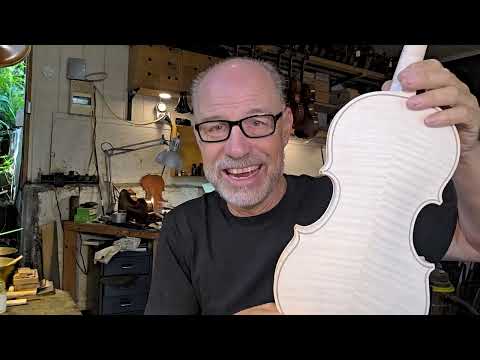
CNC vs Human : Who Crafts the Better VIOLIN ?
54K views · Jun 7, 2024 · Music

Comments · 175
@ZacharieLanoue · 2 years ago
There is a parable here with CNC in fine instrument making and the use of pin- hole cameras (camera obscura) in fine art history. Many great painters of the renaissance period secretly used a camera obscura to trace all the elements onto the canvas from life. They also had the experience of thousands of hours painting from observation. Combining the skill in the hands with the accuracy of tracing from life made for some of the most beautiful works of art ever made. Vermeer is famous for his secretive use of a camera obscura to create seemingly impossible paintings by hand.
27
@usnchief1339 · 2 years ago
John truly respects Edgars master skills as a violinmaker. This was a great discussion. Thank you!
21
@charlesblithfield6182 · 2 years ago
This was a fascinating discussion. I like the idea of a master maker, like you Edgar, using high resolution scans of great instruments and the very best woods you have selected, to craft the neck and scroll and the plates to the level where you are scraping the arching, and finalizing the thicknessing, fine tuning the plates if you will. The CNC is thus like a maker apprentice providing you with the plates “in the rough” but to the dimensions you require for that instrument. Most of the process in this manner of making is the same as has been done for centuries and the CNC machine just provides you with the basis of crafting the plates, such that you may be able to produce several more instruments per year.
19
@deltasquared7777 · 1 year ago
As an interesting historical footnote: Roy W. Morgan was a Chicago Illinois violin maker who made quite a number of violins (and other instruments) of his own pattern using a tracer lathe, which was the precursor to the CNC before the computer age. Motorized racer lathes were extensively used extensively for production of all kinds of (many times intricate) commercial wood carvings, especially since the 19th century industrial revolution. Morgan's instruments periodically show up on the market, and are quite nice of excellent student quality. Morgan's shop premises eventually passed to Zenon Petesh and Eric Prager who did not continue use of Morgan's tracer lathe equipment. Zenon Petesh was a well-known really exceptional violin maker who spent a great deal of time experimentally developing beautiful natural resin violin varnish formulations for his own very outstanding instruments of superb workmanship that he made in the traditional manner. (I worked for Petesh&Prager for several years in the early 1950's while I was in high school)
8
@parasharkchari · 1 year ago (edited)
I feel that an important factor is being left out here, which is the opportunity to experiment. CNCs give you the opportunity to validate ideas and experiments without having to invest months of time and effort on them. I think experimentation is an absolute necessity for any creative endeavor, and this is one of them. People think of old masters like Stradivari and Guarneri as having achieved the pinnacle of perfection and set that as an immovable standard. And yet, we forget how much they experimented and bucked the trends of their day. Stradivari played around with materials and did design alterations like cornice-less violins. Guarneri completely changed the design of the bridge to what we use nowadays and did violins with viola-sized ribs. Stainer played around with radius of curvature on the belly arches. I feel like everybody who just pays attention to <b>what</b> the old Cremonese masters did as if it's something magical (as opposed to <i>why</i> they did it) should also be required to make copies of Julius Zoller violins and violas as well.<br><br>If you want to argue that you've already invested so much into your current workflow that the learning curve on a new tool is too much to invest even if the monetary cost is otherwise feasible... that is an absolutely fair point. If you are arguing that we shouldn't deviate from the traditions of yore, that is not a position worthy of respect. The same old masters you revere would not agree with you either. If they thought like that, we'd still have sound holes that look like those of Renaissance lutes.
4
@raptorshootingsystems3379 · 1 month ago
While there is a beauty and art to handmade by a skilled craftsman, cnc can create quality instrument for beginners and people of less financial means expanding the number of musicians.
1
@yadaroni · 2 years ago
A CNC can get the soundboard VERY CLOSE. The dimensions on the best sounding violins ever made, have dimensions that are only a couple of millimeter difference from the thickest to the thinest part. None of them are beyond certain dimensions. It makes perfect sense to have the CNC get it to the outside of the final dimensions. Then you can refine the last thicknesses by hand, tuning it in relation to the density and acoustic characteristics of that piece of wood.
10
@danielbarbieri8199 · 2 years ago
You have to tap the wood like a bell. Sound must guide construction. Every piece of wood is different, to get the best out of it, only human experience can do this job.
8
@devinwhall9407 · 2 years ago
As a former cnc operator and someone starting to build instruments, I feel that they can both exist. I feel that the front and back plates could easily be roughed out by cnc then the master can fine tune them by ear. I even have an idea to balance the plates similar to how jet turbines are balanced that would be fun to experiment with.
38
@Michael-d2b1v · 2 years ago
great video😁 I love how even though they both have different ideas and and ways of doing things they both are interested in each others work. it is truly inspiring
6
@ellisc.foleyjr9778 · 1 year ago
I'm an 82 yr old viewer who loves watching anything pertaining to violin or cello making. I can appreciate the mental concept of the art of the master. and am in awe, and appreciation. Also I am an amateur radio operator and have a good mental concept of technology. and can appreciate the CNC. its ability to create things with unbelievable accuracy is what it's all about. in one concept. But what it can't produce it the "Feel" a master has in the shaping and varied thickness, and what I deem, 'The Thump Sound." this will determine to the master's ear what he is trying to achieve and it will vary along the axis of each instrument. <br>It will vary in proportion and dimension. and it takes years of doing it to achieve that level. That is one thing that attracted me to viewing and watching what I can't do, and don't have the time left to learn. So I watch and I appreciate. what I would have loved to have done. but time is gone for me. Thanks for sharing this was a video I appreciated both technically, and artistically. ECF
4
@blackoak4978 · 5 months ago
Adam Savage has said about the creative process that at the start of a project you are taking an idea out of your head and applying it to what you are working on. However, as you work on it there comes a point where it stops being a projection from the mind of the creator and starts to become a conversation with the creation. It starts to tell you, the creator what it wants to be and what you need to do.<br><br>I think that directly applies to this conversation. A CNC is the creator applying their vision onto the creation, but it can never go further than that point.<br>Only an artist, a crafts person, can take the next step of listening to what the creation is telling them and continuing the process.<br>In this case it is listening to the structure of each individual piece of wood and working it to get the best out of it. <br>A machine can only dictate, it cannot converse
1
Up next

Most Expensive Violins Ever Featured on Antiques Roadshow us #antiqueroadshow
PBS Antique Discoveries · 14K views

What Makes a Great Violin: The Wood or the Maker?
Edgar Russ Distinguished Violinmaker · 5.8K views

Saving My Dad's Master Violin After a Terrible Repair
Ask Olaf the Violinmaker · 72K views
We Make A Real Violin
TwoSetViolin · 107K views

What's New ,September 2026
Bishop Instruments & Bows · 4.7K views
The Secret Of The Violin ( Stradivarius - Guarnerius )
violinman_ · 270K views

New Violins vs Great Master Violins - is it POSSIBLE?!
Edgar Russ Distinguished Violinmaker · 12K views
My Dream Power Hammer Restoration! Part 10
Alec Steele · 758K views

I Built A $35,000 Guitar Out Of Wood From 3,000 BC. You Wont Believe How It Sounds!
Driftwood Guitars · 1.1M views
The Professor Who Taught People How To Think (1962)
ABC Science and ABC Australia · 2.9M views

CNC carving a violin out of olive wood with the Shapeoko XXL
Dennis van Hoof · 1.2M views

8. The Sumerians - Fall of the First Cities
Fall of Civilizations · 40M views

Building My Dream Guitar
Brandon Acker and Marshall Brune · 188K views

How To "Really" Choose A Violin Bow / The Secret
Kevin Lee Luthier Master Violin Maker · 8.6K views

Making a Clock Wheel for an Antique Clock - Start to Finish!
Tommy Jobson · 480K views

I Tried Building A Violin (from scratch)
Rob Scallon · 300K views

Where Do Photons Actually Go When You Turn Off The Light?
Sleep On Physics · 245K views

How 14 Expensive Instruments Are Crafted By Masters | Business Insider Marathon
Business Insider · 903K views

Luthier Set up Process - Southwest Strings
Southwest Strings · 103K views

The process of making of a violin. A high-end Japanese violin crafted over 6 months by a master.
プロセスX · 1M views

You Can’t Judge a Violin Until You See This
Edgar Russ Distinguished Violinmaker · 14K views

Making a violin with Dmitry Tarakanov // Creating a violin from start to sound
Dmitry Tarakanov · 69K views
The First Varnish Reveal on My New Violin…
Ask Olaf the Violinmaker · 64K views

How a Master Violin Is Made by Hand | Full Process
Rural Craftsmanship · 233K views

What is This DOT on Your VIOLIN for?
Edgar Russ Distinguished Violinmaker · 19K views

What REALLY Makes a Violin SOUND Great?
Edgar Russ Distinguished Violinmaker · 13K views