Battle of the Engines: From Radial to Jet. The Engineering Marvels of World War II
57K views · May 9, 2026 · Science & Technology

Comments · 11
@WW2CombatFiles · 4 months ago
It’s mind-blowing to see the leap from the peak of piston engineering to the birth of the jet age in just six years. The engineering pace of WWII was truly unprecedented.
4
@BlondieSuperdog · 4 months ago
Dronescape - you got one thing right, the paper by Griffith in 1926 predates Whittle - so there you have proof Whittle's paper claims to being the first are false, but the first jet patent was the Inventor Georges Mancinnet who patented the Pulse Jet in 1906, the first built by V Karavodin in 1909. Second Ohain wrote his paper in 1929 but his first design was also centrifigal,and he built his operational first engine in 1935, while Whittle's first operational engine was not until 1937. The German's first Jet flight was in 1939, and the Me 262 flew in 1942. The Gloster Metor did not fly until 1943 and had poor performance, relegated to shooting at V-1 pulse jet drones, while the Me 262's Axial engine technology was 150 mph faster and shot down hundreds of first line bombers and fighters (ref Me-262 combat diary) P-51s, Mosquitos, Spitfires, Lightnings etc.
5
@humlakullen · 4 months ago
Awesome documentary… Thanks!
5
@DavidFearn-x3i7j · 3 months ago
❤
1
@BlondieSuperdog · 4 months ago
Whittle deserves credit for what he did contribute but it's false to give him full credit for modern jet engines. The Germans flew the first jet aircraft in 1939, the He 178. using Dr. Hans Von Ohain's turbojet engine. Ohian's original concept on paper was not quite as early as Whittle's but Ohain's actual working jet engine was made in 1935. Whittle did not have a working engine until 1937, and the British first jet flight was not until 1941. Whittle's design was Centrifugal flow, while the Germans Jets were first to use Axial flow jet engines which are the type used today; no one uses the Whittle Centrifgal type today. So it might well be said that had the Germans moved forward faster with their jets they'd have dominated the skies. They could have had the Me 262 by 1941 instead of initially flying in 1942, but like the British they did not want to use the critical resources to push jets forward. Had the Me262 ever met the Gloster Meteor f.1 in combat the Me 262 was 160 mph faster. The early Meteor was only capable of 400mph not even as fast as prop planes of the period.
2
@philperry4699 · 4 months ago
Why do you keep referring to "vee" engines (e.g., Allison, Merlin, Daimler-Benz V-12s) as "inline" engines? They're not. The last inline engines (straight sixes and eights) were seen in WWI. An 8 cylinder inline is much heavier than a V-8, and you don't even want to think about an inline 12!
1
@BlondieSuperdog · 4 months ago
In summary, if you want to identify who was responsible for "modern" jet engines - it isn't Whittle, his centrifugal engines are not used today because it was an inferior performer. The Germans were the first to use Axial flow and their use of that technoloy gave them superior performance jets like the Me-262 which flew over 100 mph faster than the fastest allied prop planes while the first centrifugal jets were inferior and not capable of matching high performance prop planes of the period. In any event the first Jet engine designs were not centrifugal or axial they were Pulse jets designed and built in 1906-1909. So Whittles axial flow was not the first, it is no longer used and the German axial flow technology is what is in general use today- so Griffith and the Germans can claim that, it came a few years after the very first centrifugal jets, not decades. Redo your video.
Up next

The Black Cats of the Pacific and the Great Flying Boats of World War II
DroneScapes · 417K views

Outnumbered 30 to 1: The Lone Mustang Pilot Who Turned Back to Save a Bomber Group
WW2 Flakbound · 957 views

Hitler's "Lightning Bombers": The Schnellbombers | Luftwaffe's Speed Demons | HD History Documentary
DroneScapes · 112K views

Vietnam War: The Costly Trial of American Air Power. Rolling Thunder to Linebacker
DroneScapes · 24K views
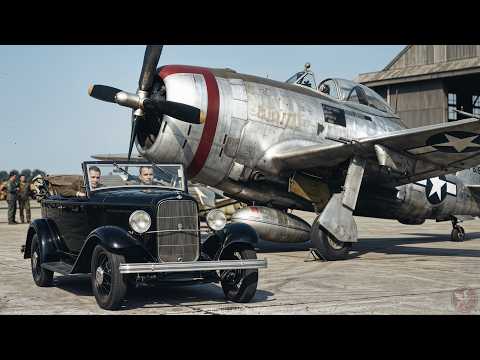
The 8-Ton Titan That Crushed the Luftwaffe. The P-47 Thunderbolt: A Flying Tank
DroneScapes · 202K views

Where Do Photons Actually Go When You Turn Off The Light?
Sleep On Physics · 245K views

How Patton's Intelligence Chief Saw the Ardennes Attack Coming
WWII Untold Stories · 21K views

Desert Storm to the 21st Century: F-117, F-15, A-10, and the Post-Cold War Drawdown
DroneScapes · 11K views

The Battle of Kursk & Other Key Events In WW2's Eastern Front
All Out Warfare · 165K views

How the P-38 Lightning Broke Japan's Air Superiority Over New Guinea for Good
WWII Untold Stories · 38K views

WWII Wonder Weapons of the Third Reich | Nazi Germany's Desperate Gambles and What Followed
DroneScapes · 470K views

Hitler’s Biggest Blunders: How the Third Reich Began to Collapse
WW2 Warweave · 48K views

THE SUPERSONIC BETRAYAL: M.52 Project In Their Own Words, Rare Footage | FULL DOCUMENTARY
DroneScapes · 26K views

The Transcontinental Evolution: Flying the Mail, Rail Connections, and All-Air Sleeper Routes
DroneScapes · 27K views

A History of the Royal Navy's Coastal Forces - full length movie version
Coastal Forces Heritage Trust · 2.5K views

A Harder Victory: New Perspectives on Global Logistics, 1942-1944
WW2TV · 11K views

Isaac Newton's Life Biography (2 Hours)
Mind Palace · 248K views

1945: The Year That Broke The "Allies" Apart (Full Series)
All Out History - Premium History Documentaries · 146K views

Airframe and Horsepower: Tactical Air Power of WWII Fighters
DroneScapes · 48K views

Japan's Battleships Found a Handful of U.S. Destroyers Off Samar — Then the Destroyers Attacked
WWII Untold Stories · 34K views