Did China Really Steal the Falcon 9 Design? | Q&A 457
47K views · Sep 10, 2026 · Science & Technology

Comments · 326
@Stewie801 · 2 weeks ago (edited)
Thanks Fraser!
@A_Canuck · 2 weeks ago (edited)
Thank you, Fraser Cain, for this edited version of your latest Question and Answer session. <br><br>Your responses, as is usually the case, were very good. I especially liked your answer to the veiled allegation of copyright violation in respect of the Land Space reusable rocket design and the Falcon 9. Your discussion made perfect sense to me.<br><br>I hope that you and your wife enjoy your holiday in the UK.
2
@BaddBadger · 2 weeks ago
Welcome to the UK!
1
@Dan-Simms · 3 weeks ago
Have fun on your trip! A colab would be a very nice surprise, hope to see one at least.
2
@WhySource · 2 weeks ago
A lot of the Falcon 9 resemblance is aerodynamic convergence: a vertical first stage that lands tail-first almost inevitably wants grid fins, landing legs, throttling engines, and cold-gas/RCS control, even without copying the underlying structures or software.
1
@gregor-samsa · 2 weeks ago (edited)
Hi Fraser,<br><br>I have a question about how continuously humanity is actually observing the universe around Earth.<br>Short summary at the end. <br>Is there currently any kind of near-continuous, 24/7 monitoring of the entire sky — or, more precisely, of the full celestial sphere around Earth — across different parts of the electromagnetic spectrum?<br>I'm wondering about radio, infrared, visible light, ultraviolet, X-rays and gamma rays. For each of these, how much of the sky is actually being monitored continuously, and what kind of "resolution" do we have?<br>By resolution, I realize there may be several different things:<br><br>angular/spatial resolution: how precisely can we distinguish where something is in the sky?<br><br>temporal resolution: how often is the same part of the sky observed?<br><br>spectral resolution: how precisely can different wavelengths or energies be distinguished?<br><br>sensitivity: how faint does an object or event have to be before we can no longer detect it?<br><br>For example, are there instruments that are effectively watching almost the whole sky all the time but with relatively low resolution, while other telescopes can achieve extremely high resolution but only observe a tiny part of the sky?<br>I'm especially curious whether we already have something like a permanent "all-sky surveillance system" for unexpected astronomical events — for example, a supernova, gamma-ray burst, unusual radio signal, interstellar object, or something else suddenly appearing anywhere in the sky.<br>And how does this compare with gravitational-wave detectors? They are listening essentially continuously, but how well can they determine the direction of a signal on the sky?<br><br>So, in the broadest sense: How close are we to continuously monitoring the entire universe around us, across all wavelengths, and what is the current angular, temporal and sensitivity resolution of that monitoring?<br><br>Thanks!<br><br>Btw question is from <br>Germany and just heared there will be a 2nd launch site ( first is in Norway ) for private launch site from a private German rocket company ... in Canada!🎉
2
@ItunuPamilerin-l5x · 2 weeks ago
Thanks for sharing your creativity.
@markmarkmark08 · 2 weeks ago
Thank you, Mr. Cain
1
@KSPRAYDAD · 2 weeks ago
SpaceX didn't 'come up' with the idea behind deployable landing legs. The commercialised it and did it successfully at scale, it isnt their idea. DCX for instance..differenty deployment but still a storable telescoping leg used for vertical landings.
20
@reganmcgee1 · 2 weeks ago (edited)
A scalable interferometer array of telescopes spread across our moon could reveal details about 6 kilometres across on Proxima b, which would be approximately double the resolution and much easier than a using the sun as a gravitational lens. That would be enough to map continents, coastlines and weather systems, if they exist.
7
@N4chomartin · 3 weeks ago
Thanks.
@paulschulte1064 · 2 weeks ago
Years ago, I was writing a sci-fi and had the same question about how big a collector mirror would be required to see planets and even continents at distances of 5 to 10 light years. I was thinking like a reflective polymer, but it was fictions so..... Short answer --------><br>Single reflector mirror: You’d need something effectively tens of kilometers across to directly resolve continents on an Earth‑like planet at Alpha Centauri in visible light.<br><br>Realistic near‑term tech: We can aim to detect such planets and maybe barely resolve their disks with sub‑meter to few‑meter telescopes plus coronagraphs, but true continent‑level imaging is far beyond current capability and requires a huge interferometer or gravitational‑lens architecture.<br><br>If you’re thinking in terms of a story or a future tech concept, “a 20–100 km baseline optical interferometer in space” is the right ballpark for continent‑level maps at Alpha Centauri.
3
Up next

What Does The Milky Way Orbit? | Q&A 463
Fraser Cain · 555 views

How Good Was Our Search for Extraterrestrial Life, Really?
Fraser Cain · 15K views

The World’s Largest Air Battery Just Switched On
Undecided with Matt Ferrell · 928K views

The Surprising Danger of Building a Human Colony on the Moon
Astrum · 1.4M views

Scientists Can't Agree On The First Ancient City
SciShow · 2.1M views

Will Roman Find Even More New Physics? | Q&A 456
Fraser Cain · 56K views

This New Evidence Could Rewrite the Dinosaur Extinction
Astrum Earth · 3M views

Are Meteorites A Big Problem for The Moon? | Q&A 455
Fraser Cain · 38K views

This Weird Pattern Will Let Us Reshape Matter
Be Smart and 50x50: Science Across America · 1.2M views

Astronomers Found a Huge Galaxy Without a Single Star
Anton Petrov · 360K views

The brilliant scam of "Dolby Atmos"
Slidebean · 604K views

How Was This Even LEGAL?! | The Tragic Story of MK Airlines Flight 1602
Mentour Pilot · 1.2M views

The Astronomer Royal on alien oceans | with Michele Dougherty
The Royal Institution · 114K views

How Feasible Is A Starship-Based Space Station? | Q&A 460
Fraser Cain · 51K views

Something is jamming GPS over Europe. Here's what we found
Veritasium · 11M views

Boom Supersonic's SuperPower Jet Engine Is Real!
Scott Manley · 566K views
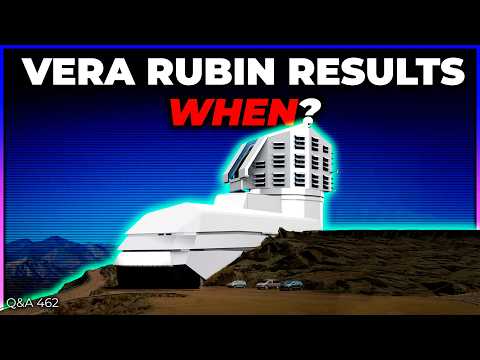
We Were Promised A Firehose of Results From Vera Rubin. Where Are They? | Q&A 462
Fraser Cain · 87K views

Have We Finally Found Dark Matter?
StarTalk · 3.8M views

Things We Have That Future Generations Won’t
Joe Scott · 734K views

What Percentage of The Universe’s Life Has Already Passed? | Q&A 453
Fraser Cain · 32K views

BREAKING: Massive Surprises From Starship Flight 14! 🤯
Marcus House · 558K views

NASA's Roman Telescope Is In Space
Fraser Cain · 309K views

Scientists Reached the Bottom of Crater Lake — What They Found Was Incredible
Hidden Horizons · 161K views

SFO Runway Mix-Up: United 2348 Gets a Number to Call
Captain Steeeve · 684K views

Can You Put A Consumer-Grade Telescope In Space? | Q&A 458
Fraser Cain · 30K views

Submarine for Titan, Planets Changing Size, Even Bigger LIGO | Q&A 230
Fraser Cain · 59K views