The True Origin of Rome's Fall: What Historians Get Wrong
74K views · Jul 12, 2026 · People & Blogs

Comments · 220
@v.g.r.l.4072 · 1 month ago (edited)
Without my being sure that what you say is true, your explanation is complex, clear, and well argued. Congratulations.
4
@ElFindelTrono · 1 month ago
The explanation is detailed and easy to follow, even though some of the claims deserve a closer look. Very well presented.
2
@frankgulla2335 · 1 month ago
Thank you for that summary of the causes of the collapse of the Western Roman Empire.
5
@Mario-z3z · 1 month ago (edited)
It should be noted that Edward Gibbon was shamelessly Anglo centric and that he held Italians in contempt. Moreover, while I absolutely agree about the fiscal issues that did so much to undermine Western Rome, I will absolutely argue that a strong causal factor was the way in which Roman armies were far more loyal to their commanders than they were to the state. In fact, I will argue that this began during the Second Punic War with Publius Cornelius Scipio Africanus and gradually gained force so that by the time we get to Caesar and the fall of the Roman Republic, the symbiotic relationship between successful Roman generals and their armies had in fact become virtually irreversible.
2
@conradsmith2441 · 2 months ago
Fine work!!! Exemplary presentation. Absolutely captivating. Outstanding. Thank you for all your fine research
1
@Msax50 · 1 month ago
Enjoying these documentaries. Thank you. !
@violetschannel6109 · 1 month ago
Interesting stuff. History can get complicated after even a short time.
1
@roypiltdown5083 · 2 months ago
now that i've enjoyed this documentary, i'm going to plug in my headphones and listen to some Leed Zeplin.
19
@gaiusflaminius4861 · 2 months ago (edited)
To emphasise essentials, my falling out with the traditional narrative of Rome's decline occurred more than twenty years ago. I used to be a history buff obsessed with exactly this period: the late Roman Empire and the emergence of the so-called "Germanic kingdoms" (400-700 AD, later pushed to 1000AD). I think my zeal bordered on a feverish dream. I was doing research on my own. "He who is searching will find". I had looked over dozens of book titles in my local library until I ran across a 19th-century edition, which was an ideally preserved copy of the Medieval history textbook for history students of higher educational institutions, translated from the original language, French. Even though its title and subject referred to the Medieval Ages, it covered a long span, starting at the 3rd century AD or even earlier. I won't mention the jaw-dropping printing quality, the high fidelity of the illustrations and the detail with which the authors presented the material.<br><br>But a fragment etched in my memory was a concluding section of a chapter summarising the aftermath of Romulus's forced abdication in 476 AD. This fragment was titled "The Reunification of the Empire" and, partially recalled, read something like this (an extremely free-form sentence building of mine in a vain attempt to mimic the marvellous literary style):<br><br>"The Empire was reunified, but at an enormous cost! Gaul was divided between Franks and Burgunds in the same manner as Spain between Visigoths and Suevi; Italy, in fact, became an Ostrogothic domain, while the Vandals tightened their grip on the province of Africa. The Western Empire was truly dead!"<br><br>The Senate's plea to Constantinople for Odoacer's elevation to patrician and governor of the Italian diocese, for merging the Western court into a single Imperial court under the sway of Constantinople. In other words, the Empire hasn't died; long live the Roman Empire! The formality of referring to the Roman order as "The Republic". <br><br>Now, this formula drastically shifts the reader's outlook. It appears more legitimate because it adds important minutiae. If the historians of late had included them, many misunderstandings could have been avoided, presenting a nuanced view without sacrificing the central plot. Much later, I realised that the historiography until, maybe, the early 20th century, including Gibbon, more or less followed suit. Gibbon had carried the timeline of "The Fall and Decline of the Roman Empire" up to his time. Why?<br><br>Despite the 5th-century crisis, nominally, the Roman Empire was not finished in the West or the East, to say nothing of the fact that the terms "Western Empire" and "Eastern Empire" weren't used in official Roman documents. There was no "East" to cross up "West", and the Emperor Zeno directed the Ostrogoths to retake Italy from Odoacer, who he wanted to destroy throughout the entirety of the latter's tenure in Rome: the theory that he did it supposedly out of fear of them near his non-existent "borders" isn't grounded in solid evidence and is easily disproved by the fact that even after the conquest of Italy, the Ostrogoths lived in close proximity: in Pannonia, Noricum, Retia and, most significantly, Italy; their fleet made them even closer to the new heart of the Empire. <br><br>The legality mattered then, and it matters now. The Empire continued in the West, too. Justinian was doing what Aurelian and Diocletian had done two centuries before him, fulfilling <i>recuperatio imperii</i> . <br>As for loyalty, the reform by Gaius Marius legalised the primacy of a commander over the Senate, which, until then, had been the embodiment of the state of Rome. The Germanic "kings" were Roman officials and commanders of Germanic origin gone rogue, and the famous inscription on Charlemagne's grave, 400 years later, ("A Frank by birth, A Roman in life and death") attests to that. As late as ~1000 AD, Emperor Otto II (or III) called himself a Roman, and even proclaimed himself <i>the</i> Roman Emperor of both halves. In Constantinople, the legend of the last Roman Emperor (the one who would reunite the West and East, confront the Antichrist at the gates of Jerusalem, and, upon defeating him, would ascend to Heaven on the Cross) made the rounds and stirred minds on the eve of the second millennium. <br><br>The Western Empire was commandeered by these people in the absence of a strong central authority that left Roman offices unattended or vacant, filling the vacuum without renouncing the Empire. Eurich of the Visigoths, Chlovis of the Franks, Theodorich of the Ostrogoths and his successors, and the Vandals never broke away. There isn't a single document, treaty or any hint that would testify to the opposite. This state in the West would survive in the 6th and 7th centuries, and all the way through Charlemagne until the official disbandment of the Empire in 1806. If you're so desperate to pin the supposed fall to a date, you may opt for the two precise years, 1453 and 1806.<br><br>On their part, the Roman Emperors ruling from Constantinople had always perceived these chieftains as local anachronisms and <i>tyrants</i> , i.e., usurpers or the pirates of the Empire's fringes, to be dealt with in due time. Justinian rolled out his claim to Italy as the legal possession that the Ostrogoths should have returned to the Emperor after deposing Odoacer. Gildas famously calls the recipients of his moral admonition "tyrants". This word wasn't an insult; it was a descriptive term for enacting power without the Emperor's sanction, directly drawing on Roman law and legal practice. So formally, these British warlords were trespassers: tribal strongmen or local officers and administrators who assumed power here and there. Most probably, they weren't aware in the slightest that they were breaking away from the Roman Empire. <br><br>What we take as the history of the Middle Ages was more like the transformation of the Roman Empire. It wasn't decisively struck down. It faded away, and the cessation of its provinces, unlike in our over-bureaucratic times, was achieved as <i>fait accompli</i> . Western and Eastern Emperors vying for the primacy of the title from the 9th century onwards ("The Problem of the Two Emperors") confirm the physicality of the shared Imperial realm.
19
@luth3713 · 1 month ago
Best history series on the entire internet.
@k3D4rsi554maq · 2 months ago
Buying the office of emperor is really expensive.
4
@AndyMyron · 2 months ago
Good information. Worth a follow.
2
Up next

The True Origin of the Witch Trials: What Historians Get Wrong
Markets of the Past and Uncover Things · 20K views

The True Origin of the Spanish Inquisition: What Historians Get Wrong
Markets of the Past · 76K views

The True Origin Of Capitalism: What Historians Get Wrong
Digital Decay · 194 views

The Real Reason Constantine Called the Council of Nicaea
Markets of the Past and How America Worked · 49K views
How Did Roman Soldiers Survive Freezing Nights Without Heaters?
Rome Unscrolled and Before Civilization · 478K views

The True Origin of the Black Death: What Historians Get Wrong
Markets of the Past · 85K views

How the Federal Reserve Was Created in Secret on a Private Island (1910)
Uncover History · 8.8K views

If You are Left Handed — Your DNA Just Revealed Where You Really Come From
Origin Files · 27K views

The Real Reason Christianity Split in Two — The Great Schism of 1054
Markets of the Past and 4 more · 302K views

The Man in the Bible No One Can Explain
Nils Glenn · 971K views
The True Origin of the Medici Dynasty: What Historians Get Wrong
Markets of the Past and Uncover Old Files · 17K views

Are We Getting Closer to Orwell’s Nightmare? | 1984 Explained
MUSTKNOW · 435K views
What Was Arabia Like Before Islam? | DOCUMENTARY
Para Bellum · 1.6M views
The True Origin of the Fall of Rome: What Historians Get Wrong
Markets of the Past and 4 more · 17K views

Scientists Compared Jewish DNA To Every Ancient Civilization — Only One Matched
The DNA Files · 250K views

The Real Reason the Protestant Reformation Happened: It Started in a Bank, Not a Church
Uncover Things and 3 more · 202K views

The Real Reason the Crusades Happened: It Was Never About the Holy Land
Past Verdict and 3 more · 44K views

How The Dutch Lost Their Empire. And Why The US Is Next
Uncover History and 2 more · 220K views

What Did People in Ancient Rome Actually Do All Day?
Rome Unscrolled and Before Civilization · 1.3M views
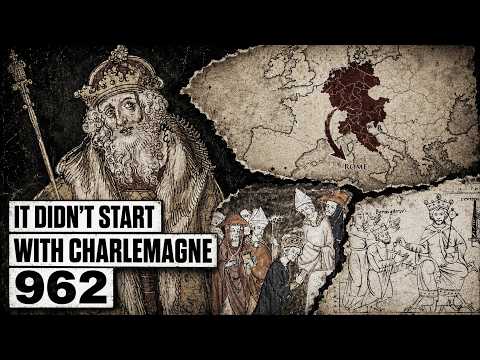
The True Origin of the Holy Roman Empire: What Historians Get Wrong
Markets of the Past and 4 more · 29K views