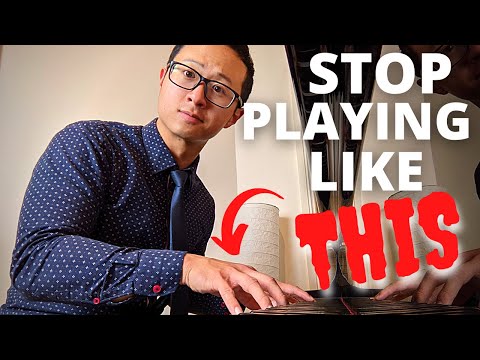
Secret to Playing FAST Scales - RELAXATION
958K views · Apr 5, 2021 · Education

Comments · 959
@julestburt · 4 years ago · pinned
Your video is incredible! Subtle in practise but so amazing! All the instruction I've had, all the slow Hanon and scales (10+ years now) and yet I'm still struggling with playing 'fast'. Assumed with my small hands I would never really have it. Yet after trying your suggestion, within 1 hour I couldn't believe how much faster / smoother I was playing...and more importantly how it was feeling so so different! It's almost like adding in the idea of a 'pre-load' to your finger, in addition to the better sense of finger independence. It's going to take a little bit of re-practising my normal routines to incorporate this...but worth it I'm sure. Will report back! Thx for sharing...watching from North Vancouver, Canada.
223
@voskresenie- · 2 years ago (edited)
ETA: if you read this comment, please also read Dharmajazz's response and my reply to it for a more complete picture that may be lacking in this comment alone.<br><br>As a classically trained pianist, I will say, first, yes, relaxation is crucial to playing anything well and more importantly, <i>consistently,</i> whether it's easy or hard. Tension leads to erratic movements, which leads to inconsistency.<br><br>But regarding the finger exercise, I would strongly advise against actively lifting fingers above the keys, even as part of an exercise, especially as high as you demonstrate in spots. I don't think it's an inherently bad motion, but it's unnecessary, and for a pianist who is already struggling with tension (and doesn't have a teacher there to point out what they're doing wrong), I think it is more likely to lead to <i>more</i> tension from trying to raise the finger.<br><br>What I would recommend is to practice <i>relaxing</i> the finger rather than raising it. Try this:<br>- First, play the note. This inherently requires tension, but not close to as much as people with tension issues think.<br>- Then relax the finger as soon as you get to the bottom of the key -- at that point, extra force won't make the note louder, which is obvious once you think about it, but not everyone thinks about it, and you need only a tiny amount of weight to keep a key down after playing it. Experiment with how little force is actually required to hold the key down. It's less than you think, even if you don't think it's very much.<br>- Then lift the finger very slightly such that the key comes up, but the finger remains in contact with the key. It doesn't actually matter that much whether the finger remains in contact, so <i>please</i> do not tense up trying to keep it in contact. The reason you should pay attention to whether your finger is in contact with the key is because if it loses contact, you probably are applying too much tension lifting your finger upward. The actually important point is that your finger should be resting on the key once the key has returned to its original position, ie do not lift your fingers above the keyboard.<br><br>Practice very slowly relaxing your finger(s) <i>immediately</i> after they get to the bottom of the keys. There should only be a few hundredths of a second where your fingers tense up (and still, not excessively, just enough to play the notes) followed by almost complete relaxation.<br><br>The last thing I want to mention is that arm weight and hand position, much more than any amount of isolated finger movements, are what allow high level pianists to play unbelievably fast. There's a gentle inward and outward rotation of the hand (wrist) as you play from 5 to 1 and 1 to 5, respectively. This allows hand <i>weight</i> to do most of the effort, rather than finger muscles. Using a muscle inherently involves tension. Weight only requires the muscles to stabilize (not collapse) under the weight, whereas pressing requires the muscles to move, which requires more tension. Practice relaxing your arm fully and dropping it from your head level down to the piano. Don't push down, but make sure you're not holding it up, either. It may take you a bit to get the hang of it, but you will know when you've fully relaxed your arm, because it will be <i>loud.</i> Counter-intuitively, you can play far louder using the weight of your hand at freefall than you can by tensing up and pushing down.
22
@angelamurnane2334 · 3 years ago
Also love that you said to turn off video if you already had the technique. Acknowledging a range of watchers and humility.
33
@vectorkade · 4 years ago
Being a beginner, I've found this to be tremendously helpful in building a strong foundation. So glad I found your channel, thank you!
90
@belindadrake5487 · 4 years ago
My DAD💔 bought me up as an embryo. Home was always filled with music. (I’ve never met a bigger fan, but he’s mates we’re all the same. My first gig l was 3yrs old, & Hearing DAVE BRUBECK. He taught me chopsticks on the stage! ( no people)! So, it ended up that EUGENE ‘the Senator’ WRIGHT is my Godfather. 🫢 Absolutely amazing upbringing. I miss you DAD 💔 But ‘UNC’is there. with you too!! ✨❤️🥰😘😘😘😘😘
7
@pianokid1373 · 4 years ago
Great exercise! Do you know Czeslaw Marek „Lehre des Klavierspiels „ (I don’t know if there is an english edition available). In chapter VIII he teaches the exercise in four movements. 1. lift up the finger 2. relax the muscles and let the finger drop on the key without pressing down 3. press down the key very slowly so that the piano doesn’t generates any sound 4. relax the muscles again but don’t lift the finger active, just let the key move it up. The hardest challenge here is 2. and 4. where you only have to relax the finger and not moving it actively. While doing so be careful to have all the other fingers resting relaxed on the keys. This will improve your control on every finger!
42
@isdochere · 4 years ago
Not just about relaxing, it’s about training the independence as well.
69
@StephaneZeyeni-Languaroudi · 3 years ago
<a href="https://www.youtube.com/watch?v=SoGdohMhlm0&t=332">5:32</a> okay, bye :) <br>(and thanks for the tips)
3
@philsarkol6443 · 4 years ago
Great serious practice advise...thx from a senior beginner!
5
@mrs.jacksonholecoin8140 · 4 years ago
I'm laughing, because that's me when I play a note, a pinky pops up lol. Your exactly right.<br>I came here trying to learn to play fast scales with sharps and regular keys. This has been very helpful, thank you for the lesson. I'm sure all of us watching, appreciate your help🙏😀
30
@saintbees2088 · 4 years ago
"I find that the trick of playing fast tempos or fast streams of notes with good time is to play very <br>lightly with a feathery touch on the piano (or any instrument). It's also helpful to eliminate all <br>"frantic" (extra) motions from the body as these detract from the flow." - Chick Corea
34
@professorsc213 · 4 years ago
Besides being an amazing musician you are also an amazing teacher! For some who play at such a high skill level it's difficult for them to break down something as simple as a five note chromatic pattern and apply methodology to it. That exercise is great for anyone at any level. Keep on sharing your amazing videos with us you have a gift and a gentle way about you.
57
Up next
The Left Hand Piano Technique That Changed My Life
Pro Piano Series | Steve Rosen · 555K views
I'm a concert pianist. I play these 10 exercises EVERY day.
Peterson Piano Academy · 289K views

The SECRET to become FAST & STEADY on the PIANO
NewJazz · 1.8M views

Jazz Piano Chord Shapes for Turnarounds in 12 Keys
Dharmajazz · 1.1K views

SCALES - New Tips For Speed, Evenness, & Reducing Tension
Josh Wright · 85K views

How I wish Scales & Modes were explained to me as a student
Nahre Sol · 520K views

The Piano Sight Reading Tricks That Make Reading Music 100% Easier
Le Chéile Music · 768K views

Stop Practicing Like an Idiot - 3 Most Common Practice Mistakes
Heart of the Keys · 200K views

HOW TO PRACTICE major scales on piano (2023)
Piano Fluency · 209K views
So You Want to Play Like Bill Evans, pt 2 / a SECRET to Good Piano Tone
Dharmajazz · 3.1K views

RHYTHMS! One of my TOP Practice Strategies - 2,3,4,5,7,9 Rhythms and MORE
Josh Wright · 64K views

Fox News Can't Defend Trump's Jensen Huang Scandal, Dems Promise to Probe NVIDIA Ties: A Closer Look
Late Night with Seth Meyers · 124K views
Vladimir Horowitz Feared No Pianist Alive. Then He Heard Art Tatum in a Club
Classic Rock & Folk 60s–70s and ArtHistories · 2.4K views

Nord vs Yamaha vs Roland — The Brutal Digital Piano Truth Nobody Really Wants To Admit in 2026
88 Keys Secrets · 27K views

You Only Need 3 Piano Exercises For WAY Faster Technique
Charles Cornell · 256K views

Jazz Theory in 20 minutes
Jazz Tutorial · 4.1M views

Reading Music Is Easy When You Know THIS
Nahre Sol · 1M views

The Secret of Ear Training
Max Konyi · 636K views

PLAY FAST AND EVEN SCALES ON THE PIANO // Make Your Scales Sound More Effortless // Piano Tutorial
Danae Dörken · 203K views
7 Piano Learning Mistakes I Made So You Don't Have To
Learn Piano with Jazer Lee · 1.3M views