Trying (and failing) to build a 48v DC Generator for Off-Grid Backup
154K views · Jan 9, 2023 · Howto & Style

Comments · 355
@RandomZ88 · 3 years ago
I think that this has been mentioned previously, The alternators will work in the way you have them set up. However, you have to isolate the second alternator from the chassis. Due to the chassis being the ground for the First alternator. Best way would be to find a way to isolate both the alternators from the chassis and each other. In the way that you have is wired/set up, the first alternator is shorted to itself through the second alternator case because it is connected to the frame and by default the case of the first alternator.
49
@barrellcooper6490 · 3 years ago
Go look at what David Poz did. To bad you guys didn't collaborate. His design worked electrically, very cool. His mechanical setup not so great but he was trying to get 48v down and dirty... Cheap. <br><br>Tesla is going to a 48v system for accessories, lighting etc. Ditching 12v. Hopefully as that makes 48V stuff will become more available.<br><br>I imagine the day when I'm running solar into a 48 VDC battery bank and then feeding it to the house directly to power 48V HVAC, lighting, and other devices. Meaning no inverter or a very small one to handle legacy 120V appliances. I except to see Marine and RV applications move to 48V.<br><br>I can dream right?
8
@jasoncarter5002 · 3 years ago
One of those two spade terminals is a voltage sense wire that allows you to measure voltage at the battery instead of the alternator to account for voltage drop due to resistance . It is internally connected with a high value resistor so it will sense at the output terminal without the sense wire on since that would be a common and horrible problem. Use two equal value resistors to create a 2:1 voltage divider. Connect your 1/2 voltage signal to the sense terminal. 24v become 12v so the alternator regulator sends more power to the rotor until the sense wire reads 24v. Output will be 48v. In theory you will need 2x rpm, In practice maybe not that much. Also, you might as well go get at least the 420 predator. Alternators are tough but not efficient.
43
@shashiekka7917 · 3 years ago (edited)
This is just what is needed for partial rv backup. Operates the ac and stuff perfectly. <a href="https://www.youtube.com/post/UgkxOTeIs0vv4_9B5hsmnLsk9r930uDQLu_Y">https://www.youtube.com/post/UgkxOTeIs0vv4_9B5hsmnLsk9r930uDQLu_Y</a> is quieter than my rv generator. Only suggestion is that it needs a fuel shutoff valve. So it is easier to store.
130
@AdamDavisEE · 3 years ago
As you're finding out, you can convert the alternators to output a higher voltage. The current will be the same, and with a higher voltage you can achieve a higher power output. That's why alternators are rated in amps, and an alternator for 12v costs roughly the same as a 24v alternator at the same amperage - same amount of copper.<br><br>Rectifying it yourself will solve the problem of the negative case grounding, and you will need a new control system since the alternator's field control is also tightly integrated with the negative chassis ground - once you properly isolate it you might as well make your own. Further, with your own control system you can make it constant voltage, constant current, or follow a charge profile - at that point it becomes a much more useful generator than a simple alternator based generator.<br><br>You aren't going to be running high enough voltages to worry about coil arcing.<br><br>One thing to be aware of and consider mitigating is the alternator/rectifier combination is going to produce ripple, which may impact battery degradation. The research paper "The effects of high frequency current ripple on electric vehicle battery performance" (free access through ScienceDirect link: https://www.sciencedirect.com/science/article/pii/S030626191630808X ) indicates that low frequency ripple results in slightly more cell degradation than zero ripple charging, and high frequency ripple is less damaging than low frequency ripple. <br><br>Since you've got the horsepower, I'd suggest increasing the speed of the alternator(s) by increasing the diameter of the pulley on the engine, and running the engine at a higher RPM. These engines are governed to 3,600 RPM, but their peak power occurs just over 4,000 rpm, so altering the governor will not only make your generator more efficient, it'll also increase the ripple frequency which will reduce the cell degradation caused by the ripple. As a nice bonus, it'll make it easier to reduce the ripple with capacitors - higher frequency ripples require less capacitance to reduce them appreciably.
9
@danielohara2974 · 3 years ago
I made a 48v generator using an 8kw 48 volt motor I got from amazon a few years ago. I used a chain and sprockets and with a few switches I was able to power the motor so it started the gas engine. after the engine was running I would switch off the battery and then use the motor as a generator. The motor was only 400 bucks brand new.
7
@Fox_Nakamori · 3 years ago
you could use externally regulated alternators (or convert those to externally regulated) the more voltage you put to your windings the more voltage output it gives, using a custom rolled AVR or finding a 48V AVR and as i said converting those alts to externally regulated, then pushing the whole 48v (or i guess 50V in this case) through a set of full bridge rectifiers to get your full power output, add some caps and you can smooth any output ripple and get clean output power to what you are trying to charge
17
@DannyBokma · 3 years ago
Sorry for being blunt, but if you didn't see this problem coming ( the common ground being a problem for putting them in series), then it will be very challenging to make the system work with your proposed solutions. A few pointers for the proposed solutions:<br>1) Since the windings are fixed your are not going to change a 24V output to a 48V output with any usable power output. <br>2) The field applied to the rotor has a linear relation to the output current, not the output voltage. The field is used to control output current, not the output voltage.<br>3) Sidenote; alternators are current sources, not voltage sources ( although they try to regulate to a certain voltage, they highly depend on a battery for making that system stable ), current sources should not be put in series without additional care of making them stable. <br><br>By far the simplest solution to this problem is: Use the alternators as intended (beware that some alternators need a light / lamp to operate correctly ), connect each alternator to a 24V battery ( preferably leadacid to keep it simple ), isolate both systems from each other and the machine it's mounted to. Then connect both systems in series.
73
@tombrenes2411 · 2 years ago
Awesome content <br>Love all the hard work <br>My 2 cents : <br>The entire unit I’d put it on a metal dolly (mobile unit camping or off grid )<br>The pedifile motor change it to run off propane, remove the governor, a racing carb better out put at low RPM save even more fuel<br>To calm the vibration platform to frame weld used valve springs <br>To ground use heavy long welding ground clamp with magnet <br> In an off grid system get those copper rods cut in quarters, point and into the ground or clamp to a bumper bracket (member 2 separate grounds)<br>* one motor . . . 2 alts one set to do refrigeration / or ice machine to prolong cooling and lighting<br>Second pair of alts (can disengage from main motor) used as a back up or power washer and a shop for tools maintenance or even build a house, stable, ranch, mill wood <br>I got my idea from Brazil they got this down the power companies keep this hush hush
1
@ticklemeorange8328 · 3 years ago
I wish I had the time to try most of the stuff you have done... Eventually I will. Love your channel.
5
@northidahodreaming5657 · 3 years ago
Thanks for doing this. I really enjoy your channel and humor.<br>I'm also stuck with running an AC gas genny to charge my off grid system in the winter. I think that I've exhausted my searching for a reasonably priced commercially produced DC battery charging generator. I run a 5 kw AC generator between 70 to 125 hours annually. I look at this cost of this operation as reasonable. I don't know enough electrical engineering to build my own DC charging unit. In my mind, as a sort of parallel thought, I rationalize that I drive a 14 mpg 4x4 truck for about 2K miles per year in the deep snow and a 48 mpg Prius the rest of the year. The large inefficiency and expense of my winter transportation is necessary and reasonable. but please keep doing Trial N' Error and I'm delighted to watch.
@soldierski1669 · 2 years ago
For what it's worth, great idea, back in the early days of YT you would see projects like this, mostly riding mowers converted to welders. Another guy on YT ran into a similar issue doing this with a Bike, he used a separate DC input to excite the regulator. <br>I would simply isolate the grounds on each alternator, get the power from both units and figure it out post. Going to check your next vid and see what you did...and maybe see if you got a heater.
Up next
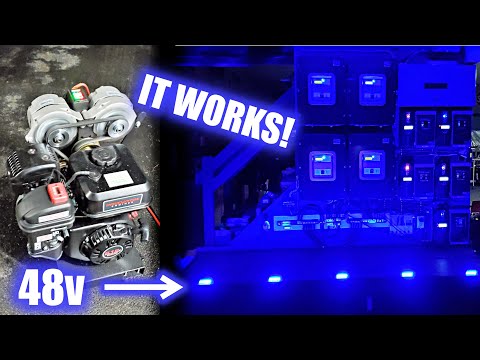
Building a 48v Off Grid Generator: Part 2 - Got it figured out!!!!
Trial N' ERROR · 66K views

The AlternatorGenerator, First Attempt. 48V Battery Charging
DavidPoz · 2.5M views

This $80 SEMI TRUCK ALTERNATOR Runs A Whole Cabin WITHOUT A Generator. Why Aren't We Using Them?!
Grain & Gravity · 83K views
10 Things Already in Your Garage That Are a Power Plant (You Paid For Them Once)
Backyard Low Tech · 194K views

This $40 TREADMILL MOTOR Runs Your Whole House WITHOUT A Generator. Why Aren't We Using Them?!
Grain & Gravity · 79K views

How to Modify an Alternator for Charging AND Welding
Sweeney Off-Road · 453K views

Why Don't Seniors Use This Delco Alternator That Powers a Whole Cabin 24/7 Instead of a Generator?
Jhon Construction and Jhon Home Hacks · 172K views

I built a homemade electric generator using a 4-stroke engine and a car alternator.
BIROTOR · 315K views

This $60 AutoZone Alternator Powers an Amish House All Winter. Why Is the Power Company Silent?
Caleb Yoder · 623 views
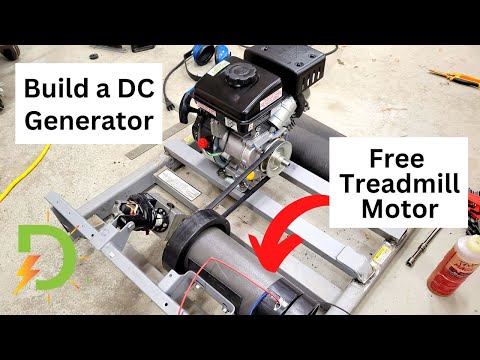
DIY DC Generator: charge batteries off grid
DavidPoz · 612K views

Two $60 AUTOZONE ALTERNATORS Power A Whole HOUSE WITHOUT A Generator. Why Aren't We Using Them?!
Grain & Gravity · 122K views

This $60 AutoZone Alternator Powers a Whole Cabin All Winter — No Generator, No Grid
Builds With Eli Yoder · 1M views

I Made a DIY Generator With Car Alternator and a 3HP Rototiller Engine!
Tyler Creates · 25K views

Alternating Current, Motors, & Controls
CaptiveAire · 1M views

DC Generator, Battery Bank Charger.
Small City Homesteaders · 80K views

DIY 12V Generator Charger - 3 Getting Ready to Fire it Up
knurlgnar24 · 377K views

Nobody In California Would Recover This Dozer Hanging On A Cliff
MURPHYS DIESEL · 5M views
Toyota Accidentally Built The PERFECT Off-Grid Battery. The $500 Forklift Part That Runs Homes
The Future House Files · 182K views
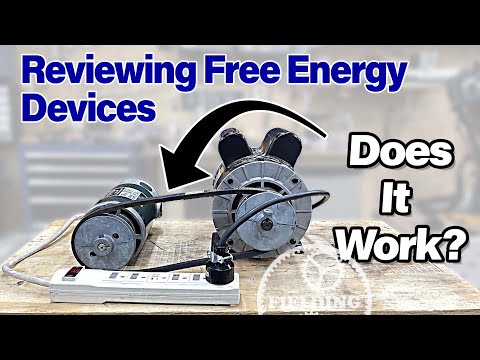
Reviewing Free Energy Generators. A Response to My Video "Nikola Tesla's Greatest Invention"- 102
Jeremy Fielding · 8.4M views

The Most Impressive Diesel Heater I’ve Ever Tested (And It’s Not Even Close)
Joeatitagain · 58K views