The Real Reason Why Three-Phase Power Won The War
176K views · Jul 28, 2026 · Science & Technology

Comments · 622
@EngineeringMindset · 2 months ago · pinned
:_Voltage: Try Brilliant for free 👉 <a href="http://brilliant.org/TheEngineeringMindset">http://brilliant.org/TheEngineeringMindset</a> Plus our viewers 20% off an annual Premium subscription. <br>Watch ad-free here:➡ <a href="https://www.patreon.com/theengineeringmindset">https://www.patreon.com/theengineeringmindset </a><br>Get your engineers mug here:➡ <a href="https://engineeringmindset.store/products/why-not-two-phase-mug">https://engineeringmindset.store/products/why-not-two-phase-mug</a>
12
@rafau4765 · 2 months ago
I am dissapointed that there's no boiling water involved
231
@EricLS · 2 months ago
Well now I finally understand how the step down on the pole works when I have a neutral in my house. I always wondered how it “got back” to the power plant, but it does so via the closed loop in the transformer, and the neutral is really just a reference conductor allowing a path back to the middle of the load side of the transformer. The neutral never actually goes out into the grid itself as a neutral, the power is entirely inducted through the coils. Excellent video.
96
@steeltoe_stats · 2 months ago
I'm gonna have to watch this again to really understand. 😮
67
@Nervosaretrospective · 1 month ago
I love how you always start from absolute basics before getting to the main topic of the video so that people can really understand
5
@koyamamoto5933 · 2 months ago
Good discussion. A couple of comments: You might want to extend the discussion to 4 or more phases and why there is diminishing returns from more phases. Also, you might want to recap at the end. Thanks from a retired EE.
12
@amanichristopher719 · 1 month ago
This is one of the best videos expaining 1p, 2p and 3p systems. Thank you so much
7
@1bgrant · 2 months ago
All the Power!<br><br>I’m an electrician who specializes in gensets and still enjoy watching these videos. I’ve been watch this channel for a few years now.
24
@giulioperissinotto1431 · 2 months ago
<a href="https://www.youtube.com/watch?v=NDnjMjFDCe8&t=814">13:34</a> I think you nailed the point why 3 phase power is so common, it cost less to trasmit it per instantaneous power. <br>That's also why DC distribution where most common in the early days, they costed less to transport from the generating station to the equipment some tens of meters away, the plants where small. <br>Than the national or continental grids where born and AC is used because it's easy to convert LV/MV/HV for tranamission and 3 phase because it gives lower cost (of material) per power transmitted. <br>Now we are seeing high voltage DC for extremely long line, because losses induced by capicitance in AC outweighted the urdle for AC/DC and DC/AC conversion. <br>Shurely the benefit of rotating voltage in 3 phase is great but the ultimate reason I still agree is cost
42
@buckykattnj · 2 months ago
I love that moment when all the bits of knowledge accumulated in one's brain snap together and give you the 'Ah-ha!' moment (not quite an Eureka! moment).<br><br>Your video has provided one of those rare moments. As a neurodivergent armchair electrician, I have understood the pieces... this is why I still have a 3-phase converter in my storage, because the family business used to use a few 3 phase machines, but this answers most of the in-between questions rarely asked and not covered in the 40-year old memories of discussions between my electrician maternal grandfather and my father. You have earned my subscription and my thanks.
6
@andrewbalgobin · 2 months ago
All the power!<br><br>Greetings from the University of the West Indies. I use many of your videos to teach young aspiring electrical engineers in our engineering faculty. Thank you!
5
@FailureDetective · 1 month ago
Electrical systems are a great example of how engineering solutions are shaped by history as much as pure technical optimisation. Once infrastructure, equipment and standards develop around one architecture, changing the “better” engineering solution can become harder than inventing it.
1
Up next
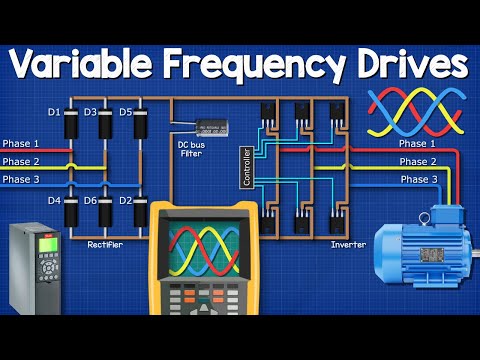
Variable Frequency Drives Explained - VFD Basics IGBT inverter
The Engineering Mindset · 3.9M views

How 3 Phase Transformers Work – why we need them
The Engineering Mindset · 2.2M views

Why Put Diodes Together In Both Directions? Explained With Examples!
Mr Carlson's Lab · 947K views

Power Factor Explained – Your Electricity Bill Money Drain (Reactive Power)
The Engineering Mindset · 1.1M views

An Engine That Doesn't Need a Crankshaft
driving 4 answers · 331K views

The Scariest Chart in Electrical Engineering
Veritasium · 5.9M views

Why Circuit Breakers DON'T Protect People (electric shocks)
The Engineering Mindset · 2.9M views

Nobody Explained Maxwell's Equations Like THIS!
Animated Physics · 531K views

MOSFET vs Transistor vs Relay: Most People Get This Wrong
The Engineering Mindset · 640K views

How Electrostatic Motors are Breaking All the Rules
Ziroth · 1.1M views

This is Why They Don't Make These Anymore...
Alec Steele · 5.3M views
What Powers An Electron? The Answer Will Shock You
The Roger Physics · 359K views

The Incredible Engineering of Precision Rotary Motion
New Mind · 393K views
What Happens to You 6ft from an Exploding Atomic Bomb?
Curious Droid · 2.6M views

The Grid That Doubles the Strength of the Ground
Practical Engineering · 917K views

Why RCDs Fail: The Hidden Danger in Your Consumer Unit
The Engineering Mindset · 271K views

Casting Engine Parts from 3D Prints
Camden Bowen · 1.9M views

The Legendary Magnetron: How It Really Works
Kasyan TV · 213K views

Voyager 2 Discovered Something Strange at the Edge of Our Solar System
The Infographics Show · 1.6M views

How Inverters Turn Battery Power into AC
Prof MAD · 338K views