Cold Bed, No Warping, Super Tough: PHA Filament Tested!
214K views · Nov 28, 2025 · Science & Technology

Comments · 448
@fredpinczuk7352 · 11 months ago · pinned
Guten Tag, <br>I’m the CTO of EcoGenesis, and I wanted to start by thanking you for the incredibly honest, technically sharp, and thorough review.<br><br>Really appreciate the work you put into it. <br><br>I’d like to offer a bit of additional insight that may help clarify a few points:<br>PHA Post-Print Behavior PHA naturally has a low glass-transition temperature (around +10°C to –5°C), which means it keeps nucleating and crystallizing after printing—just like you noted. At room temperature, this process can take up to 48 hours (or longer for bigger parts). You can also speed it up by incubating the parts at 70–80°C for about 6–8 hours. Because of that, mechanical test results can vary depending on whether the print has aged for 24 vs. 48 hours. <br><br>Slicer Settings Most slicers don’t have proper PHA profiles yet (Bambu has one, but it’s not really usable), so the generic suggestions are mostly there for printability and ease of use for new users. For best layer adhesion, PHA actually prefers 212–215°C, not the 195°C seen in your review (at ~<a href="https://www.youtube.com/watch?v=Me8UEWEKvmA&t=150">2:30</a>). And since PHA gets stickier at higher melt temps, we recommend up to 217°C for the first layer, depending on your build surface. <br><br>Biodegradability (Sorry in advance for the lengthy answer below, but this part is too important to oversimplify.) <br><br>PHA is naturally biodegradable because it exists in nature. It’s not a synthetic invention, it was discovered it in the 1920s in France. Over 250 known bacteria produce PHA internally as an energy reserve, similar to how humans store fat or sugar. PHAs can be made from: plant oils and sugars agricultural waste even CO₂ and methane (carbon-rich biogases) So your analogy comparing PHA degradation rates to wood was spot-on.<br><br>Both store carbon, and both break down naturally in the environment. <br><br>We test using ASTM D6691 marine biodegradation, the most stringent standard in the U.S. Our EU testing goes further: our materials are TÜV Austria Marine Biodegradable, which includes ASTM D6691, ecotoxicity testing, and fragmentation testing. You can verify our certificates using these IDs: S2138, S2433, S0318 Lookup via TÜV’s database: https://okcert.tuvaustria.com/database-of-certified-products/ <br><br>Marine environments have the slowest biodegradation rates because bacterial concentrations are low. So if it biodegrades in marine conditions, it’ll biodegrade faster: in soil in home compost and fastest of all in swamp-type environments (high temperature + highest bacterial concentration) Regarding colorants: the limited color palette is intentional. There’s no point making a biodegradable polymer if the dyes would introduce toxic microparticles. <br><br>EU Market Update: We’ve completed testing with a co-manufacturer in Germany and are in active discussions with a distributor in Poland. More news soon. In the meantime, our other U.S. distributor West3D does ship internationally. https://west3d.com/products/ambrosia-pha-filament-earth-friendly-filament-for-everyone<br><br>Pricing:<br> <br>There is no shortage of PHA production, we are therefore not limited by the supply chain. But rather by the raw material cost and infrastructure (Compounders, filament contract mfg) that are new to the industry. As an example, no one makes a PHA ready filament extrusion line, the equipment typically designed to handle PLA requires adaptation to accommodate for its production.<br>Expertise in its compounding is limited and the industry is mostly concentrating on food packaging applications and not our industry. <br> <br>Our goal is to reduce these costs overtime, and this will be mostly driven by volume as our industry further adopts the material when wanting a truly sustainable solution that offers a very unique end of life in addition to just recycling and composting.<br> <br>Thank you again for the great tech review.
933
@jarnMod · 11 months ago
$40 a roll is crazy to me living in SEA printing PETG at $7 a roll
113
@vim55k · 11 months ago
Please do another layer adhesion test using higher temperature
196
@wisefix9256 · 11 months ago
I wish at the end there would have been a table summarizing all the tests done with their respective materials comparisons.
45
@Aser6000 · 11 months ago
You can print PLA on a cold bed with masking tape as well. That used to be the main way we printed stuff before heated beds became common.
24
@ajw3630 · 1 day ago
you will never bore me with charts, tests, and a very honest take on biodegradability. 10/10 filament deep dive; This was exactly the sort of info dump I want when looking into new materials. Subscribed<br><br>Please continue the filament compatibility tests. I already have one, but that info will become insanely valuable with the rise of consumer priced toolhead-changing printers. It always starts with the flashy features in 3D printing, but I am confident that the rise in tool changing systems vs filament managers will increase the use of material mixing for the sole purpose of support material. The "pooping" systems made an expensive support material a stupid waste. Cut out the poop waste and material mixing is going to be much more commonplace. Very happy to see multitool printers coming up in the world, bambu labs created more plastic waste than Coca-Cola (probably no stats there but honestly poop was a good term because filament change/purge systems are so wasteful)
@Sorryagain123 · 11 months ago
Interesting, I worked on PHA extraction from biomass. It is made by microbes as an energy store, so can be completely renewable. Interesting material.
10
@ChrysMTP · 11 months ago
Thanks I’m still looking for abrasion test and UV résistance tests.
19
@tenchuu007 · 11 months ago
As soon as it hits 30 it's going to be my goto filament. At the moment I reserve it for things that I don't want to stick around.
8
@crashfactory · 11 months ago
the "sample applications" is a great idea. I like that as a TL;DR recommendation for a filament. Keep up the good work!
16
@TECH_GEEK10 · 11 months ago
Wow! How far you have come in terms of production quality! I KNEW I would see great things from you!
11
@girenloland · 11 months ago
No warping? 🤣 Well, is that the truth?
10
Up next

TPU is Underrated. Here's What You're Missing Out On.
JanTec Engineering · 185K views

What do 3D Printing Businesses Actually Sell? I Tested 5
Print Farm Academy · 26K views

Scientists Said This Wave Was Impossible
Veritasium · 2M views

Should You Start 3D Printing with PHA Filament?
ECOstruder · 14K views

15 Genius 3D Printer Hacks You Won't Believe Actually Work!
Print Heads · 21K views

Perfect 3D Printed Surfaces Without Post-Processing
JanTec Engineering and CNC Kitchen · 489K views

How to Electroplate 3D Prints | The Complete Beginner's Tutorial
HEN3DRIK - Electroplating 3D Prints · 1M views

I Spent 6 Years Turning This Stump Into a Bonsai
Bonsai Releaf · 987K views

The best thing at Formnext 2026 wasn’t from Bambu
perspektive3D · 157K views

I had ASA Poisoning! 25 IMPORTANT Filament Answers!
Loyal Moses · 554K views

Stronger 3D Prints by Inserting Hardware While Printing
JanTec Engineering · 121K views

Why did Nobody Make this Before? SUNLU i10 Dry Cabinet
CNC Kitchen · 619K views

30 Hacks and Facts EVERY 3D Printer Should Know!
Zack Freedman · 567K views

I Replaced My Bike Spokes With Trampoline Springs!
Well Done Tips · 1.3M views

100 COOL TOOLS YOU MUST SEE
KRAFTY · 3.5M views

Why PHA is my go-to filament, and why you might consider making it yours.
future things · 54K views

These 3D Printed Tools Are GENIUS! (Mostly)
The Next Layer · 220K views

Why aren't more people 3D Printing this Indestructable Filament?
CNC Kitchen · 752K views
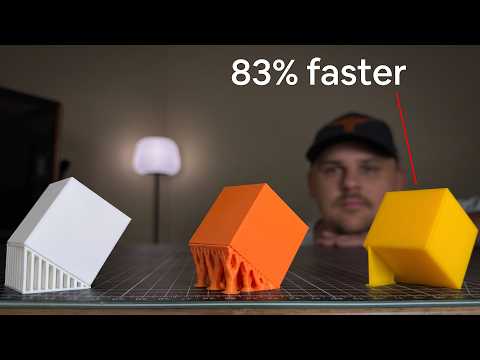
Stop Using Tree Support for Your 3D Prints
Matthew Trahan · 1.7M views

The Best Way to Smooth 3D Prints (No Sanding)
JanTec Engineering · 275K views