why is this so hard to sharpen?
227K views · Jan 10, 2023 · Education

Comments · 757
@wittworks · 3 years ago · pinned
👋 These worked for me: Cabinet Scraper Preparation Kit: <a href="https://lddy.no/1eh3s">https://lddy.no/1eh3s</a> | Accu-Burr Carbide Burnisher: <a href="https://lddy.no/1eh3t">https://lddy.no/1eh3t</a>
18
@joelongstaff7601 · 3 years ago
Sir, thank you for sharing your video with us. I'm 72 and my father was a buffer so I learned a lot of this stuff when I was young. A trick my grand dad taught dad so I learned it is to take a damp tea towel and lay it on the wood then mist the wood with an iron. Dad tought me to use a steam iron not the old sad iron his dad tought him. What this will do is make all the little fibers stand up so your scrapper will cut them easyer. Your a cool teacher showing stuff as you learn. Impressive. Thanks and God bless.
141
@christinezacharer1035 · 3 years ago (edited)
Have been sharpening my dozens + scrapers for decades....a fine file, file card and hardened screwdriver shank is all you need. It is important to keep the file clean, some scrapers are softer than others and will load up the file over time. You can use your bench vise to hold either the scraper or file. I usually vise the file and draw the scraper across it lengthwise to flatten and then use a scrap block to support the scraper to remove the old hook. You can also remove the hook before flattening by drawing the burnisher up flat against the scraper. It's critical to keep both flat and square edges (all four) and not to round them. I used to use an oil stone to polish, but not really needed with a good clean file. By trapping the file in the vise I can quickly set the edge while using or reestablish a hook, literally takes only a couple of seconds to do this. Burnish the edge quickly flat, then skewed. I couldn't tell you the angle or pressure as it varies a depending on how thick your scraper is and how aggressive you want to cut. Each of my scrapers has a personality and it takes a little while to learn it and know how to get what I want from it. All in all, it literally takes less than a minute if you keep one in good shape, and that's for all four edges. Once you get it, you'll be able to adjust the hook on the same scraper so when you flip it, you have the same hook, but when you turn it, you get a less aggressive hook. You can set this however you want, I personally do diagonal edges the same-ish.<br><br>There is a comment down below too by a James Ervin about hardened edges left after the machining process. This makes a lot of sense. Scrapers are "soft" spring steel but they need to be able to curl a consistent edge. This is only possible if your burnisher and file is harder than your scraper and the scraper has consistent hardness along the edge. I guess I don't think about that much with some well used scrapers. But as I mentioned each one has a personality of its own. Note too that burnishing will harden the edge as well that is why it is desirable to set the burnish with one pass, and then set your hooks on opposing edges with one pass each as well. It takes practice. This is experiential, try different pressures, different angles. You'll get it, don't give up. Good luck..
18
@oldhamworksltd · 3 years ago
I struggled pretty hard with this so I watched JKM’s video and just did it until I got it. A couple of tips: 1. round over the sharp corners of your scrapers to make them more comfortable to hold, 2. it’s really easy to get your edge out of straight while filing so use that to your advantage by taking a stroke or two at each end leaving your middle slightly high. That way you’ll always get a good burr and you don’t have to bend it quite as much to get a good shaving. I know that this probably goes against traditional woodworking dogma, but I actually keep one edge of my scrapers polished with no hook. I use that edge as my final surface prep on spindles/tool handles, to break corners/arrises, and to clean up overhangs/epoxy squeeze-out on my marking knives. Point is, just because YouTube woodworkers say you need huge, fluffy curls from your scraper, it doesn’t necessarily mean that any other result is useless or unwanted. Sorry for the long comment, love your videos, keep doing what you’re doing, man!
75
@boatbeard7767 · 3 years ago (edited)
I would never expect any beginner to get an edge on a scraper until shown how to. It's at the same level in apprentice training of sharpening any edged tool. First, we learn how to get the edge square and true, that might start with draw filing or even grinding to start with, then forming that perfectly square edge on stones to remove all burrs - also lightly round corners to avoid gouging work in the future, although you should be bending the scraper so it doesn't present the whole edge to the work all at once.... Then we learn to polish or hone the edges - all genuinely sharp blades get there by understanding a cutting edge is simply the meeting of surface planes so that is the key. Then you roll the edge using a ticketer (basically a triangular file but with no teeth and polished instead) at about 10 degrees or a special vice mount tool with a hardened rod or wheel in it at just the right angle. Kunz make a very good tool for this. I suggest having a small hook is better than forming a really big hook. You need to lean on that ticketer hard, you are deforming hardened steel and you need to put some grunt into it. Personally, I like the hand ticketer better as apart from the regular ones I make all sorts of shaped scrapers including swan neck etc. and often make special little ones out of old band saw blade bits to suit a particular detail job at the time. Five minutes with a scraper beats any amount of sanding - if you finish with a scraper after sanding you will get that next level finish, critical for french polish. You don't need to get plane shavings out of a scraper - the whole point is they are a very fine plane, able to cut fractions of wood cells. They are a fine finishing tool and the dust/shavings you get are not relevent as long as you are getting that surface scraped down just right. If you use the scraper in a shearing motion you will get more plane like shavings, that is you angle the scraper as well as bending it You can get all sorts of different blade thicknesses from very light to very heavy. You need to set your hook according to that thickness - very light flexible scrapers only need a very small hook, big chunky ones a lot more of a hook. When you are burning blisters on your thumbs because of the heating up of your scrapers you know you are getting into some serious work... I have at least a handful in a pile ready to go, so I can swap around and let them cool while doing a table top or panel. Some I sharpen all around - but that won't work unless you have the heavy callouses to cope with not getting cut yourself. Like chisels, planes etc. we used to do sharpening of everything at once in the morning, then hopefully you would get through the day with only touch ups. Apart from chisels, that's as needed and when carving can be 25% of your time... Once you have your scrapers set, you can generally re-form the hook several times before stoning or filing is required. How often that happens will depend on how abrasive the work is...
35
@TheSMEAC · 3 years ago (edited)
For beginners, starting with a plain 90° jointed scraper is a great place to start. A crisp 90° will get them going and they’ll learn a process for themselves as they use them. I love my accu-burr (have 2 of them), and still use the old trusty carbide rod too but believe my process will continue to develop throughout my woodworking life. Admittedly, I’m a 95% handtool woodworker, so I’m far more involved/intimate with handling, sharpening, knowing edges. I can definitely see why a power tool or heavily electric hybrid woodworker would struggle with a card scraper. In this video, just seeing you pick up, hold, and use the b@st@rd file; I and any other handtool only guy can recognize just how unfamiliar you are manipulating handtools. That’s not a bust, it’s too be expected, and would be know different than if you were to watch me setting up an offset bearing/bushing router job. One thing that jumps out to my eye immediately is that you like to go back and forth with files, stones, jigs, etc…. Sharpening can be effective doing so, but jointing and burnishing usually produce the best results using a single direction. Also don’t Willy nilly make your strokes, know how many you made, so that after this round, you know by way of feedback what to do differently the next until you dial in for best results. Finally, very little pressure is required when drawing/burnishing. I’m really think the #1 reason folks struggle with preparing scrapers is they are pressing far too hard. Thanks for the video and I’m not bashing, just giving my perspective. Prepare methodically and ease up on the pressure 👍 in the handtool world, repetition, practice, and just doing things organically is a HUGE part of how we improve. It’s hard to expect a power/hybrid woodworker to just pick this (or any) skill up right away. Sure there are those that will find one or two things that come quickly to them, but sharpening (et al) in the handtool world is a life long journey. So for a power tool guy to just wish to exploit the amazing uses of a card scraper without being immersed in that world continuously is asking a lot already. I think you’re doing great personally. Again, do this methodically so you can actually make super minut adjustments and ease up on the burnisher pressure. <br>Just my 2¢
35
@Chrisisreal978 · 3 years ago
Unless the wood has already been scraped it's normal to get dust at the start. The surface usually doesn't start out smooth enough to make thin curls.
131
@CP-rm7rz · 3 years ago
The process that works for me is to strike scraper edge flat with a burnisher. Then use the burnisher on an angle several times. This creates a tiny sharp hook on the scraper edge which results in shavings. There are holders keep the card flexed and at the correct arc
22
@davidtimperley4241 · 3 years ago
Sometimes simply altering the angle of the scraper is the key to shavings you are looking to create.
7
@taylormedia1000 · 3 years ago (edited)
Your candour is refreshing. I'm just starting and have watched dozens of YouTube videos. Sadly, many edit out their mistakes, don't admit to any, or they've been woodworking for decades.
7
@stevenseligman2135 · 3 years ago
Couple of things<br>Take more deliberate consistent strokes with the file across the complete edge, not the back and forth motion. The file really only cuts in one direction. Buy stopping in the middle the edge isn't completely flat and even.<br>Second, you might be putting to much of a burr on the edge. You can actually start to fold it under. Try once or twice with the acuburr thing.<br>Last Lee Valley tool makes a very awesome card scraper holder that makes it easyer to use the scraper
38
@rwoodard2 · 3 years ago
May have been commented on but. . . I also had a terrible time sharpening a card scraper. Three things really helped me 1) get a Good card scraper- LieNielsen - made a huge difference 2) use WD -40 it’s not as thick and the burnisher can completely remove the old burr and easily create a new one 3) ditch the file it takes way too long to remove the file marks. Put the scrape on edge, hold against a square block of wood and use a coarse and fine diamond stone. Hope this helps. Great video.
4
Up next
How to Sharpen and Use a Cabinet / Card Scraper
Workshop Companion · 140K views

Secret Card Scraper Method
Epic Woodworking · 120K views

How to sharpen and flatten the back of a narrow 1/8 chisel.
Aussiemorons · 151 views

The Most Comprehensive Sharpening Test Ever Done
Jonathan Katz-Moses · 139K views

The Controversial Method That’s Ruining Woodworking
wittworks · 407K views

Tick Stick: The Carpentry Tool That Does the Impossible
Essential Craftsman · 4.4M views

How To Sharpen & Use Card Scrapers (The Ultimate Guide)
The Art Of Lutherie - Guitar Making · 50K views

Why Your Card Scraper Isn't Working And How To Fix It
Biscuit Tree Woodworks · 31K views

Can I make this Rusty Chisel as sharp as a Razor?
Matt Estlea · 265K views

The Most Important Skill In Woodworking
ENCurtis · 214K views
You've Been Sharpening Cabinet Scrapers Wrong for WAY too Long!
Taylor Toolworks · 13K views
Innovative Card Scrapper Sharpening – Techniques, Practice & Patience
Brian Boggs: Boggs Bench educational woodworking · 73K views

The MAGIC of card/cabinet scrapers!
Stumpy Nubs (James Hamilton) · 168K views

Card Scraper Sharpening Jig - Gorgeous Shavings - Free Plans and Free Hardware
Jonathan Katz-Moses · 87K views

Sharpening A Plane Blade 2020
RobCosman.com · 956K views

5 steps for easy woodworking card/cabinet scraper sharpening
Stumpy Nubs (James Hamilton) · 156K views

I don’t know why people still buy these
wittworks · 235K views

I Can't Believe I Sold This for $3750!
wittworks · 690K views

What Pros Know About Screws That Beginners Don't.
Five Duck Studio · 9.8M views

Why Don't People Know This About Miter Saws
Lincoln St. Woodworks · 755K views
Build this amazing traditional mallet
Rex Krueger · 1.1M views

Card Scraper Guide | Paul Sellers
Paul Sellers · 128K views
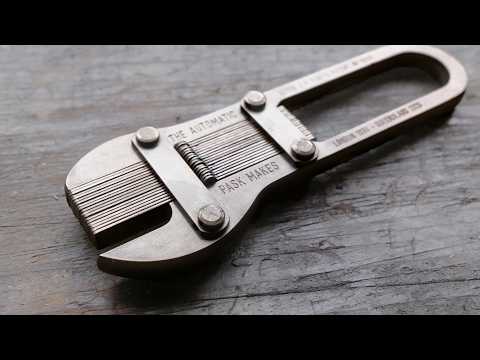
Why Was This 1896 Tool Forgotten?
Pask Makes · 1.8M views

The Incredible Card Scraper
Ramon Valdez Fine Furniture · 91K views

The No-Nonsense Way to Sharpen a Card Scraper
Inspire Woodcraft · 70K views

the worst way to build a guitar
wittworks · 214K views