How Airplane Wings REALLY Generate Lift
2M views · Mar 15, 2025 · Education

Comments · 11K
@MathAndScience · 1 year ago · pinned
IMPORTANT NOTE - I should have put this in the video. All of these wings can fly upside down such that the curved side is facing toward the earth and the flat side is facing toward the sky. I did aerobatics and flew upside down many times, and the way you do it is roll inverted and right when you pass the halfway point you have to push the stick forward and give a lot of forward force. What this does is raise the belly of the aircraft up toward the sky and increase the angle of attack of the airplane such that you’re getting most of the lift on the curved side, just by impacting the relative wind.<br><br>So basically, a lot of the lift of even the traditionally shaped wing is just from the angle of attack and the bottom of the wing impacting the relative and redirecting the flow down as I mentioned in the video. And you can prove it to yourself by knowing that when you invert the airplane, you still get lift simply by raising the angle of attack of the airplane in the upside down configuration.
1.1K
@pyreaurum676 · 1 year ago
Aerospace engineer and Formula One aerodynamicist here. Aerodynamics in general is complicated and I applaud anyone putting in effort to educate others. There is a lot of good information here, some points I think deserve further emphasis, and some things that I think are a bit misleading.<br><br>I did like the emphasis on how the momentum change of the fluid contributes to forces. I do think one step further is worth exploring. Navier-Stokes, the fundamental equations governing continuum fluid dynamics, enforces the condition that change in momentum of the fluid MUST be congruent with the boundary conditions of the flow. Essentially, that change in momentum you describe has to appear as a pressure (+ small viscous contribution) at the surface of the wing. Extending this concept to a virtual surface behind the wing can yield a nice mental picture where you look at the flow a bit after the wing and understand where the lift and drag comes from. In the wake behind the wing, the fluid is moving slower, which is consistent with the drag force, and the fluid also has a downward component, consistent with the lift.<br><br>There is a related bit to this, in that some people perpetuate the idea that there is a newtonian component to the lift, resulting from this momentum change, and a separate bernoulli component, resulting from the velocty pressure relationship demonstrated by bernoulli's principle. The incorrect idea is that these are two independent contributions that sum to the total lift of the wing. Instead these are two different ways of looking at the same thing, which is clear when looking at the implications of the NS equations. I make this point because it's a common enough myth that I think it's worth bringing up.<br><br>I think the discussion of the coanda effect is quite misleading and I believe there are better ways to understand what is going on here. Why I think it is misleading is that the explanation heavily relies on intermolecular forces / viscosity and indeed this is not necessarily to explain why fluid will follow curved surfaces. The clearest example of this is Thin Airfoil Theory is an inviscid theory of lift. There is no viscosity, yet it still predicts attached flow around surfaces. The more fundamental explanation of this occurence is due to the flow tangency boundary condition at solid surfaces. Arbitrarily close to a surface, the flow MUST be tangent to that surface (this includes zero velocity for clarity). If there was any component of flow perpendicular to the surface, that implies the flow would travel through the surface or conservation of mass is not being followed. With this in mind, the options for what the flow is doing at any point along a surface are 1) traveling tangently around the surface (what you would describe as the coanda effect), 2) is completely stationary, or 3) is traveling in the reversed direction to case 1. In typical conditions, the flow around the wing is nearly all in case 1. Case 2 can only occur at a finite number of points in the field (leading edge stagnation points, for example) otherwise the flow would have to be entirely stationary. Case 3 occurs during flow separation / stall as a result of the adverse pressure gradient forcing the boundary layer to separate and a recirculation region forming on the wing surface. To circle back to the main idea, you don't need any form of intermolecular forces to explain why a fluid must follow the curvature of a surface, conservation of mass and the boundary conditions is enough.<br><br>If you take these ideas further you can get to Thin Airfoil Theory, which is really the best way to understand lift. The brief intuition of TAT is that if you assume the fluid is following the surface of the wing (following the tangency boundary condition, I previously mentioned, which applies for pre stall conditions), there is one unique flow field that will occur (due to properties of Laplacian fields). This avoids the circular logic used to explain the pressure-velocity coupled field (an example of this is when you look at the high pressure at the front compared to the top surface and say that this results in faster velocity). Essentially, the flow field around the wing is the only flow field that can exist in the same way you can say that two non-parallel lines can only intersect at one point. It is mathematical certainty. Internalizing this was one of the most important lessons of my engineering education.<br><br>Like I said, I really appreciate anyone working to spread the joy of aerodynamics, so I don't want to come across as overly critical, but I did want to throw out some thoughts.
685
@shiladityadeb199 · 1 year ago
I am a mechanical engineer and we did wind tunnel experiments, your fantastic explanation has made my understanding about the whole concept rock solid and now I can join the dots what we did in the labs. Your contribution to the scientific community will surely generate new ideas and concepts. Keep up the good work. Best wishes from India.
17
@sankaranarayanchandrasekha7796 · 5 months ago
As a former fighter pilot I enjoyed the way you put it across so well.
6
@jnbfrancisco · 3 months ago (edited)
I was an instrument and autopilot instructor in the USAF from 1974 until 1977 at Chanute AFB. I found that the self paced instruction pamphlet was teaching that the reason for having a rudder trim system was to compensate for crosswind. I pointed out to my boss that this was wrong. He agreed and said they taught it that way because it was easier to understand. I was flabbergasted.
1
@DocScience2 · 1 year ago
Air is compressible but water is not. <br>When we use hydrofoil boats, the Bernoulli effects can be analyzed better. <br>The Bernoulli lift generates more lift with less drag than a flat plate angled for lift.<br>The entire Bernoulli effect and wing shape is about efficiency of lift vs drag. <br>The Bernoulli effect is not logically obvious like a flat plate, to those who skipped physics class, and that would be most of the population, and comments below. <br>The video maker has not given any explanation that the Bernoulli effect is all about efficiency of lift. <br>-
67
@arcburn3364 · 1 year ago
Thanks. I too got my private pilot’s license although probably many years before you, and I was stubborn enough to dispute the school’s theory of lift in my mind. Your explanation makes me feel better that the intuitive reasoning in my head was not wrong. Not that I understood the different applications of laws of motion etc as you do and have presented. Several years ago I started watching some of your algebra and trig videos just for fun and to help sharpen my mind some. You are a great teacher. Thanks.
83
@ThePuterMan · 1 year ago
Fascinating! I used to teach Principles of Flight to Air Cadets and yes, we taught the conventional wisdom. In 57 minutes you have destroyed 57 accumulated years of my understanding of flight. But now at 77 I am enlightened. It makes perfect sense. Thank you so much!
53
@prsearls · 6 months ago
I found this interesting; I'm a retired professional pilot. I took my first plane ride almost 80 years ago with my dad's flight instructor (I was a small child). Your explanation of how the boundary layer works peaked my interest and explains why a wind surface contaminated with frost or snow is so dangerous. The "roughness" caused by these contaminates degrades the boundary layer enough (from flow separation) that the wind does not produce the normal, expected lift of a "clean" surface. I knew this happens but never had such a good, technical explanation. Thanks!
@ronaldclobes9340 · 1 year ago
This was pretty much covered in the book Stick and Rudder by Wolfgang Langewiesche back in 1944.
34
@davidmorse8432 · 1 year ago
I was always fascinated as a child, how when I held my hand flat outside the window of my parents moving car, I could produce enough lift to hold my arm up and even raise it simply by changing the pitch of my hand. I could also get the wind to force my arm down depending on the pitch of my hand.
194
@medic472 · 1 year ago
I'm not a pilot, windsurfer, mathematician or a scientist. But I love to learn and I, like many others, thought I had a firm grasp on why airplanes can fly. Now I'm a retired firefighter who has a better understanding of the world I live in. Thanks!
52
Up next

A Jet Engine's Thrust Does NOT Come From the Exhaust
Math and Science · 303K views

Intro to Orbital Motion & Orbital Mechanics
Math and Science · 155K views

There’s a Problem with Quantum Mechanics – Quantum Reality (1/3) with Jim Al-Khalili
Unbaffled with Jim Al-Khalili · 469K views

What Is Electricity Made Of According to Quantum Physics?
Sleep On Physics · 317K views

1963 Physics Has No Business Being This Entertaining
ABC Science and ABC Australia · 493K views
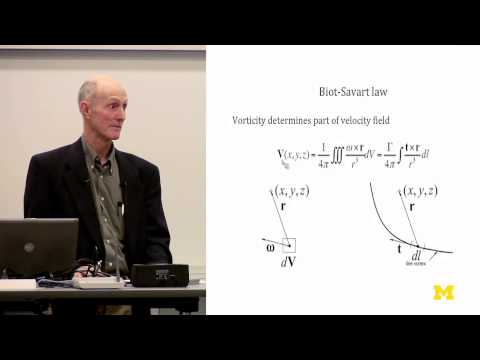
Doug McLean | Common Misconceptions in Aerodynamics
Michigan Engineering · 851K views

The Ridiculous Engineering Of Jet Engines
Veritasium · 15M views

Imaginary Numbers: The Biggest LIE In Math
Math and Science · 76K views
How the Lockheed SR-71 Blackbird Works
Animagraffs · 11M views

Pilot's Deadly Mistake Was Worse Than We Thought!
Pilot Debrief · 581K views

USA Unleashes Second Atomic Weapon Against Japan: The Fatal Calculation Nagasaki Paid For
Military Studio and Global Military Archive · 801K views

The Closest We’ve Come to a Theory of Everything
Veritasium · 17M views

The Professor Who Taught People How To Think (1962)
ABC Science and ABC Australia · 2.9M views

The Insane Real Engineering of the Nazi Enigma Machine
Veritasium · 13M views

What is Energy, Force, Motion & Waves in Physics?
Math and Science · 122K views

How the Grumman F-14 Tomcat Works
Animagraffs · 1.3M views
Why is it called a 'cockpit'? | AVIATION WORDS
Words Unravelled · 259K views

How Was This Even LEGAL?! | The Tragic Story of MK Airlines Flight 1602
Mentour Pilot · 1.2M views

Why Does Mass Create Gravity? The Real Answer by Richard Feynman Changes Everything
Feynman Reborn · 156K views

Brian Cox - The Most Mysterious Facts About The Universe
Astral Curiosity · 1.5M views

Monster Plane: Uncovering the Antonov AN-255 (Full Episode) | Superstructures: Engineering Marvels
National Geographic · 5.3M views

How a Helicopter Works (Bell 407)
Animagraffs · 4.4M views

How Does Pressure & The Bernoulli Principle Work?
Math and Science · 61K views

Where Does Light Get Its Speed From?
Sleep On Physics · 199K views

How Does Lift Work? | Student Pilot Podcast: Aerodynamics
Pilot Institute Airplanes · 57K views

Calculus Made EASY! Finally Understand It in Minutes!
TabletClass Math · 2.3M views