Why Film Directors avoid Deep Focus Cinematography
524K views · Mar 20, 2023 · Education

Comments · 535
@wolfcrow · 2 years ago · pinned
Download My Free Ebook! How to Make Stunning Films on a Budget. My Proven Secrets: <a href="https://wolfcrow.com/free-ebook/">https://wolfcrow.com/free-ebook/</a>
2
@Kyles_ArtPile · 3 years ago
Spielberg talked about this in an old interview. I'm not sure if he still does this, but he said he likes to use deep focus and wider angles than other directors because he feels a lot of movies over direct the viewer's eye. He prefers to have the audience feel like the director, if they want to wander around the frame, they're free to do so without bokeh or tight framing telling them they cant.
393
@fh854 · 2 years ago
Deep focus is generally better, leads to more interesting compositions and allows our eyes to explore the frame
103
@claysettlement · 3 years ago (edited)
A funny historic annecdote: in Hitchcock's "Spellbound", his cinematographer refused to stop down because shallow depth of field was more pleasing for close ups. This was a problem because he wanted to do a POV with a gun in frame, pointed at Ingrid Bergman. Hitch's solution was to use a GIANT novelty hand and gun so it would be less out of focus 😅
272
@3runjosh · 3 years ago
I love deep focus. The shallow focus we see in this era makes me feel like I need to get glasses
40
@PF-Matt · 3 years ago
As a professional in video/film, I'm confident that the shot at <a href="https://www.youtube.com/watch?v=6ZsaGDqlo5w&t=24">0:24</a> used as an example of an 'easy wide angle' was actually a longer focal length - it was not a wide, you can tell by the compression (apparent distance foreground to background). The reason it's in focus is that the further away from the lens you're focusing, the larger the depth of field. Since the army, building and background are all far away from the camera, they all stay in focus.
392
@konserwowy1092 · 3 years ago
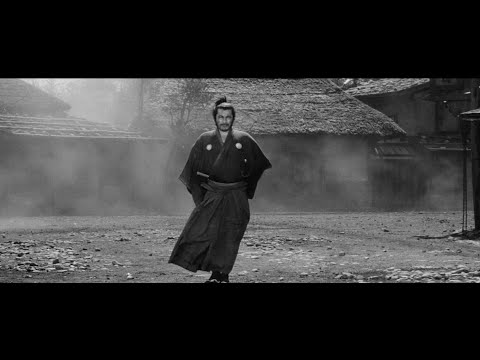
As a kid, I noticed Kurosawa's films have unique, epic quality about them, even if it's just two actors against a tree. Now I know it was deep focus. Shallow focus looks cozy and intimate, deep focus looks grandiose and operatic.
27
@Chacha-xg7cm · 3 years ago
Besides painting, Kurosawa was also inspired by theatre, another medium where you can see everything on the stage (in frame) at the same time. His use of deep focus is one of the bigger contributors to crafting the theatrical feeling of his movies imho.
46
@Archontasil · 3 years ago (edited)
As a photographer, i like kurosawa because in every frame, I can tell what's going on even without dialogue. He can tell a story through visual alone. While DOP todays are mostly focus on the actor's face, you can't tell what's happening just by looking at someone's face.
74
@jeffwilson3818 · 3 years ago
In photography, it's generally more challenging to compose well when everything is in focus and you can't rely on shallow dof to obscure distracting background elements. I imagine in cinematography that's also the case, probably more-so. But when it is pulled off well, it's hard to beat. It can add so much richness to a frame.
198
@marin_real_estate_photography · 3 years ago (edited)
Thanks for the video. For me, super shallow depth of field is truly "The Youtube Look," as opposed to being cinematic :(
57
@dezainaa · 3 years ago
Deep focus presents an objective (observer) experience whereas shallow focus does a subjective experience. Deep focus doesn’t just imitate the traditional Japanese painting but also a live theater experience, which leave such freedom for the viewer to feel all the characters on stage and the tension between them.
162
Up next

Why Great Directors Lock the Camera
StudioBinder · 587K views

Why Movies Just Don't Feel "Real" Anymore
Like Stories of Old · 6.5M views

Can Composition Be Taught? Or Is It Instinct?
Seigher Brown · 411K views

Why Steven Spielberg Avoids a Wide Open Aperture
wolfcrow · 855K views

Tarantino's Storytelling Philosophy
Story Jaeger · 17K views

Digital Cinema Cameras Can Look (Almost) Exactly Like Film
In Depth Cine · 137K views

The Movie That Captured Light That No Longer Exists
wolfcrow · 2.8M views

When Hollywood Legends Were Asked About Bruce Lee
Sovrenza and Nointra · 1.8M views

There Is No Oscar for the Shallowest Depth of Field
CinePro | Online Film School by Hugo Will · 41K views

What Movies Lose When They Use "Blender Cutting"
Thomas Flight · 1M views

Why don't movies look like *movies* anymore?
Patrick Tomasso · 5.3M views

Ultimate Guide to Camera Movement — Every Camera Movement Technique Explained [The Shot List Ep6]
StudioBinder · 6.6M views
Akira Kurosawa - Composing Movement
Every Frame a Painting · 10M views

How Stanley Kubrick Looked At Lighting
Rory Anderson · 85K views

Why Spielberg stopped using the Axial Cut
wolfcrow · 412K views

The Difference Between Anamorphic And Spherical Lenses Explained
In Depth Cine · 2.3M views

Why Some Cinematographers Don't Want Clean
Seigher Brown · 57K views

Why New Movies Are So U-G-L-Y
tographer · 40K views

Why do Short Films look like that?
Movie LUTs · 1.3M views

Why You Should Film Past f5.6 (It's not what you think)
Clever Ghost · 197K views