The TRUTH About ETTR: Why It's Not Always Necessary - Avoid The #1 Mistake!
125K views · Jan 29, 2025 · Education

Comments · 713
@backcountrygallery · 1 year ago · pinned
I've received a lot of recurring questions and want to clarify a few points regarding ETTR (Expose to the Right). Here are the top five:<br><br>1. Base ISO or High-Gain Only<br>My main argument is that increasing ISO in an attempt to achieve ETTR is generally ineffective unless you are shooting at base ISO or at your camera’s high-gain ISO setting. For example, if you are at ISO 1600 with a proper exposure and still have some headroom to the right of the histogram, it usually doesn’t help to raise ISO further for noise reduction—especially with modern, ISO-invariant cameras. Instead, capture the image as is and save yourself the extra post-processing. If you need less noise, consider reducing shutter speed or opening the aperture so you can lower your ISO.<br><br>2. Use the Necessary Exposure<br>This does not mean you should always aim for base ISO or your camera’s high-gain circuit. Rather, choose the shutter speed and aperture you need to properly expose the scene and select an ISO that achieves the desired brightness without clipping important highlights. In short, use the settings you need to get the shot.<br><br>3. Understanding Exposure<br>If you want to learn more about exposure concepts, please check out my dedicated histograms video—it covers these principles in detail and will greatly help your understanding.<br><br>4. Clarifying ETTR Usage<br>I recognize that ETTR is technically done at base ISO (or at the high-gain ISO on certain modern cameras). However, I often see people applying it at higher ISO settings and still referring to it as ETTR. This causes confusion among those who fully understand the technique. Although I’m aware of the correct definition of ETTR, not everyone is, and this video aims to address that gap in knowledge.<br><br>5. Bit Depth and Noise<br>ETTR is intended to utilize the full bit depth of the file (often 14 bits on newer cameras) by shifting darker portions of the image into bit levels with higher capacity, thereby retaining more detail and smoother tonal transitions. True ETTR exposure indeed works when done at base ISO or high-gain ISO. Simply raising ISO, however, does not add new information—it amplifies noise and creates larger files, which do not necessarily mean higher quality. In most real-world scenarios, especially when shadows are not pushed to extremes, ETTR is less crucial than many people believe.<br><br>Here's how it works in a nutshell:<br><br>The tonal range of light is captured by the camera and recorded into the raw file. The more unique tones that a camera can capture within a given stop of light, the more bits that are required to represent them in the raw file. Noise causes the transitions between tones to become muddied - what looks like a transition can't be distinguished from noise. This reduces the number of unique tones the camera can accurately identify, which in turn means you need fewer bits to encode them. This is why brighter tones require more bits than darker tones - it's because the SNR is higher in the brighter tones, which means there is less noise to interfere with their capture. Using ISO-based ETTR shifts the noisy tones into higher bit areas of the file that usually are used to capture bright tones - since the noise is higher, the extra bits usually employed to encode unique tones are wasted encoded false transitions of tones caused by the noise.
30
@ronwebb610 · 1 year ago
I've been a photographer for over 50 years. This is the finest explanation of ETTR and exposure management I have seen! Brilliant! Well done Steve.
102
@davestokes3446 · 1 year ago (edited)
The reason to ETTR is not about noise, but about number theory. If you have luminance values of 1 and 2, there is one stop between them but no data (there are no integers between 1 and 2); if you have luminance values of 128 and 256, there is still 1 stop between them but 128 discrete values for data between them. When you drop a stop from ETTR, you lose one stop of bit depth and half your image data. Not a big issue when using full-frame pro cameras, but most of us use crop sensors with only a 12 bit image it is a much bigger issue. It's always a good sanity check with arithmetic to take things to extremes: if I under-expose by 14 stops with my Olympus, I literally don't have a picture; all my pixels will be black. It doesn't matter how I juggle aperture, shutterspeed and ISO, I still have no picture.
38
@BarryGee-pm6rv · 1 year ago (edited)
Isn't the take-home here the fact that ISO has absolutely nothing to do with exposure?<br>Exposure is determined solely by aperture, shutter speed and scene luminance.<br>ISO is simply a means of increasing sensor gain and thus brightening the image.<br>This explains why noise levels in modern cameras are largely unaffected by ISO.<br>It's underexposure which causes increased noise.<br>However, there is another point that has been missed here.<br>The point of ETTR (which is always enacted at base ISO) is not so much to minimise noise but to optimise exposure in order to maximise the amount of data collected.<br>Unlike the film and the human eye, digital sensors collect data in a linear, exponential fashion.<br>For every stop of underexposure from the clipping point (sensor saturation) there is a 50% loss of data.<br>Another 50% of what is left for the next ...and so on.<br>This loss of data leads to overall reduced detail especially in the shadows, poorer colour and of course more noise.<br>So, ISO may not matter, but underexposure sure does.
11
@bobani17 · 1 year ago
NO ONE else can explain things like this the way you do!<br>This is hands down the best photography channel on youtube, no doubt!
12
@GaryKFroehlich-jh5mm · 1 year ago
Excellent video! I’ve been making the same argument for years. While ETTR is not BS—there’s a legitimate mathematical and practical basis for it—HOW you expose to the right is paramount! Cranking up the ISO is just increasing the amplification of whatever the sensor captured, and both the signal and the noise get amplified by the same amount. Thus, the signal to noise ratio remains constant. Only by increasing the signal (wider aperture, slower shutter) while keeping the noise (it’s photo-electronic shot-noise) constant can you increase the signal to noise ratio. With landscapes that sit relatively still while you dink around with settings, ETTR can provide minor benefits. With wildlife or sports, it’s not practical, and any benefits are offset by the likelihood of missing your shot.
30
@Aviator168 · 1 year ago
Best explanation ever. To reduce noise, use the lowest shutter speed and largest aperture possible.
5
@DanielWray-z7m · 1 year ago
I agree. I have never used ETTR, without regrets.
2
@KevinVirgil · 1 year ago
I remember when ETTR was first introduced. It had to do with there being more information in the higher tonal ranges and progressively less as you move down in the tonal range. It was always about increasing the exposure via aperture or shutter speed, not ISO. It was targeted at high dynamic range scenes like landscapes. Maybe some people didn’t understand this and assumed you could use ISO to do this. Regardless, good video on the topic.
16
@johntoolan7243 · 1 year ago
So, expose to the right but don’t use iso to do it. Use shutter speed and aperture. My approach to ettr has always been when there isn’t enough light because the aperture and shutter speed have been maxed out then it’s go to the iso or go home! If you’re hand holding and the subject is stationary or on a tripod and there’s some movement in the subject. In the first example I’m hand holding, the subject is stationary and I know that hand holding at 1/25 may not pull it off, I’m going to increase the shutter speed to 1/40 and adjust iso to ettr to not have to pull shadows and make the image worse when processing.
3
@jakecook716 · 1 year ago
I agree with this, but I think it's still the most sensible method. Raising exposure in edit is something you always want to avoid. ETTR lessens the chance of underexposed images. Underexposed should be purposeful, the goal is to limit the accidental ones. ETTR is the answer
2
@kristian-pal · 1 year ago
There's a second, more important reason for ETTR: using the full range of the 14 bit file. If you do not amplify the analog signal by let's say 2 stops, you get a quasi 12 bit file. Therefore with ETTR you can improve the tonality of your image, which is especially visible in the shadows with smoother transitions. <br><br>The 3rd reason is to understand your sensor and avoid clipping in high dynamic range situations. If you always expose for the highlights, you won't ever clip them.
29
Up next

Bird in Flight Photography: The Mirrorless Settings & Techniques That Actually Work
Steve Perry · 101K views

Lightroom Denoise Secrets: Make ISO 12,800 Look Like ISO 400!
Steve Perry · 236K views

Pre-Capture Explained: Secrets Most Wildlife Photographers Miss!
Steve Perry · 87K views

"Your Exposure is Wrong..."
James Popsys · 112K views
5 Mistakes Every Wildlife Photographer Makes
Focused On Wildlife · 15K views
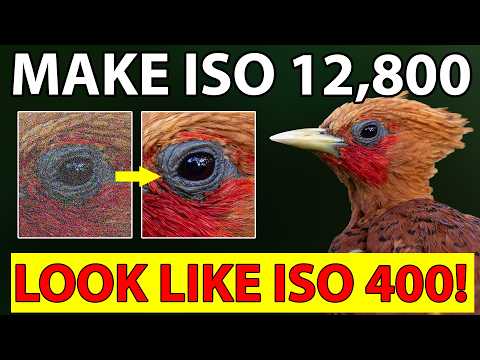
Make ISO 12,800 Look Like ISO 400: My 2026 Lightroom Workflow
Steve Perry · 59K views

Here's Why ETTR (Expose to the right) Is wrong!
Seim · 8.3K views

WOW! How To Sort & Cull 4000 Image AN HOUR!
Steve Perry · 48K views

The 10 BEST Nikon Shortcuts Ever!
Steve Perry · 164K views

What the Pros Know About Cropping (Unlock These Secrets!)
Steve Perry · 155K views

What Pros See That Beginners Miss
Steve Perry and Jan Wegener · 38K views

How Sailors Repaired A Wooden Warship In The Middle Of The Ocean
Old Sailor Thomas and 정일만 · 19K views

Scientists Said This Wave Was Impossible
Veritasium · 3.4M views

What is ETTR in photography, and when should you use it?
DPReview TV · 113K views

The Auto ISO Trick Every Wildlife Photographer Should Know
Steve Perry · 45K views

20 photography hacks and tips you will actually use
Simon d'Entremont · 198K views

Exposure Compensation Made Easy!
Steve Perry · 133K views

Why Nobody Reacts to Your Photographs (Composition in Photography, Part 2)
Martin Osner · 53K views

THIS makes photography SO MUCH EASIER!
Simon d'Entremont · 231K views

The TRUTH behind Exposing to the Right !
Ian Worth · 20K views