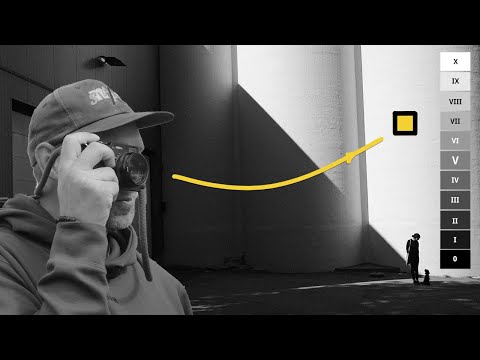
The Zone System
11K views · Jun 17, 2022 · Howto & Style

Comments · 36
@Socrates... · 4 years ago
Thank you so much for the video, your passion bursts out the screen
3
@abelpf1 · 2 years ago
Thank you for this video!!
@genadigenchev9956 · 3 years ago
Thank you. :)
@herbiemac100 · 1 year ago (edited)
Isn’t it like having a spot meter and averaging out the seen to the very best one can with the film being used, with the lighting conditions at the moment of recording something. You can write each value down. And in the dark room, can bring the image to its exact values from 10 to 1. Where the film could not do it on its own.
@Socrates... · 4 years ago
I miss your videos; I hope that you are well.
@baladino · 4 years ago
Hello Matt. I finally did it. After considerable amount of planning. I self developed 2 rolls of Delta 400 exposed at box speed with Ilford DDX. I’m keen to show you the results. The results were certainly encouraging. Fine grain with great detail though the camera was a Contax G2. I expect sharpness and detail to improve with a Leica camera and lens.
1
@gerrit6273 · 4 years ago
i would like to thank you from the bottom of my heart for this video dear matt. what a great channel. the way you bring the topic "zone system" closer to me is so full of passion and dedication that it is really a pleasure to listen to you and watch. you are a great educator. something like that is really rare here on youtube. so: have very dear thanks for this and please continue. <br>nevertheless...this is surely due to my obtuseness...i didn't understand it in the end. 😅……<br>isn't it enough in the end to simply make out a zone v in the picture…to determine. shadows and highlights are then based on this? at the end of your video it went a bit too fast for me. please excuse me. i send you greetings from berlin. gerrit
@TeddyCavachon · 2 years ago (edited)
I used the Zone System for my B&W from 1971 to 1990, apprenticed and assisted Monte Zucker 1972-74 worked in the photo lab at National Geographic 1974-77, taught college classes in photo reproduction and managed offset printing as a career dealing with the transition from analog to digital methods deep into the technical weeds.<br><br>Adams was a amazing photographer — I had reproduced a dozen his original prints with double-black duotone in one of the magazines we printed in the 1980s — but he made the Zone System overly complex and confusing because most think Zones = f/stop or EV values. They don’t.<br><br>In the 1968 edition of The Negative and The Print I learned from Adams acknowledges the confusing in the Forward suggesting the reader mentally replace the word “Zone” with “Print Value”. The 1968 Edition also only had ten zones 0 - 9 because it hadn’t yet occurred to Adams to assign a zone to the specular highlights on white objects and that photographers would have the common sense to know that a “Zone 9” smooth white object like highlights on a white car need to be reproduced on a print as a light gray tone with the paper base reserved for reproducing the SPECULAR highlights he later described as Zone 10 Print Values because those using the Zone System were misunderstanding and blowing out the specular highlight clues to 3D shape.<br><br>There are a lot of things Adams did which you will not understand unless actually reading the books and understanding how B&W film and paper respond to light intensity and color. Early Adams prints prior to 1930s were shot on orthochromatic film which does not react to red light and renders anything red much darker. The Panchromatic B&W film is overly sensitive to blue and also reacts to UV we can’t see which renders blue skies much lighter than seen by eye unless a yellow and UV filter are used which then make any yellow objects seem brighter than seen by eye. His dramatic dark skies where created at capture by using a red filter on the lens and the shots with birch trees with shimmering leaves were shot with a green filter.<br><br>Because I had a 1° Honeywell / Pentax meter when I learned it I quickly figured out the Zone System is much simpler forget the grey card and Zone V metering and instead meter a Zone 2 textured shaded black object with a spot meter then adjust the ISO dial lower by 3 or so stops so when you expose your prints for Zone 0 Black in the border you get Zone 2 rendering where you metered. For example using ISO 400 Tri-X the ISO on the meter would be instead set to ISO 50, three stops lower instead of metering Zone 2 area with the meter calibrated for Zone V and doing the f/stop math in your head. <br><br>The precise ISO needed is determined by always exposing prints so film base = max black with minimum exposure. If making contact sheets on #2 paper do a bracket exposure test from 1 sec to as long as it takes to get max black on the borders then always use that as your proof exposure and you’ll have a baseline for visually evaluating correct exposure in the Zone 0 - 1 - shadows and whether the film development time was correct to render the Zone 8-9-10 scene areas correctly on #2 print paper.<br><br>Changing development time of negatives to always print on # 2 paper as Adams preferred isn’t practical with a roll film camera unless all the frames on the roll are captured under the same EV range between Zone 2 - 8 which is the range with texture on 3D objects in cross-lighting. So instead of using the measurement of scene range to change development of the negative you use it to know in advance what Polycontrast filtration is needed to fit the paper to the density range on negative development at a consistent time a time selected by testing so sunny cross lit scenes print perfectly with #2 filtration.<br><br>Once the negative and print paper ranges are match to reproduce the full range of tone and texture from Zone 0 - 10 the rest is done with dodging and burning. Adams would make a baseline full range test print then after dodging and burning to taste create a tissue overlay map of all the + / - correction he make in different areas so he or an assistant could repeat them.<br><br>Zone V = 18% became a problem for Adams when film changed from being rated by ASA number to ISO because meters which use ISO are calibrated to reproduce 12% not 18% which is way if you fill the frame of a digital camera with an 18% card the spike it creates in the histogram isn’t in the center. If you base digital exposure on centering the card spike you will blow out the Zone 9 / 10 separation and perception of 3D shape that critical transition creates in 2D reproductions.<br><br>The reason Kodak still makes and sells 18% cards is because Adams lobbied Kodak executives not to change it to 12% when the ISO standard was adopted. If you buy one and read the instructions you will see them say a meter reading with a modern 12% ISO standard meter needs to be adjusted 1/3 lower to correctly expose. <br>To adapt Adams method to roll film I spot metered with my Zone 2 adjust ISO for exposure, read a zone 8 textured white highlight and 9 smooth white highlight to know the scene constant between 2 - 9 in EV / stops, then made notes as I shot. Back in the the dark room I’d develop film to fix cross lit sunny scenes on #2 paper then adjust the paper grade with yellow / magenta filtration using the color head of my enlarger on drop in filters. <br><br>The Zone System method of changing film contrast via development to match #2 paper contrast doesn’t work with color negative film because how changes in development time affect the color balance. With color and digital the ambient light contrast if equal or lower to the print / sensor range is no problem and flat overcast lighting is ideal because contrast can easily be increased by burning in or using flash in the foreground over the ambient to increase the contrast.
5
@baladino · 4 years ago
Due to work commitments I watched this video to completion over 2 separate sessions. I gather that in order to get consistent results over time it would better to use a single film stock. To understand how the film stock responds to light. Ergo it would be difficult to visualise something we don’t understand entirely. Secondly if the dynamic range is too wide, sometimes the mid tones would be suitable to place in zone 5. Of course bearing in mind what the final image and where we want maximal detail to be as well as what we intend to create. Possibly this is why hard light in the afternoon is often avoided and the professionals always gravitated towards early morning light or golden hour. I’m still turning things over in my mind and I wish to thank you for your advice and discussion. I have 2 questions: why would we push or pull film if in doing so it would either reduce detail , acutance and add grain ? Since we have digital cameras with good sensors these days, does pushing FP4+ from 125 to 2 stops over or exposing HP5+ 400 to 1600 seem worthwhile ? Though by doing this we are able to use higher shutter speeds. I guess I just don’t understand the principle of this. That image of The Clash bass guitarist Paul Simonon for example was exposed in low light and is amazing.
1
@Daetalus67 · 2 years ago
Oh man, “the 90’s?! I believe the first book was 1940…
@chriscard6544 · 3 years ago
I have no opinion but does it make sense to speak about Zone System in digital ? and how to be close to it because negative is very different than sensor ?
@gabedamien · 3 years ago (edited)
~<a href="https://www.youtube.com/watch?v=v3rs02_KXRM&t=331">5:31</a> FYI, Yosemite is pronounced "yoh-SEM-ih-tee". The name was a mistaken interpretation by an American explorer from the Miwok word Yohhe'meti meaning "they are killers [who live there]".
1
Up next

The Zone System Part 1 Introduction with Hans de Graaf
The Photography Minimalist · 29K views

Is the Zone System Still Relevant?
Cedar Mesa Photography · 4.8K views

Introduction to Infrared Photography (2022)
Rob Shea Photography · 26K views

How To Measure Exposure For Film Photography - The Zone System (Ansel Adams)
RYAN PARK PHOTOGRAPHY · 85K views

Spot Metering and the Zone System with Richard White
The Photographer Academy · 178K views

More about Metering - Incident Meters, Spot Meters, Zone System & More
Vintage Camera Digest · 24K views

How To Use The Zone System To IMPROVE Your Photos (Black & White Metering)
DistPhoto · 69K views

The Russian Air Force is Losing Control of the Sky
Cappy Army · 489K views

Developing Your Film... Wrong!
Trangent · 128K views

EZ Zone System Part 1 - Quick and Easy Film Speed Tests
Pictorial Planet · 9.9K views

Exposure and Spotmeters
David Chalmers · 10K views

Digital ZONE SYSTEM Fundemntals.
Seim · 31K views

Why Nobody Reacts to Your Photographs (Composition in Photography, Part 2)
Martin Osner · 51K views

Black and White Film On Location + Extended Zone System Discussion
DistPhoto · 11K views

The Zone System Explained
The Art of Photography · 264K views
Ditch the Guesswork, Use This Exposure System
Kim Daniel Vedal · 3.9K views

Shoot Like Ansel Adams
The Photo Show · 33K views

Zone System In 10 Minutes or Less
FIGITAL REVOLUTION · 10K views

The Ansel Adams Zone System: HDR Capture and Range Compression by Chemical Processing
Google TechTalks · 32K views

3 ALTERNATIVES to the ZONE SYSTEM according to Ansel Adams! Simple & intentional exposure metering.
Fil Nenna · 9.9K views