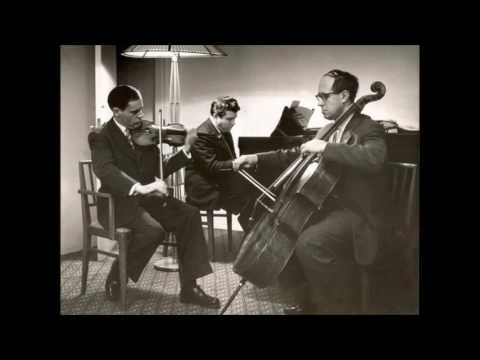
Beethoven: Trio, Op. 97 "Archduke" (Century's recording: Eugene Istomin, Isaac Stern & Leonard Rose)
30K views · Feb 13, 2025 · Music

Comments · 32
@classicalmusicreference · 1 year ago (edited) · pinned
🔥🎧 Album available // Beethoven: Trio, Op. 97 "Archduke" by Eugene Istomin, Isaac Stern & Leonard Rose<br>🔥🎧 Choose my streaming platform: <a href="https://lnk.to/beethovenop97triostern">https://lnk.to/beethovenop97triostern</a><br>Qobuz, Tidal, Amazon Music (Hi-Res/flac) Apple Music (Alac/aac) <br>Spotify (Lossless/mp3) Deezer (Hi-fi) Youtube Music (mp3) <br>🔊 Official Merch: <a href="https://classicalmusicreference.com/">https://classicalmusicreference.com</a> (Hi-Res Master/wav uncompressed)<br>Ludwig Van Beethoven (1770-1827) Trio No. 7 in B-flat Major, Op. 97 "Archduke"<br><a href="https://www.youtube.com/watch?v=uggchtxdvbA">00:00</a> I. Allegro moderato (2025 Remastered, Winterthur 1965)<br><a href="https://www.youtube.com/watch?v=uggchtxdvbA&t=838">13:58</a> II. Scherzo: Allegro (2025 Remastered, Winterthur 1965)<br><a href="https://www.youtube.com/watch?v=uggchtxdvbA&t=1270">21:10</a> III. Andante cantabile; ma però con moto, Poco più adagio (2025 Remastered, Winterthur 1965)<br><a href="https://www.youtube.com/watch?v=uggchtxdvbA&t=2018">33:38</a> IV. Allegro moderao (2025 Remastered, Winterthur 1965)<br><br>Piano: Eugene Istomin<br>Violin: Isaac Stern<br>Cello: Leonard Rose<br>Recorded in 1965 , at Winterthur<br>New mastering in 2025 by AB for <a href="https://classicalmusicreference.com/">https://classicalmusicreference.com/</a><br>❤ Support me on Patreon <a href="https://cutt.ly/ZezaldhI">https://cutt.ly/ZezaldhI</a><br>🔊 Join us with your phone on our WhatsApp fanpage (our latest album preview): <a href="https://cutt.ly/5eathESK">https://cutt.ly/5eathESK</a><br>🔊 Find our entire catalog on Qobuz: <a href="https://cutt.ly/geathMhL">https://cutt.ly/geathMhL</a><br>🔊 Discover our playlists on Spotify: <a href="https://cutt.ly/ceatjtlB">https://cutt.ly/ceatjtlB</a><br><br>Irving Kolodin: "Asked to provide a capsule characterization of the Beethoven trios as opposed to the many other fine ones that the Istomin-Stern-Rose Trio performed, Isaac Stern offered the summation that "Beethoven is constantly driving himself and his performers in a way unknown to any other composer. There is none of the romantic levity one finds in the works of others. He is always deadly in earnest, even when introducing a lighter touch for contrast..." This might be considered an exaggeration if applied to the E-flat Major Trio, say, of Op. 1, in the light of the later Op. 70, No. 2, and the B-flat Major, Op. 97 ("Archduke"). But if it is possible for the reader to expunge from his mind the idea of "driving force" on the scale of the later works, it is possible to recognize a similar disposition, if only in embryo, in the Op. 1, No. 1.<br><br>Lest it be supposed that the quality to be heard in the very first published trio was spontaneously generated, it may be noted that, just as there were trios before Beethoven, so there were Beethoven trios before those published as Op. 1. One (from 1791) that was not accorded the honor of inclusion among Op. 1 was nevertheless judged good enough to be perpetuated after his death. It is the E-flat Major (WoO 38), designated "opus posthumous."<br><br>The trios-before-Beethoven are worthy of at least momentary attention, if only to clear up any vexing considerations of precedence that may cloud the listener's mind. Haydn's thirty-odd works utilizing keyboard instruments (klavier, harpsichord, cembalo, or piano) are recalled today primarily for the G Major, with its "Gypsy" rondo finale. For all the decades that separated them (when Beethoven was born in 1770, Haydn was nearly forty years of age), the trios of Op. 1 predate the Haydn G Major. It was written in 1795, during Haydn's second visit to London and, thus, after he had heard the Beethoven trios prior to his departure from Vienna in late 1794. Mozart's concern for equality of instrumental distribution in the trios he wrote in his maturity (1786, when he was approaching thirty) may be read in the documented fact that K. 496, in G major, is notated with two different colors of ink. The purpose, it may be assumed, was to remind the composer not to overuse the keyboard instrument at the expense of the strings.<br><br>Nevertheless, the cello is treated most compassionately, rarely venturing into the upper positions or being burdened with rapid figurations (save in unisons). It has been said, of the generality of Haydn trios, that they could be performed as piano solos and not lose too much. The Mozart trios could be played as piano-violin duos and also retain most of their musical meaning.<br><br>The history that stretches back through trio sonatas and sonata a tré, or whatever language was preferred in their countries of origin, is long and marked by many names. The history that stretched ahead is dominated by one name—Beethoven's. Into the rather restricted arena that accommodated the trio works of Mozart and Haydn strode the youthful Beethoven, armed with his training in Bonn as a violinist (even before he was a pianist) and with his later experience as an orchestral violist. Seated beside him was a cellist named Bernhard Romberg, soon to rewrite the manual of how that instrument should be played. Beethoven was not averse to expanding the function of the cello in the early trios, but he was still obedient to the view that there was no point in writing what could not be performed.<br><br>Much of this had changed by the time Beethoven came to write the trios of Op. 70 (in 1808), and much of the change had been wrought by Beethoven himself. The new manual of arms for cellists, Leonard Rose gladly pointed out, had been published by Romberg during the first decade of the nineteenth century, and the changes of procedure may be read in Beethoven's writings for the instrument in the Triple Concerto. This score also served as a bridge from the early trio writing to the later, with an addendum in the eloquent Cello Sonata, Op. 69, in A Major.<br><br>What the preceding recitation sets forth, directly or by implication, is the interior identity of the trios with the total productivity of Beethoven. This relates not only to the rising tide of expressivity—a synonym of "drive," in the Stern sense—and the symphonic interrelation of one movement with another, but also to the ever-expanding demands of Beethoven on the instruments for which he wrote.<br><br>Closely woven into the evolution of the trios, thus, were the insight and understanding that Beethoven acquired in the creation of the piano sonatas and concerti, the violin sonatas and concerto, the cello sonatas and triple concerto. Into them, as time passed, went the sharpening sense of motivic function as a basis for development, derived from his symphonic writing. This may suggest how the promise of Op. 1, No. 1, erupted into the fulfillment of Op. 97, which remains not merely the "Archduke" of fabled associations, but the archetype of trio composition through the decades.<br><br>Trio in B-flat Major, Op. 97 // So much has been written about the B-flat Trio of 1811 (which earns its subtitle of "Archduke" through dedication to one of Beethoven's most devoted patrons, the Archduke Rudolph), that more would be redundant. Like so many other of his final works in a given form—the last piano sonata in C minor, Op. 111; the final sonata for violin and piano in G major; the Ninth Symphony—it does not merely postulate an absolute: It defines an ideal so comprehensively that further progress along the same lines would be futile without a total change of personality traits within a man of equal genius (named Franz Schubert, for example)."<br><br>🔥🎧 Album available // Beethoven: Trio, Op. 97 "Archduke" by Eugene Istomin, Isaac Stern & Leonard Rose<br>🔥🎧 Choose my streaming platform: <a href="https://lnk.to/beethovenop97triostern">https://lnk.to/beethovenop97triostern</a><br><br>Other Album available // Beethoven: The 11 Trios for Piano, Violin & Cello by the Beaux Arts Trio<br>🎧 Qobuz (Hi-Res) <a href="https://cutt.ly/6eJxwEgc">https://cutt.ly/6eJxwEgc</a> Tidal (Hi-Res) <a href="https://cutt.ly/reJxw8aV">https://cutt.ly/reJxw8aV</a><br>🎧 Apple Music (Lossless) <a href="https://cutt.ly/MeJxeph3">https://cutt.ly/MeJxeph3</a> Deezer (Hi-Fi) <a href="https://cutt.ly/2eJxexCq">https://cutt.ly/2eJxexCq</a><br>🎧 Amazon Music (Hi-Res) <a href="https://cutt.ly/XeJxeY6r">https://cutt.ly/XeJxeY6r</a> Spotify (mp3) <a href="https://cutt.ly/2eJxeJJr">https://cutt.ly/2eJxeJJr</a><br>🎧 Youtube Music (mp4) <a href="https://cutt.ly/teJxe5FS">https://cutt.ly/teJxe5FS</a><br><br>Ludwig Van Beethoven PLAYLIST (reference recordings): <a href="https://www.youtube.com/watch?v=yemP0H529Zg&list=PL3UZpQL9LIxOhkdci2M8WKMSVaf9WiF8x&t=318">https://www.youtube.com/watch?v=yemP0H529Zg&list=PL3UZpQL9LIxOhkdci2M8WKMSVaf9WiF8x&index=28&t=318s</a>
16
@jonazo7188 · 1 year ago
With all due respect to the symphonies (and the piano concertos and the string quartets, etc.) I feel like this is one of Beethoven’s most beautiful pieces. It’s so stately and pleasant but with so much going on, and the way the themes link to each other seamlessly is just so beautiful.
10
@classicalmusicreference · 1 year ago (edited)
Irving Kolodin: "Asked to provide a capsule characterization of the Beethoven trios as opposed to the many other fine ones that the Istomin-Stern-Rose Trio performed, Isaac Stern offered the summation that "Beethoven is constantly driving himself and his performers in a way unknown to any other composer. There is none of the romantic levity one finds in the works of others. He is always deadly in earnest, even when introducing a lighter touch for contrast..." This might be considered an exaggeration if applied to the E-flat Major Trio, say, of Op. 1, in the light of the later Op. 70, No. 2, and the B-flat Major, Op. 97 ("Archduke"). But if it is possible for the reader to expunge from his mind the idea of "driving force" on the scale of the later works, it is possible to recognize a similar disposition, if only in embryo, in the Op. 1, No. 1.<br><br>Lest it be supposed that the quality to be heard in the very first published trio was spontaneously generated, it may be noted that, just as there were trios before Beethoven, so there were Beethoven trios before those published as Op. 1. One (from 1791) that was not accorded the honor of inclusion among Op. 1 was nevertheless judged good enough to be perpetuated after his death. It is the E-flat Major (WoO 38), designated "opus posthumous."<br><br>The trios-before-Beethoven are worthy of at least momentary attention, if only to clear up any vexing considerations of precedence that may cloud the listener's mind. Haydn's thirty-odd works utilizing keyboard instruments (klavier, harpsichord, cembalo, or piano) are recalled today primarily for the G Major, with its "Gypsy" rondo finale. For all the decades that separated them (when Beethoven was born in 1770, Haydn was nearly forty years of age), the trios of Op. 1 predate the Haydn G Major. It was written in 1795, during Haydn's second visit to London and, thus, after he had heard the Beethoven trios prior to his departure from Vienna in late 1794. Mozart's concern for equality of instrumental distribution in the trios he wrote in his maturity (1786, when he was approaching thirty) may be read in the documented fact that K. 496, in G major, is notated with two different colors of ink. The purpose, it may be assumed, was to remind the composer not to overuse the keyboard instrument at the expense of the strings.<br><br>Nevertheless, the cello is treated most compassionately, rarely venturing into the upper positions or being burdened with rapid figurations (save in unisons). It has been said, of the generality of Haydn trios, that they could be performed as piano solos and not lose too much. The Mozart trios could be played as piano-violin duos and also retain most of their musical meaning.<br><br>The history that stretches back through trio sonatas and sonata a tré, or whatever language was preferred in their countries of origin, is long and marked by many names. The history that stretched ahead is dominated by one name—Beethoven's. Into the rather restricted arena that accommodated the trio works of Mozart and Haydn strode the youthful Beethoven, armed with his training in Bonn as a violinist (even before he was a pianist) and with his later experience as an orchestral violist. Seated beside him was a cellist named Bernhard Romberg, soon to rewrite the manual of how that instrument should be played. Beethoven was not averse to expanding the function of the cello in the early trios, but he was still obedient to the view that there was no point in writing what could not be performed.<br><br>Much of this had changed by the time Beethoven came to write the trios of Op. 70 (in 1808), and much of the change had been wrought by Beethoven himself. The new manual of arms for cellists, Leonard Rose gladly pointed out, had been published by Romberg during the first decade of the nineteenth century, and the changes of procedure may be read in Beethoven's writings for the instrument in the Triple Concerto. This score also served as a bridge from the early trio writing to the later, with an addendum in the eloquent Cello Sonata, Op. 69, in A Major.<br><br>What the preceding recitation sets forth, directly or by implication, is the interior identity of the trios with the total productivity of Beethoven. This relates not only to the rising tide of expressivity—a synonym of "drive," in the Stern sense—and the symphonic interrelation of one movement with another, but also to the ever-expanding demands of Beethoven on the instruments for which he wrote.<br><br>Closely woven into the evolution of the trios, thus, were the insight and understanding that Beethoven acquired in the creation of the piano sonatas and concerti, the violin sonatas and concerto, the cello sonatas and triple concerto. Into them, as time passed, went the sharpening sense of motivic function as a basis for development, derived from his symphonic writing. This may suggest how the promise of Op. 1, No. 1, erupted into the fulfillment of Op. 97, which remains not merely the "Archduke" of fabled associations, but the archetype of trio composition through the decades.<br><br>Trio in B-flat Major, Op. 97 // So much has been written about the B-flat Trio of 1811 (which earns its subtitle of "Archduke" through dedication to one of Beethoven's most devoted patrons, the Archduke Rudolph), that more would be redundant. Like so many other of his final works in a given form—the last piano sonata in C minor, Op. 111; the final sonata for violin and piano in G major; the Ninth Symphony—it does not merely postulate an absolute: It defines an ideal so comprehensively that further progress along the same lines would be futile without a total change of personality traits within a man of equal genius (named Franz Schubert, for example)."<br><br>🔥🎧 Album available // Beethoven: Trio, Op. 97 "Archduke" by Eugene Istomin, Isaac Stern & Leonard Rose<br>🔥🎧 Choose my streaming platform: <a href="https://lnk.to/beethovenop97triostern">https://lnk.to/beethovenop97triostern</a><br><br>Other Album available // Beethoven: The 11 Trios for Piano, Violin & Cello by the Beaux Arts Trio<br>🎧 Qobuz (Hi-Res) <a href="https://cutt.ly/6eJxwEgc">https://cutt.ly/6eJxwEgc</a> Tidal (Hi-Res) <a href="https://cutt.ly/reJxw8aV">https://cutt.ly/reJxw8aV</a><br>🎧 Apple Music (Lossless) <a href="https://cutt.ly/MeJxeph3">https://cutt.ly/MeJxeph3</a> Deezer (Hi-Fi) <a href="https://cutt.ly/2eJxexCq">https://cutt.ly/2eJxexCq</a><br>🎧 Amazon Music (Hi-Res) <a href="https://cutt.ly/XeJxeY6r">https://cutt.ly/XeJxeY6r</a> Spotify (mp3) <a href="https://cutt.ly/2eJxeJJr">https://cutt.ly/2eJxeJJr</a><br>🎧 Youtube Music (mp4) <a href="https://cutt.ly/teJxe5FS">https://cutt.ly/teJxe5FS</a>
12
@Dumballa · 1 year ago
This is a legendary piece. And a worthy recording of Ludwig. 😊🎼
16
@tokyoboy-qn2hf · 8 months ago
But when I listened to this music it's like Beethoven's right here talking to me, telling something like, It's okay, don't worry about it. That's life. I've done some pretty awful things in my life too. Not much you can do about it. Things happen. You just got to hang in there.
2
@BrucknerMotet · 1 year ago
possibly my favorite scherzo in any work for symphony, chamber orchestra, small ensemble, and even solo instrument. So playful and no frenetic rushing around.
4
@leonardopiodafonseca1500 · 1 year ago
... alguém já disse q o terceiro movimento, " andante", é a mais bela e profunda elegia de saudade e adeus , jamais saída de um coração humano,
3
@NobelSkye · 1 year ago (edited)
SUPERB Performance & Recording for a relax evening . . THANK YOU ❤
9
@marcofimiani8568 · 7 months ago
Le melodie immortali beethoveniane
1
@marksmith3947 · 1 year ago
At age 64 I don't believe I've ever listened to this composition before. I look forward to a wonderful experience
1
@renaudpontier · 1 year ago
Comme toujours chez Beethoven, cet équilibre entre les instruments, ces enchainements de thèmes, cette énergie. Ce trio est un pur chef d'œuvre, inépuisable, d'une beauté immortelle. .
@BlackSpock135 · 1 year ago
Magical, whimsical!!!!
7
Up next

Menuhin, Rostropovich, Kempff Beethoven Trio Op 97 Archduke Paris, 1974
Natalia Karatjeva · 132K views

Beethoven: Piano Trio No 7 "Archduke" - complete (Rubinstein, Heifetz, Feuermann)
pwong702 · 81K views

Chopin - 24 Preludes Op. 28 / Remastered (Century's recording: Claudio Arrau, Live 1960)
Classical Music/ /Reference Recording · 44K views

Brahms: Piano Concerto No. 2 in B-flat Major, Op. 83 (recording of the Century: Sviatoslav Richter)
Classical Music/ /Reference Recording · 97K views

Beethoven - Violin Concerto Op. 61 / Remastered (reference rec.: Nathan Milstein, Erich Leinsdorf)
Classical Music/ /Reference Recording · 24K views
Beethoven - Piano trio op.97 - Kogan / Rostropovich / Gilels
incontrario motu · 177K views

Beethoven - Piano Sonata No. 23 in F minor, Op. 57 "Appassionata" (Ct..rc.: Sviatoslav Richter)
Classical Music/ /Reference Recording · 54K views

Brahms "Piano Trio B Major op 8" - Istomin-Stern-Rose
Addiobelpassato · 37K views

Dinu Lipatti: The Last Recital at Besançon (Bach, Mozart, Schubert & Chopin) (Century's recording)
Classical Music/ /Reference Recording · 131K views

Beethoven: Piano Concerto No. 5 'Emperor' (Ct.rc.: Edwin Fischer, Wilhelm Furtwängler / Remastered)
Classical Music/ /Reference Recording · 53K views

Beethoven: Piano Trio op. 97. Menuhin, Kempff, Rostropovich.
erick hoffmann · 50K views

Beethoven: Piano Concerto No. 4, Op. 58 / Remastered (reference recording: Arthur Rubinstein)
Classical Music/ /Reference Recording · 26K views

Schubert - Piano sonata D.960 - Richter studio
incontrario motu · 3.3M views

Dinu Lipatti - Mozart Concerto No. 21 in C K 467
scartatum · 183K views

Beethoven - Archduke Trio
bachlokillo · 265K views

ATOS Trio: Beethoven - Piano Trio op.97 in Bb-Major "Archduke" - live
Thomas Hoppe · 117K views

Antonio Vivaldi L'Estro Armonico Op.3, Accademia Bizantina
Ria Brezova · 467K views

Tchaikovsky Piano Trio A minor, Op 50 - Kissin piano, Bell violin, Maisky cello Verbier 2009
Nikolaus Williams · 152K views

Beethoven, Archduke Trio, Suk Trio
SERIOSO SERIOSO · 17K views

Beethoven Klaviertrio B Dur op 97 „Erzherzog Trio“ Archduke Istomin Stern Rose
Sonorum Concentus Beethoven · 8.5K views