Run Capacitor Fundamentals Class
688K views · Apr 28, 2021 · Education

Comments · 325
@grashoprsmith · 5 years ago · pinned
The next generation of techs will be much more ethical and efficient with access to good training like this!
183
@robertanderson2118 · 4 years ago
The first thing that should have been talked about in this class is how to safely discharge the cap.
13
@ralphparker · 4 years ago
A meter could check the capacitance by putting a AC test charge on the capacitor and measure the phase shift in the circuit. It could also measure the voltage rise rate and /or decay rate over a resistive circuit. When an ac capacitor is installed on an AC circuit, the voltage of the capacitor is dependent of the current "pumped" into the capacitor, since the voltage would change direction before the current could completely build up the charge it would always lag the source voltage. This lag is really represented by the line resistance. The more line resistance, the more the lag.
13
@BigPowerAL · 4 years ago
As a long time boiler operator and now moving into my company’s HVAC / electrical group this information is gold! Never stop learning and challenging yourself to master new skills!!!
41
@joedc8169 · 5 years ago
62 years old. I have been in the HVAC Trade since my early Teens in my Dad's Marine AC Biz. I am now Manager of Technical training for Home Serve USA and found all your Videos to be a great resource. And accurate.
104
@Mikael5732 · 4 years ago (edited)
I will make only one comment, a board being able to be marked with dry erase marker showing the circuit path is such an advantage teaching students this theory, or any theory is very helpful. I listened to you but wished I was there to clarify by drawing the circuit path to aid in your teaching. Great job in your explanation I must add but adding drawing’s really helps solidify their understanding in theory.
2
@waylonlevins · 5 years ago
PFM LOL! I think “the math” is probably based on this equation. Amps x 2652 / Volts=MFD. For example you can check a capacitor on a running system without disconnecting by measuring the amps on the start wire multiplied by the constant 2,652, and then dividing that number by the voltage across the capacitor terminals. This trick comes in handy in situations when shutting the system down is not an option or when using a meter that doesn’t measure MFD.
10
@GNX157 · 4 months ago (edited)
I wish you could of shown in a scope wave form, the phase (timing) change that the run cap imposes on the electricity, and how that delayed wave form hits the start windings, creates magnetism, and gets the shaft turning and keeps it turning efficiently, chasing it around in a never ending circle ahead of the main wave form.
@truthseekerKJV · 4 years ago
I was taught that in a sine wave, the amps lead the volts which means they do not happen at the same time, so they are essentially out of phase. A run capacitor works to put the amps and the volts in phase and this gives a running motor much more torque.
6
@frankmontez6853 · 5 years ago
I can't get to coils to check / clean unless I take it apart even more quite extensively than I have so far and so I guess I'm going to try replacing blower motor capacitor . Coils sitting on top of furnace and I would have to cut freon and drain lines . Yes it might be very dirty but don't wnat to go further and capacitor is only $12 . That might work ?
@gama1123 · 4 years ago
The meter is actually acting as a very high impedance path, that's why it is slowly discharging. If it were low impedance the cap will discharge rather quickly.
6
@spelunkerd · 4 years ago
I've heard that standard reasoning, of back EMF from the motor causing higher voltage drop across the upstream capacitor, but I think it's not accurate. It's a confusing topic because there are two kinds of back EMF, the kind of reverse voltage that comes from the motor acting as a generator, and the kind that comes from inductive properties of the coils inside the motor. I think the higher drop across the upstream capacitor comes from the inductive properties, not the generator effects. You can easily model the higher drop across the upstream capacitor with an A/C series LC circuit. At resonant frequency you get huge drops across the cap, since electrons are shifted back and forth between capacitor and inductor like a juggler tossing a ball. That's why it is so important to have the correct run cap in line. The circuit needs to be tuned to resonant frequency. On the other hand, the generator effects of the motor cause a reverse voltage (in phase) which can never exceed incoming voltage. A reverse voltage charging the downstream side of the capacitor would tend to increase voltage on the downstream plate, effectively reducing the drop across the capacitor plates. Unless the generator effects are out of phase, you shouldn't see big voltage drops across the capacitor coming from pure generator effects.
1
Up next

Capacitor and Hard Start Myths Busted
HVAC School · 313K views

How to Test HVAC Relays, Contactors, and Transformers (Multimeter Tutorial for Techs)
Taddy Digest · 317K views

Why Do Capacitors Fail? (It’s not why you think)
HVAC School · 564K views

How to use a digital multimeter to test a starting capacitor
sosanasa1 · 351K views
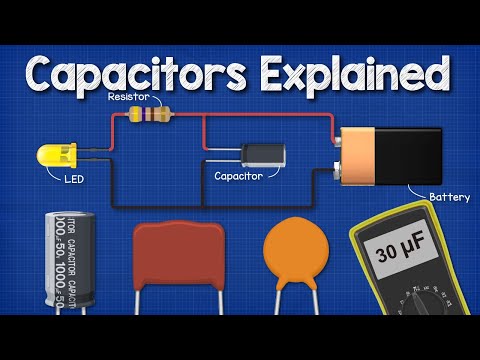
Capacitors Explained - The basics how capacitors work working principle
The Engineering Mindset · 11M views

Why Are Capacitors on Motors? What is Capacitive Reactance and Inductive Reactance?
Electrician U · 451K views

The Refrigeration Cycle Put Plainly for Diagnostics
Jersey Mike HVAC · 107K views

HVAC Relays 101 3D
HVAC School · 74K views

Electrical Basics Class
HVAC School · 916K views

How to Test a Capacitor with a $7 Multimeter (No Capacitance Setting)
Richard Lloyd · 1.3M views

10 Old Machinist Tricks Nobody Teaches Anymore
Mech Archive and 3 more · 15K views

How to Troubleshoot on a Service Call - HVAC Training (Part 1)
Pioneer HVAC Controls · 136K views

HVAC Capacitor Testing! 3 Methods, Underload, Bench Test, & Visual Inspection!
AC Service Tech LLC · 46K views

Multimeter 101 for HVAC 3D
HVAC School · 125K views

Nobody Builds Supersonic Propellers. I Found Out Why.
Michael Rechtin · 1.4M views

Air Conditioner Troubleshooting! Connecting, Measuring, Fixing, Disconnecting!
AC Service Tech LLC · 689K views

HVAC Low Voltage Control Wiring for Total Beginners
Jersey Mike HVAC · 205K views

WHY CAPACITORS FAIL in Air Conditioners! Watch it Break!
AC Service Tech LLC · 1.9M views

Trump Pressures Nvidia to Reinstate CEO Jensen Huang & He Tries to Explain Calling Putin His Friend
Jimmy Kimmel Live · 2.5M views

What is Common, Start and Run?
HVAC School · 272K views