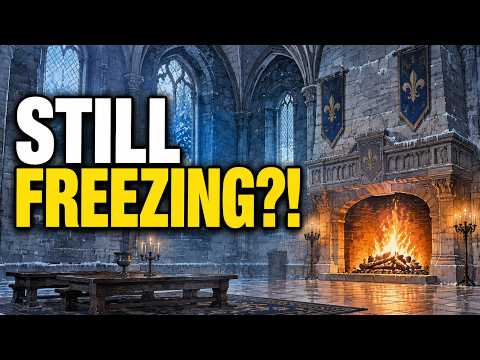
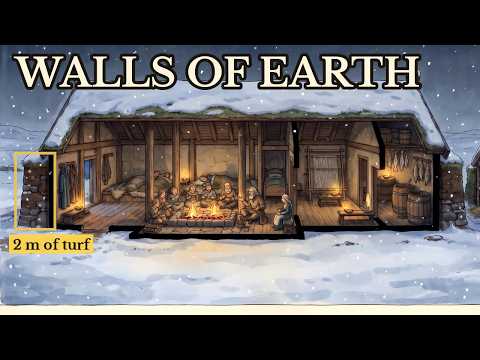
How did VIKINGS survive freezing winters inside houses made of GRASS and DIRT — without modern heating, electricity, or even a chimney?
In Viking Age Iceland, Norse settlers built remarkable longhouses using thick turf walls, stone foundations, timber frames, and open central hearths. These buildings were designed to protect their inhabitants from wind, cold, and extreme winter conditions.
But how could a simple fire keep a large house livable? And where did the smoke go if there was no chimney?
In this engineering history documentary from **OLD SYSTEMS LAB**, we explore the hidden physics of Viking homes and the ingenious building techniques used in medieval Iceland.
Using historical evidence, archaeological reconstructions, and principles of building science, we examine how these ancient structures managed heat, airflow, and moisture.
HOW DID VIKING HOUSES STAY WARM?
The secret wasn't simply a bigger fire. It was the interaction of several building systems:
*THICK TURF WALLS:* Layers of soil and grass helped reduce heat loss and buffer temperature changes.
*CENTRAL HEARTH:* A long, open fireplace provided radiant heat for cooking and daily life.
*THERMAL MASS:* Heavy building materials could absorb heat and moderate temperature fluctuations.
*LIVESTOCK AND FARM LAYOUT:* In some historical arrangements, animals occupied connected or shared spaces and could contribute additional warmth.
*ROOF SMOKE OPENING:* An opening above the living space allowed smoke and rising hot gases to escape, while admitting necessary ventilation.
*WIND PROTECTION:* Low building profiles and substantial earth walls reduced exposure to the elements.
But these houses were far from perfect.
Smoke, moisture, difficult maintenance, scarce timber, and the constant need for fresh air created serious challenges.
We also examine the archaeological site of **Stöng in Iceland**, traditionally associated with the Hekla eruption of 1104, and discuss what archaeological evidence can — and cannot — tell us about historical indoor conditions.
Could such a house remain livable during a hypothetical winter night at −30°C?
The physical principles can be investigated, but reliable measurements of indoor temperatures in Viking Age houses are limited. This documentary distinguishes historical evidence from illustrative engineering reconstruction.
CHAPTERS
00:00 — How Did Vikings Survive Extreme Cold Without Chimneys?
00:37 — A House Made of Grass in a Freezing Winter
03:55 — Inside the Viking Longhouse: Hearth, Walls and Timber
07:20 — How Turf Walls and Livestock Affected Indoor Warmth
11:36 — The Roof Opening: Smoke, Fresh Air and Heat Loss
15:46 — Why Icelandic Turf Houses Eventually Changed
18:56 — Viking Engineering Principles That Survive Today
21:35 — What Ancient Houses Can Teach Modern Builders
AI DISCLOSURE — ARTIFICIAL INTELLIGENCE AND HISTORICAL RECONSTRUCTIONS
This educational documentary was produced with the assistance of artificial intelligence (AI) tools.
AI-assisted technologies were used to create historical illustrations, architectural reconstructions, animations, visual explanations, and technical diagrams.
*The reconstructed Viking Age buildings, interiors, historical environments, and simulated physical processes are educational visualizations. They are not authentic historical footage or direct archaeological recordings.*
The architectural representations are informed by historical references and archaeological research. Some visual details and mechanisms are interpretive because complete physical evidence is not always available.
Thermal diagrams, airflow visualizations, and temperature scenarios are explanatory models. They should not be interpreted as direct measurements of historical Viking buildings.
The purpose of this documentary is to make the history of engineering, architecture, and applied physics accessible through original educational storytelling.
---
*OLD SYSTEMS LAB* explores forgotten engineering, ancient technology, traditional architecture, and the ingenious physical systems that allowed civilizations to solve extraordinary problems before modern machinery.
From ancient heating and ventilation to water systems, construction methods, and historical inventions, we uncover how old engineering actually worked.
Subscribe to OLD SYSTEMS LAB for more engineering history documentaries and explanations of the technologies that shaped our world.
#VikingHistory #AncientEngineering #OldSystemsLab