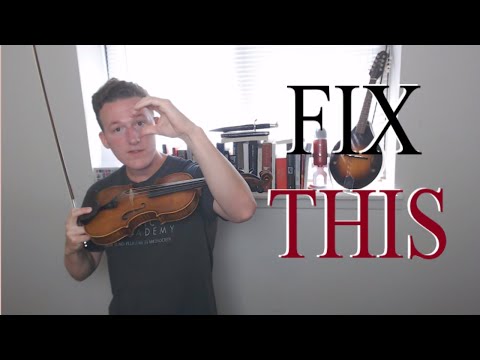
The Left Hand "Frame" Is a Trap (Why Your Pinky Hurts on Violin)
4.1K views · Apr 13, 2026 · People & Blogs

Comments · 50
@tomlockney895 · 5 months ago
Very well explained.
3
@ivrz · 5 months ago
Dont turn the scaffolding into a cage! <br>The thumb, in constant change
2
@DriveDetailCo · 3 weeks ago
Excellent explanation. So crucial, I find many adult students struggle with this concept.
@rl7651 · 2 months ago
I believe this is on the right track but from a Body Mapping perspective, you might want to consider/add the following: The movement in the left hand for the supination you describe originates in the shoulder joint (the glenohumeral joint) where the ball of the humerus (the upper arm bone) rotates around in the socket of the shoulder blade. After approximately 30 degrees of motion by the humerus in any direction the shoulder blade which connects to the collarbone will rotate as well. The shoulder blade wraps around sideways, not really up as the upper arm swings bringing along with it, the lower arm and the hand and therefore the fingers. This broader movement is what changes the shift in how the fingers appear over the string, especially when traveling in higher positions. The elbow joint allows for pronation and supination and extension and flexion. It is these movements at the elbow joint that allow you to balance each finger as you go up or down from one to the other on any given string. You do not need to separately attempt to twist the wrist to create pronation and supination. Let the elbow do that work just as it does in the right arm when you travel from tip to frog and back like pouring a pitcher of water to leverage weight into the string. As for the shoulder moving forward, we must be careful here, because if it moves forward and up and in, one risks narrowing the space in which the rest of the arm can reach up and over. Keeping the pectoral area more neutral and keeping a wider rotation actually frees up the arm to reach anywhere and with it the hand and the fingers which are, anatomically, considered a part of your whole arm. You will also notice movement in the first joint of the arm where the breastbone and collar bone meet, known as the sterno clavicular joint which is often not even thought of as part of the arm because most people think of the arm as just the upper and lower arm bones which is considered a mismapping, a misunderstanding of what the arm is, and what the functions are of its various parts.<br>Finally, it would be important for students to realize that the location of the fingers in the hand is what often makes them stretch for the fourth finger because it is the smallest finger and the furthest away, but the minute you let the elbow flex forward and swing from the glenohumeral joint, you gain the up and over balance of the fourth finger so its size and position in the hand becomes a non-issue. And the fourth finger, given its place in the hand is the best finger to pluck with for left hand pizzicato, because it can swing the furthest unlike the first finger which is "too close" to the string,
4
@Heather-f1t5h · 5 months ago (edited)
🎉🎉🎉🎉❤❤❤❤ like dancing. I applaud you for saying this, pointing it out in the way you did.
2
@sherom · 5 months ago (edited)
Thanks....I appreciate it.....I believe Ruggiero Ricci uses this concept
2
@nickiemcnichols5397 · 1 month ago
Joesph, thanks for this help! I’m a nurse, and I should have understood this body mechanics stuff from the beginning..,
@celinahuezo5518 · 3 weeks ago
Simple yet seems do effective and effortless. I can't wait to try this tomorrow morning. My hands are small and I struggle with pinky on g string. I learned from experimenting to move my thumb a little more to the right and more under the neck to help my pinky. Also instead of a straight thumb I slant it more to the left.
@anacristinadelmiro7347 · 5 months ago
Thank you for explain that...💚💛
1
@violinbite · 1 month ago
How do we approaches to deal with tenths interval double stops, especially in high position?
1
@ivrz · 5 months ago
Excellent presentation
1
@marygrant8715 · 2 months ago
This fits beautifully with how Kato Havas taught. Are you familiar with her work? She said violin movements are (or should be) natural and we know how to do them already.
1
Up next

21 Ways to Eliminate Tension and Transform Your Violin/Viola Playing
Wilhelm Magner · 61K views
Why Playing Violin Causes Pain and How You Can Fix It
Murphy Music Academy · 22K views

Finding your best personal left hand frame
Chia-Chien Goh · 5.9K views

Free your violin left hand: Mind the Gap
Nathan Cole · 28K views

Your Left Hand Is Holding You Back
The Violin Gym · 1.5K views

🚨 PLÖTZLICH ESKALIERT DIE RUNDE! Lisa Eckhart sagt EINEN SATZ – PUBLIKUM RASTET KOMPLETT AUS!
Scharfer Blick · 39K views

Something BIG Just Happened Over Lithuania… NATO Takes EMERGENCY ACTION
The Frontline Show · 106K views

The Real Reason You're Playing Out of Tune
Price Violin Academy · 10K views

Improve violin left hand (fast!) | Rodney Friend | Violin Masterclass
Beares Publishing · 51K views

The Voynich Manuscript Was Reanalyzed by AI - Nobody Expected the Findings
Quantumized · 78K views

EU Tells USA To BACK OFF! Dutch BAN Microsoft, Bonds COLLAPSE, Trump PANICS
House of El · 212K views

Why Your Hands Shake When You Perform (and the Move That Stops the Spiral)
Soulforce Arts Institute · 42 views

Balanced Violin Hand Frames (ft. Nancy Zhou)
tonebase Violin · 10K views

4 Ways to Build a RELIABLE Hand Frame
Jonathan Tanner Violin · 14K views

The Professor Who Taught People How To Think (1962)
ABC Science and ABC Australia · 2.9M views

Claude Took On the Riemann Hypothesis. Here’s What Actually Happened
Ellie Sleightholm · 487K views

Why Trying to Relax Makes You More Tense (The Real Fix)
Soulforce Arts Institute · 103 views

So, what are all these violin parts?!?
Cozy Clef Violin & Viola Studio · 60 views

Never miss a violin shift again
Nathan Cole · 68K views