Why KW and KVA Are NOT The Same Thing (Even If They Seem Like It)
992K views · Apr 21, 2025 · Education

Comments · 1.2K
@ThePirate1113 · 1 year ago
Hi German here. We have a funny analogy for this to explain to trainees: KVA as apparent power is like a nicly poored glas of bear 🍺 the hole including the foam is the apparent power, the foam is the reactive (wattless) power and the nice yellow liquid is the active power 🥴 cheers
467
@3cutiescousins · 12 days ago
I've been watching a lot of videos trying to understand kW vs kVA, but it finally clicked thanks to your video. Thanks
@PaulMorgan1 · 1 year ago (edited)
My favorite analogy for reactive power and power factor is pushing a kid on a swing. If you give the kid a push at just the right time, it's easy to get the swing to go up high. But if you give a push at the wrong time, it's wayyy harder or impossible to keep things swinging.<br><br>In the case of motors, you're essentially trying to slow down the motor with the load you have on it. So instead of the AC current "pushes" from the power company being perfectly in sync with it's movements, the load causes the motor to fight against that perfect timing. As a result, the power company is effectively pushing the kid at slightly the wrong time, resulting in wasted power that could have been useful if you had better timing.<br><br>That's the big reason there's a market for fancy motor controllers and power factor correction devices. You can actually fix the imperfect timing if you're smart about it, resulting in better efficiency. You do it intuitively in the swing example by watching and feeling, in electrical engineering we use carefully tuned inductors/capacitors and computer equipment to do the same thing.
149
@johnreyn19 · 1 year ago
My favorit analogy: KW = beer (actual power) KVA = beer + foam (apparent power)
106
@kayakMike1000 · 1 year ago (edited)
A watt is 1 joule per 1 second. A volt-amp is coulmbs per second scaled by volts. Volts are joules per coulomb, so the couldmbs cancel out.
15
@JeffClearwater · 1 year ago
It’s a good video but I encourage you not to use the words “storage or “capacity” when describing the KVA side. It’s not accurate and only confuses. “Storage” means energy with no flow- no current which is measured in KWH (rating of a battery). KVA is the measurement of supply side power before it is converted to useful work. Using “capacity” and “storage “ is a slippery slope.
227
@wb5mgr · 1 year ago
One thing, though, is that all of these items that you’re listing off like light ballast and most electronic equipment have built-in power factor correction if they are manufactured with any quality. The big item that you have to worry about is motor loads. But in most factories that have a lot of motor loads they also install automatic power correction, for those in order to bring the PF back up.
6
@LOX_LH2 · 1 year ago
A pretty good discussion of a very difficult topic. I have not seen better. Your practical applications help to clarify.
9
@newscoulomb3705 · 1 year ago
Thank you for this breakdown. I do a review model for public charging sites where I do assess the power available at the transformer level. For simplicity, I've always referred to the transformer power as "kW," though the the transformer rating is in kVA. What I am looking for in this is the total throughput or power available for the site, so kVA is the more accurate metric. <br>The other factor I am checking for is a discrepancy between the power supply and the rated output power of the chargers themselves. Most often, the transformer is rated for more power (kVA) than the total kW rated output power of the chargers themselves, though some providers (Tesla in particular) can have rated output power at their chargers that is more than double the rated power of the transformer. <br>Basically, checking the transformer enables me to know whether EV drivers will be seeing full, rated power when charging if the site is full or mostly full.
7
@tincanpete · 1 year ago
Best explanation I’ve heard on this subject. Many thanks!
16
@eengkb · 1 year ago
This is a good video. The power triangle is the most important thing to understand. Watts Real P is the X axis. VAR reactive is the Y and VA is vector sum (hypotenuse). When you're using real and imaginary numbers you can evaluate the rectangular sum or polar vector quantity in your head. With alternating current capacitors and inductors are reactive components and they store and release energy at different times. In perfect systems the real is the only part actually using real power, but you still need to account for the reactive components. It's why power factor correction is important because the power company still has to supply and transport the power in VA regardless of what is consumed and even if the load give it "back" every half cycle.
6
@sessionfiddler · 1 year ago
For extra confusion, add in Kv for the 3 phase motor rating of the number of RPM per volt of electricity.
1
Up next

Difference Between VOLTAGES - Why We Need Them All
Electrician U · 629K views

What the Heck is Reactance and Why is it So Weird?!?
Electrician U · 57K views

Why Put Diodes Together In Both Directions? Explained With Examples!
Mr Carlson's Lab · 947K views

The Most Confusing Part of the Power Grid
Practical Engineering · 3.2M views

Solid vs. Stranded Wire: The Difference Nobody Explains
History of Simple Things · 452K views

TRANSFORMERS - What They Are, How They Work, How Electricians Size Them
Electrician U · 435K views

What Is True RMS? Why Two Meters Can Read Differently
Electrician U · 53K views
The US electrical system is not 120V
Technology Connections · 3M views

Why Are Capacitors on Motors? What is Capacitive Reactance and Inductive Reactance?
Electrician U · 444K views

I Built a SOLAR FREEZER that reaches -48°C ❄️ DIY
The Liberty Engine Project · 1.6M views

How Inverters Turn Battery Power into AC
Prof MAD · 339K views
The Biggest Misconception About Electricity
Veritasium · 28M views

5 Formulas Electricians Should Have Memorized!
Electrician U · 1.5M views

How Do Electrical Harmonics Work?
Electrician U · 106K views
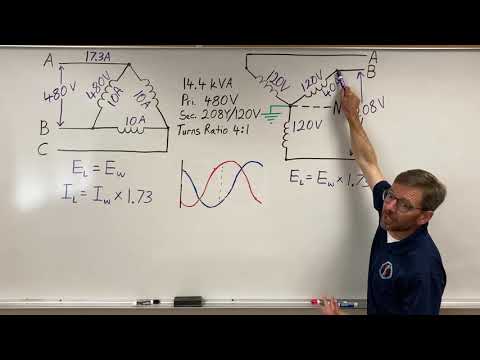
Delta and Wye - Volts, Amps, & VA
Dave Gordon · 674K views

Power Factor Explained – Your Electricity Bill Money Drain (Reactive Power)
The Engineering Mindset · 1.1M views

Voltage vs Amperage vs Wattage vs Ohmage?
Electrician U · 47K views
What Powers An Electron? The Answer Will Shock You
The Roger Physics · 360K views

This $12 OLD TV ANTENNA Pulls FREE Power From The Air (No Solar NEEDED!!)
Glen Pritchard · 1.3M views

Contactors: how we power the big stuff
Technology Connections · 1.6M views

How are AC and DC Electricity Different?
Math and Science · 61K views

Why Loose Wires Cause Fires: Why I Pre-Twist.
Electrician U · 71K views

Alternating Current, Motors, & Controls
CaptiveAire · 1M views

What Is Electricity Made Of According to Quantum Physics?
Sleep On Physics · 317K views

How Patton's Intelligence Chief Saw the Ardennes Attack Coming
WWII Untold Stories · 18K views

Power Factor Explained - The basics what is power factor pf
The Engineering Mindset · 2.1M views