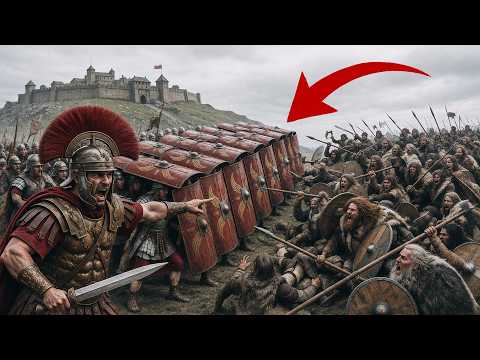
The Roman Soldier's Toilet Problem on March: What Do We Know? A Roman soldier marches twenty miles in five summer hours, carries sixty pounds on his back, and needs to relieve himself. In this section, we separate not where a soldier relieved himself on a march, but how much we know about it today, by looking at the march accounts of Josephus and Vegetius, toilets in permanent forts, pits remaining from temporary Roman camps, and the chemical analysis of the single pit at Hermeskeil. Is there a direct record describing what happened during the march? Was there a toilet in the fort? Could a pit have been dug in the temporary camp? What does Hermeskeil show, and what does it not show? Could a soldier have left his ranks? At each step, we separately state what the source says, our inference, and what we don't know.
The soldier, commander, and other people in the video are a reconstruction; their names, faces, and conversations are not in the documents. We have no source that we have read about what a soldier did during a march. Josephus wrote around the seventies AD and described Vespasian's army; Vegetius compiled the ancient rules in the fourth or fifth century, and twenty miles and sixty pounds are a measure of training. The castles are from Britain and the Netherlands, and Hermeskeil is from Germany between 58–51 BC; none can be directly adapted to Anatolia. We read the work of Haalebos, Kaye, and Hermeskeil through summaries or excerpts; the Hermeskeil text is a preliminary edition that has not been peer-reviewed.
SECTIONS
00:00 Twenty miles, sixty pounds, and the question
00:49 Part of the answer: no record
01:13 Four parts: authors, camp, castles, road
02:30 The soldier of our dreams
02:54 What is on the infantryman's back?
03:13 Departure and three trumpets
03:54 Vegetius and the measure of training
04:26 How many hours are five daylight hours? (calculation)
04:57 What is missing from the pages?
05:47 Permanent forts: Caerleon, Nijmegen, Housesteads
06:55 Wooden forts and Hod Hill
07:20 Longinus and the 'ad stercus' papyrus
08:07 The sponge stick and Seneca's letter
08:38 What came out of the toilets
09:23 Temporary camp: Josephus's account
11:31 Archaeology: camps that left no trace
12:42 Steve Kaye and the pits
13:49 Hermeskeil's only pit
15:26 Four warnings
16:05 What happened on the road? Three options
17:35 Why did predictions remain predictions?
18:29 What could fill this gap?
19:37 Let's summarize: certain, possible, unknown
21:01 If you were the commander? 22:17 Layer at Hermeskeil
SOURCES AND READING NOTES
• Flavius Josephus, The Jewish War 3.70–3.109 (translated by William Whiston): the march and camp of the army. • Vegetius, Epitoma rei militaris 1.9: military step, twenty miles, sixty pounds (via B. J. Whipp, S. A. Ward, M. W. Hassall, "Paleo-bioenergetics: the metabolic rate of marching Roman legionaries", Br J Sports Med 1998).
• J. K. Haalebos, "Romeinse latrines in de legioensvesting te Nijmegen en enkele andere militaire versterkingen" (1994): Caerleon, Nijmegen, Housesteads, Hod Hill, Alphen aan den Rijn et Oberaden.
• Seneca, Moral Letters 70.20: stick with sponge attached.
• Steve Kaye, "Roman marching camps in Britain: GIS, statistical analysis and hydrological examination of known camp sites" (undated PDF).
• "Pit Without Finds = Worthless Pit? Investigating a Roman Military Camp from Caesar's Gallic Wars (58–51 BC) Near Hermeskeil (Germany)" (preprint, abstract).
• Romans in Scotland, "Inside a Roman marching camp" (information page).
The images are drawings and animations illustrating the historical subject; they do not substitute for archaeological or legal documents.
#AncientRome #RomanArmy #Archaeology