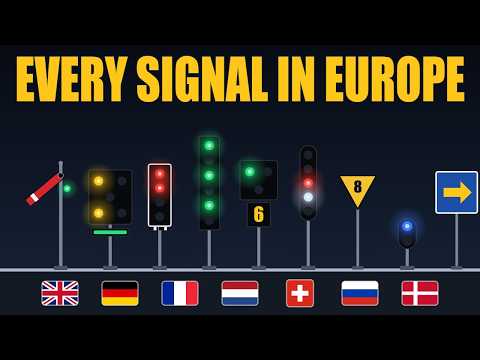
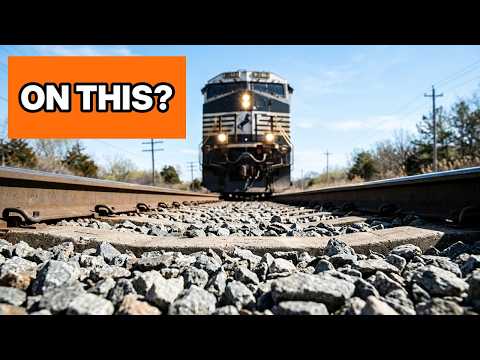
Why do train tracks have rocks? Why are the ties made of wood, why are rails shaped like an I, and how does a train steer with no steering wheel? Every weird detail of a railway, explained with real footage, one simple idea at a time.
Fourteen things you've seen your whole life and never understood: the gauge that isn't Roman, the clickety-clack that disappeared, why railroads set their own tracks on fire in winter, the sandbox, how a switch steers the train, how the rails know a train is coming, the horn pattern, the three lights, why a freight train needs a mile to stop, and why some engines ride in the middle.
0:00 A railway is full of weird details
1:02 01 · The rocks under the track
2:51 02 · Why the ties are wood
4:11 03 · Why rails are shaped like an I
5:45 04 · 4 ft 8½ in (not Roman)
7:33 05 · How trains steer with no steering wheel
9:01 06 · Where the clickety-clack went
10:45 07 · Why railroads set tracks on fire
12:02 08 · The sandbox
13:00 09 · How trains change tracks
14:07 10 · The rails are a wire
15:24 11 · The horn pattern
16:28 12 · Why three lights
17:28 13 · Why trains can't stop (and the air brake)
19:09 14 · Engines in the middle
20:37 Every weird detail, in one sentence
Which machine or building should we take apart next? Tell us in the comments.
SOURCES
Railway Tie Association, FAQ (wood share, ties per year): https://www.rta.org/faq/
Practical Engineering, "Why Are Rails Shaped Like That?" and "Why Railroads Don't Need Expansion Joints": https://practical.engineering/
Standard gauge, Stephenson, the Roman-chariot story and the 1886 change: https://en.wikipedia.org/wiki/Standar...
Track gauge in the United States: https://en.wikipedia.org/wiki/Track_g...
Rail neutral temperature (continuous welded rail): https://railway-news.com/what-is-rail...
Metra and the "tracks on fire" switch heaters (Trains.com): https://www.trains.com/pro/passenger/...
Rail fuel efficiency, 470 miles per gallon per ton (US DOT FRA): https://railroads.dot.gov/rail-networ...
Track circuit (William Robinson, 1872, fail-safe): https://en.wikipedia.org/wiki/Track_c...
Train horn rule, 49 CFR 222.21: https://www.ecfr.gov/current/title-49...
Locomotive headlights and auxiliary (ditch) lights, 49 CFR 229.125: https://www.law.cornell.edu/cfr/text/...
Stopping distance, Operation Lifesaver: https://oli.org/about-us/news/operati...
Railway air brake (Westinghouse, fail-safe): https://en.wikipedia.org/wiki/Railway...
Long freight trains and distributed power (National Academies, 2024): https://www.nationalacademies.org/rea...
FOOTAGE & PHOTO CREDITS
Pexels (free licence): 53 clips from Pexels contributors (railway, freight, crossing and yard footage).
Wikimedia Commons: Bote Rail (FEC ballast tamper-regulator, CC BY 3.0) · Geogast (Plasser & Theurer tamping machine, CC BY-SA 4.0) · Пинчук В.В. (aluminothermic rail welding, CC BY-SA 4.0) · Cjp24 (thermite rail welding, CC BY-SA 4.0) · Jan Beránek (man shifting a switch, CC BY-SA 3.0) · Devilreborn (MTR switch blades, CC BY-SA 3.0) · Scott Hiddelston (BNSF on Greenhorn Trestle, CC BY 4.0) · Beantowndude316 (Pan Am Southern freight, CC BY 2.0) · Nolannsheeehyy (Gevo air horn, CC BY 4.0) · Mega Trains Rail Productions (NJ Transit ALP-45DP, CC BY 3.0) · Bonnachoven (switch heating on the LIRR, CC0) · Saud (rail switch heater, CC BY-SA 4.0) · Lankyrider (buckled rails, Yarra Valley Railway, CC BY-SA 4.0) · Al*from*Lig (rails painted white, CC BY-SA 4.0) · Arnoldius (DB Museum rail section, CC BY-SA 3.0) · SCHolar44 (rail profiles, CC0) · Mikko J. Putkonen (concrete sleepers, CC BY 4.0) · Tony Webster (rail switch, CC BY-SA 2.0) · 4300streetcar (AAR knuckle coupler, CC BY 4.0) · Larry D. Moore (caboose, CC BY 4.0) · Harvey Henkelmann (Nathan M5 horn, CC BY-SA 3.0) · SonicGamingTV2019 (end-of-train device, CC BY-SA 4.0) · Greg Goebel (BNSF 7596, CC BY-SA 2.0).
Public domain: George Westinghouse (Joseph G. Gessford) · Westinghouse air-brake patent, 1873 (US Patent Office / DPLA) · George Stephenson (Lives of the Engineers) · Richard Feynman, 1959 · CN FP9 6506, 1971 (railfan 44) · G Line crossing signals (Lars Smiley).
Music: original, made for this episode. Narration: AI voice. No AI-generated images.