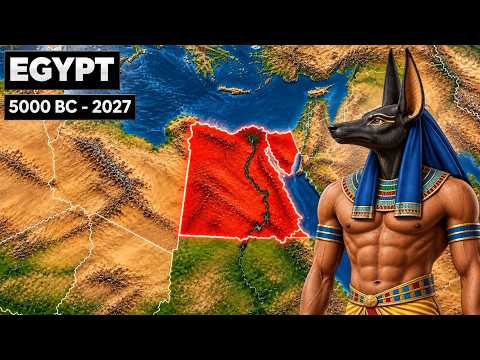
What happened to Egypt after the pharaohs? The entire history of Egypt in one map-led documentary, from the first kings on the Nile to Nasser, Sadat and the Nile dam today.
From the pyramids and the New Kingdom to Persian rule, Alexander the Great, the Ptolemies and Cleopatra; then Roman Egypt, Coptic Christianity and the Arab conquest of Egypt; Fatimid Cairo, Saladin and the Mamluks; Ottoman Egypt, Napoleon, Muhammad Ali and the Suez Canal; British rule, Nasser and the Suez Crisis, Sadat and Camp David, Tahrir Square in 2011, and the Ethiopian dam on the Nile today.
Who ruled Egypt after the last native pharaoh, and why did every empire want it? Period maps for each era and real archive images tell 5,000 years of Egyptian history.
Chapters
0:00 What happened to Egypt after the pharaohs?
0:24 The Nile and the first kingdom
1:53 The pyramids: who built them?
3:32 Collapse and the Middle Kingdom
4:25 The Hyksos and the New Kingdom
6:17 Akhenaten, Tutankhamun and Ramesses II
7:38 Bronze Age collapse and foreign kings
9:04 The last pharaoh and Alexander the Great
9:36 Ptolemaic Egypt and Cleopatra
11:04 Roman Egypt and Christianity
12:20 The Arab conquest of Egypt
13:17 Fatimid Cairo and Saladin
14:00 The Mamluks
14:54 Ottoman Egypt and Napoleon
15:47 Muhammad Ali and the Suez Canal
16:58 British Egypt and independence
18:22 Nasser and the 1952 revolution
19:58 Sadat, Camp David and modern Egypt
21:36 The Nile dam and Egypt today
22:14 After the pharaohs: what changed
Maps are simplified; ancient borders are approximate (hatched = influence, not rule). The Ahramat branch is one 2024 study's reconstruction. The Pharos and Library images are reconstructions.
What should we explore next: a country, a great leader, or a turning point in history? Tell us in the comments.
Sources & further reading
Shaw, I. (ed.), The Oxford History of Ancient Egypt (2000)
Baines, J. & Málek, J., Cultural Atlas of Ancient Egypt (2000)
Tallet, P. & Lehner, M., The Red Sea Scrolls (2021)
Ghoneim, E. et al., "The Egyptian pyramid chain was built along the now abandoned Ahramat Nile Branch", Communications Earth & Environment 5, 233 (2024), doi:10.1038/s43247-024-01379-7
Bryce, T., The Kingdom of the Hittites (2005)
Bowman, A. K., Egypt After the Pharaohs (1986)
Kennedy, H., The Great Arab Conquests (2007)
Petry, C. F. (ed.) and Daly, M. W. (ed.), The Cambridge History of Egypt, vols 1–2 (1998)
Fahmy, K., All the Pasha's Men (1997)
Images (Wikimedia Commons unless stated)
CC BY 2.0: Blue Nile Falls (Giustino); Caesar bust (Gautier Poupeau); Psamtik II (OliBac); Siwa oracle temple (Isabelle + Stéphane Gallay); Tahrir Square 2011 (Mona).
CC BY 3.0: Abu Simbel (Olaf Tausch); Deir el-Bahari (Olaf Tausch); Deir el-Medina (Olaf Tausch); Ibn Tulun Mosque (Berthold Werner); Philae (Marc Ryckaert); Red Pyramid (Ivrienen); Sultan Hassan Mosque (Berthold Werner).
CC BY 4.0: Cairo lithograph, 1840s (after David Roberts, Wellcome Collection); el-Sisi (Kremlin.ru).
Attribution licence: Kadesh treaty tablet (Giovanni Dall'Orto); Pharos reconstruction (Emad Victor Shenouda).
CC BY-SA 2.0: Axe of Ahmose I (Heidi Kontkanen); Cairo Citadel (Ahmed Al.Badawy); Giza pyramids (Ricardo Liberato).
CC BY-SA 2.0 FR: Amarna letter (Rama).
CC BY-SA 2.5: Akhenaten (José-Manuel Benito); Horus and Nectanebo II (Keith Schengili-Roberts); Tanis 1878 (B. Strassberger); bakery model (Keith Schengili-Roberts).
CC BY-SA 3.0: 1979 treaty signing (Yaakov Saar); Aswan High Dam (Sharaf al-Din); Bab Zuwayla (JMCC1); Deir el-Bahari terraces (Neithsabes); Great Pyramid (kallerna); Hatshepsut statue (Postdlf); Medinet Habu (Rémih); Mentuhotep II (Khruner); Mosque of Amr (Buyoof); Nasser (Stevan Kragujević); Nile in Cairo (Ghaly); Ostia grain-ship fresco (Sailko); Pyramid of Djoser (Wknight94); Ramesses II bust (Wikimedia Commons contributor); Saladin portrait (Sailko); Tutankhamun mask (Bjørn Christian Tørrissen); boat model (Sripr.80).
CC BY-SA 3.0 FR: Seated Scribe (Rama).
CC BY-SA 4.0: Al-Azhar (Daniel Mayer); Bent Pyramid (Daniel Mayer); Hanging Church (Daniel Mayer); Khufu statuette (Djehouty); Mark Antony bust (unknown photographer); Memphis (Zemanst); Nile fields (Raimond Spekking); Rosetta Stone (Hans Hillewaert); Sphinx of Taharqa (Prioryman).
Public domain / no known restrictions (47): archive photos, paintings and documents via Wikimedia Commons, The Met Open Access, the U.S. National Archives and NASA.
Film: Universal Newsreel, 30 July and 1 November 1956 (public domain, U.S. National Archives).
Maps: Natural Earth (public domain); borders drawn by us from the sources above.
Music and sound (CC BY 4.0, freesound.org): "slow atmosphere 2.wav" by ERH (32332); "Epic Orchestral Strings" by TheoJT (511196); "Epic Orchestral Battle/Film Score" by Leonard.B.Blaesing (527314); "Gentle beautiful piano music…" by kjartan_abel (532774); UI clicks by Erokia (470201) and FiveBrosStopMosYT (537025, 537029).
#history #egypt #documentary