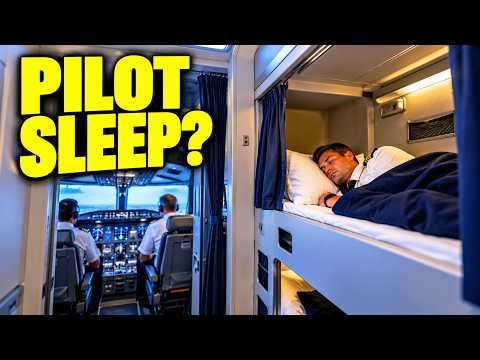
What REALLY happens on the world's biggest passenger plane while hundreds of people are sleeping?
At 3 AM, the cabin of an Airbus A380 is quiet. Passengers are asleep, the lights are dimmed, and thousands of feet below, the world is completely dark.
But behind the scenes, this giant aircraft is anything but asleep.
While you rest, flight attendants remain on duty, the cabin's air is constantly renewed, engines generate performance data, and crews prepare for everything from medical emergencies to unexpected turbulence.
In this Flying Citys documentary, we follow what happens aboard the Airbus A380 during a long overnight flight, hour by hour.
HERE'S WHAT HAPPENS WHILE YOU SLEEP:
HOUR 1 — The Lights Go Down
How the Airbus A380 uses cabin lighting and 15 temperature zones to keep passengers comfortable.
HOUR 2 — The Air Never Stops
Why cabin air is renewed approximately every 2–3 minutes and how HEPA filters work.
HOUR 3 — The Engines Are Monitored
How Rolls-Royce engine health monitoring helps engineers identify potential problems.
HOUR 4 — Unexpected Turbulence
Why keeping your seat belt fastened while sleeping can prevent serious injuries.
HOUR 5 — Medical Emergencies
How cabin crew and doctors on the ground respond when a passenger becomes ill.
HOUR 6 — Inside the Giant
The incredible engineering behind the world's largest passenger aircraft.
HOUR 7 — The Aircraft's Hidden Records
How the A380 became one of aviation's most recognizable passenger aircraft.
HOUR 8 — The Final Descent
Why turbulence risks don't disappear when the flight is almost over, and how airlines prepare an A380 for its next departure.
THE NUMBERS BEHIND THE A380:
Up to 853 passengers in its maximum certified seating configuration
545 seats in a typical four-class configuration
15 separate cabin temperature zones
Cabin air renewed approximately every 2–3 minutes
Four powerful jet engines
A wingspan of almost 80 metres
A standard turnaround target of approximately 90 minutes under Airbus planning assumptions
We also examine research from the U.S. National Transportation Safety Board, which found that flight attendants made up the majority of people seriously injured in turbulence-related U.S. airline accidents during its 2009–2018 study period.
And we explore why one simple habit matters so much when you're trying to sleep at 35,000 feet.
The next time you fall asleep on a long-haul flight, remember: the passengers may be sleeping, but the aircraft and the people operating it are still hard at work.
Subscribe to Flying Citys for more aviation secrets, Airbus A380 documentaries, flight attendant stories, airline operations, and behind-the-scenes looks at the world's biggest planes.
QUESTION: Do you keep your seat belt fastened while sleeping on a plane?
#AirbusA380 #AviationSecrets #FlyingCitys
---
MUSIC & VISUAL CREDITS
Music:
"Welcome to HorrorLand" Kevin MacLeod (incompetech.com)
Licensed under Creative Commons: By Attribution 4.0 License
http://creativecommons.org/licenses/b...
Music source:
https://incompetech.com/music/royalty...
Images and footage: Wikimedia Commons, Pexels, Pixabay and other online archives and sources. Some visuals are AI-generated.
SOURCES & FURTHER READING
Airbus — A380 Aircraft Overview:
https://www.airbus.com/en/products-se...
Airbus — A380 Facts and Figures:
https://www.airbus.com/sites/g/files/...
Airbus — Health Onboard:
https://www.airbus.com/en/safety/heal...
Rolls-Royce — Engine Health Monitoring:
https://www.rolls-royce.com/products-...
NTSB — Preventing Turbulence-Related Injuries:
https://www.ntsb.gov/safety/safety-st...
New England Journal of Medicine — In-Flight Medical Emergencies:
https://www.nejm.org/doi/full/10.1056...
This video is an educational overview. Aircraft configurations, crew procedures and operating conditions can vary between airlines and flights.