Premium Bible Terminology – Over 40 Terms Explained!
58K views · Aug 27, 2024 · People & Blogs

Comments · 174
@michaelmurphy2234 · 2 years ago
"Yapp" was named for the 19th Century British bookbinder William Yapp who introduced the technique for pocket-sized Bibles, this form of binding is still quite common for contemporary Bibles.
43
@shawnglass108 · 2 years ago
He did mention that Humble Lamb is out of Kentucky but they have their Bibles printed and bound in China. That is important to some of us.
14
@josiahcooper · 2 years ago
I thought I had a premium bible until I saw this video. I now realize I have been driving a Civic thinking it was a Bentley
108
@samaranatha · 1 year ago
When I first read “full yapp” I assumed it was a translation of the Bible with extra words lol. Yapp as in talk a bunch lol
20
@ianmichaelsmith · 2 years ago
A few nitpicks: Namely about head & tail bands, spine hubs, yapp, smythe-sewing, glue & 'perfect binding.' <br><br>Head and tail bands used to serve a structural purpose in book binding. the hinges at the top and bottom of the book were structurally some of the weakest in the overall product, head bands were literally sewn into the binding of the book adding additional strength. This is still done in some fine book-binding, and can be quite elegant, but is overall time consuming. The effect, and added protection from dust and mold could be achieved much more cheaply by glueing in a false head-band and tail-band. This is now the standard.<br><br>The same is true with spine hubs. Before the modern Smythe-sewing machine, book bindings were hand sewn. They would actually be sewn around a jig that had several pieces of twin, leather, or rope as the hubs for the binding. These would later be covered over with the outer leather cover material, but underneath they were largely structural. To keep the aesthetic they have gone to gluing in pieces of rubber or leather. <br><br>The yapp or circuit on a leather bible was an innovation (much like page gilting) meant to protect the page edges. In the 20th Century most people take cars to church, but in the past people would walk with bible in hand to church, and have to face the elements; this was a nice added touch that kept bibles meant to be carried safe from the elements. Bibles meant for study or home use tended to be hard backed, and often features metal clasps to help the book keep shape. Soft leather bibles with yapps are a later development (largely of the 19th century).<br><br>Smythe-sewing is actually a brand name; it is the name of a book binding machine that sews together signatures with great rapidity, and at a high quality. This innovation revolutionized book publishing, and today, almost any mass produced book bound with signatures is smythe-sewn. <br><br>This is in opposition to its main competitor, 'perfect binding,' that is, individual leaves of paper glued together without any signatures or sewing. This is actually the standard in paper back publishing and in much of the modern print world. 'Perfect binding,' is a bit of a misnomer, because 'glued,' or 'perfect bindings,' are less structurally durable than a sewn binding by their very nature. Individual pages can come loose, destroying the book's integrity. <br><br>However, both smythe-sewn books and perfect bound books use copious amounts of glue in their binding. In fact, in the case of a smythe-sewn book, after a generous amount of glue is applied to the signatures, it isn't uncommon for them to be sanded down to create a more consistent spine, removing some of the stitching (but since the glue is there, it remains structurally sound) before book tape and other spine materials are applied.<br><br>I would encourage you to go watch some book restoration videos on youtube (or custom book binding), to get a better idea of how books were traditionally bound, and how many aesthetic choices in premium bibles today are more or less vestigial tails left over from these previous methods being eclipsed by modern technology and mass production.
18
@agnewikistuff · 1 year ago (edited)
I can see the practical protective element of a trained full yapp, but the aesthetics don't jump out to me and they feel unnecessarily cumbersome when I pick them up and carry. But I appreciate learning more about the immense craftsmanship and thought that goes into the production of these Bibles. <br><br>Edit to add - I'll check your channel to see if you ever made that video on the complexity of Bible paper but, if you haven't yet, add me to the list of fans who would love to see that vid!
7
@tedyesca · 1 year ago
The most premium Bible is read and studied one.
8
@viperviperpiro · 1 year ago
i just learnt 40 terms in my first day into Premium Bibles. BTW, I am still looking for a premium Bible. This video really speed up my learning. Thanks Tim.
7
@TiaWiggins · 1 year ago
It would be interesting for you to cover the different types of leather used to make premium Bibles. I've heard that goatskin is common, but I don't know why. And also the different weights (thicknesses) used. I've recently started getting into leathersmithing, so all of these things are on my mind.
6
@sojourner57 · 1 year ago
As a pastor, I'm more interested in the way the INSIDE of the Bible is laid out, along with various helps such as footnotes, commentary, cross-references and articles. Yes of course, those things all apply to STUDY Bibles, but that's mostly what I buy, and I enjoy reading through the Bible with a different version every 9-12 months. Lots to chew on here, but many of these would be out of reach of most pastors on a budget. A car can be basic transportation or a luxury. I never thought of Bibles that way, but they're meant to be digested on the journey, not looked at on a shelf. At least that;s my opinion. Great video!
7
@kyt_teacher · 1 year ago
Much appreciated! Thank you! I’m deaf and have to rely on subtitles. I was confused by “colorway” until I saw this. To be honest, the CC is not always accurate and this helped me understand what you’re talking about!
5
@sillyrabbi64 · 2 years ago
The Oxford Hollow is triple-width, not double. 👍
5
Up next

Building My PERFECT Bible
Tim Wildsmith · 58K views

If Bible Publishers Let Me Take Over… This Is What I’d Do 👀📖
Tim Wildsmith · 22K views
A Simple Tool to Help You Memorize More Scripture | MeePlus Mini Reporter EDC Notebook
Be Found Faithful · 170 views

Is This a Reason NOT to Trust the ESV?
A Nickels Worth Bible Reviews and Christ In Focus · 27K views
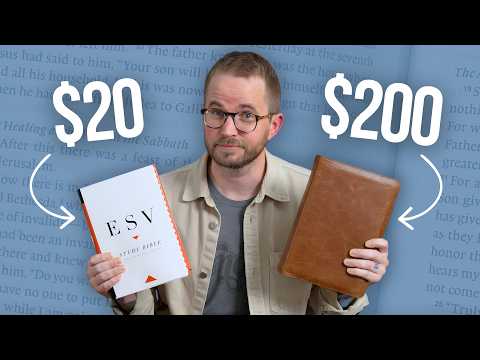
$20 Bibles vs $200 Bibles — What’s the REAL Difference?
Tim Wildsmith · 83K views

Do You really need a Premium Bible?
Sword & Banner Press · 7.5K views

Why So Many Bible Translations/Which One is Best? (ft. Mark Ward)
Sean McDowell · 195K views

A New Bible Rebinder You Need to Know About (Foundry Bibles)
Tim Wildsmith · 12K views

Mailbag 📬 Answering YOUR Questions About Bibles, Tattoos, and More!
Tim Wildsmith · 14K views

Rebinding a Bible from Start to Finish | ASMR
Sofield Leather · 175K views

Why Bible Typography Matters
Ward on Words · 34K views

If I Could Only Keep 3 Bibles... Toughest Choice Ever!
Tim Wildsmith · 175K views

Bible Features We Love and Our Favorite Bible Translations!
A Nickels Worth Bible Reviews and 2 more · 15K views

The Evolution of the Most Printed Book in History
Moon’s Rare Books · 316K views

How to Repair your Bible: THE RIGHT WAY
KEEP PREACHING · 103K views

Bible Translations Ranked by a Pastor
Discipled Daily · 829K views

7 of the Most Commonly Misunderstood Bible Verses
Melissa Dougherty · 106K views

Bible Publishers Tier List (2025)
Tim Wildsmith · 75K views

Issues with English Bible Translations | Dr. Mark Ward
Wes Huff · 213K views

I ordered these Ethiopian Bibles with "1,700 books" from Amazon...
DiscipleDojo · 392K views