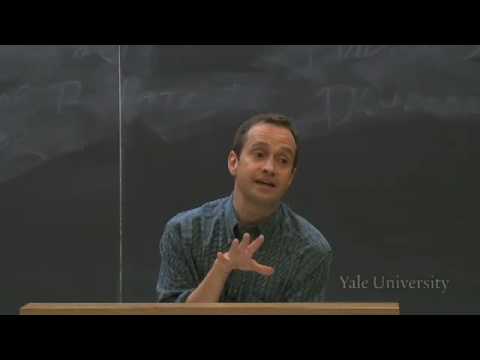
Hamlet (2 of 3)
37K views · Aug 19, 2014 · Education

Comments · 34
@clairerobsin · 6 years ago
how meaningful, cogent your lectures are for me Prof. Cantor, having spent so much time over these last 30 years wandering about that Mansion of Shakespeare's plays presented by the BBC.
7
@SleepingDogVideo · 8 years ago
My impression is that when Hamlet says "get thee to a nunnery" he is trying to push away and protect Ophelia from the repercussions of his plotting at court (and possibly avoiding her being used against him, or being hampered by concern for her). He cannot simply ask her to go (they are overheard; she may refuse). He is acting 'mad' at this point, I gather.<br><br>Professor Cantor's view on a persistent strain of despondent Christianity in Hamlet seems contradicted by his wide and various friendships (with palace guards, players, fellow students and so on, and not least with Ophelia): he seems well-adjusted and well-liked before seeing his father's ghost during his period of grieving. This event changes him, perhaps strengthens his belief in life after death, and brings home the unpleasant responsibilities of his position for the first time.<br><br>I agree that the play is concerned with the problem of other minds (or a difficulty in peering into other people's souls), but I would interpret Shakespeare's deep interest here is in miscommunication: how often custom (like courtly language) or social difference or deceitful intent (and on and on) get in the way of clear and accurate communication and meeting of minds.<br><br>There is also, I think, more than a simple contrast between Christian piety and pagan heroic virtue. Paris represents a more hedonistic, flamboyant worldview; and Wittenberg something of the more rational, philosophic, sober worldview. Both of these were represented since ancient times too. I suppose for teaching purposes some simplification helps guide the discussion.<br><br>Aside from that, I think this lecture is full of profound and entertaining insights, and I'll have to revisit Hamlet.
20
@brianonuanain7535 · 1 year ago
Not sure about Horatio's agnosticism. Upon hearing, "Something is rotten in the state of Denmark", Horatio's response is: "Heaven will direct it". (RIP Prof.)
1
@jamesduggan7200 · 8 years ago (edited)
A strange play Hamlet is: Much of the important action is invisible or occurs offstage. The pirates are crucial. They represent the followers of Hamlet, the faction that would see him as King, the opposites of characters like Osric, Guildenstern, and Rosencrantz. And, ofc they are the catalyst who complete the transformation of Hamlet into action hero. Also, apparently only those friendly to Hamlet can see the ghost of his father, who defeated Old Norway, and died at his brother's hand.
5
@zevshanken548 · 10 months ago
Brilliant and fun
@robertarmitage1899 · 9 years ago (edited)
The point about Denmark and Norway, in which Hamlet talks about Fortinbras becoming the next king of Denmark, could have had subtle messages to the early audiences of the play. Those would have had nothing to do with the actual political realities that existed, at the time, concerning Denmark and Norway, as the latter had been under the former's rule for over two hundred years: Danish nobility, in that period, ousting most Norwegian nobility, as land holders. They might, however, have had to do with how those countries are presented in the play, as two neighboring and often warring nations. England and Scotland fit that description perfectly. The early 16th century had seen Anglo-Scottish wars and border raids, on both sides, were still endemic. When Hamlet was first performed Elizabeth 1st was on her last legs and it was illegal to talk about the succession. There were other claimants to it, but James VI of Scotland, had, as the great grandson of Henry VIII's oldest sister, the strongest one. Therefore Hamlet's support of Fortinbras could have been Shakespeare, or whoever wrote the plays, giving a hidden hint in support of James becoming James 1st of England. The lectures are about Shakespeare and politics and the political reality, when "Hamlet," was first staged was one could not be too open in what he or she said about sensitive political situations. Just a thought.
12
@williepura6433 · 4 years ago
how prophetic!
@mediatapwater · 6 years ago
While Hamlet’s indifferent to Denmark, he doesn’t like Denmark, yet he desires to be king and in power.
@rogerevans9666 · 5 years ago
@<a href="https://www.youtube.com/watch?v=WY5OSdwlclg&t=1560">26:00</a> Dear Prof. Cantor, I have recommended your videos to my Roman history professor and his students. very well done, friendly, warm, good speaker
3
@jamesduggan7200 · 8 years ago (edited)
A more complete formulation, as has been well-known for many decades, is that Shakespeare's tragic heroes fail because they're in the wrong plays. Switch Hamlet and Othello, switch Hamlet and Romeo, switch Lear and MacBeth, etc. So, it's not just that Hamlet is in the wrong place at the wrong time, it's part of Shakespeare's tragic formula.
2
@provisionofgrief1473 · 2 years ago (edited)
<a href="https://www.youtube.com/watch?v=WY5OSdwlclg&t=930">15:30</a> Whoah!!!! I never caught that before. Hamlet says "your" not "our" or "my". Sir, in thy Hamlet lecture be all my lit failings remembered. Get me to English Lit 101 for why would I be considered a Hamlet fan.
1
@HighMaintainanceMachine · 2 years ago
😊
Up next

Hamlet (3 of 3)
Shakespeare and Politics · 27K views

Coriolanus (1 of 3)
Shakespeare and Politics · 25K views

Kenneth Branagh interview on "Hamlet" (1996)
Manufacturing Intellect · 198K views
The Merchant of Venice (3 of 3)
Shakespeare and Politics · 19K views

Macbeth (2 of 3)
Shakespeare and Politics · 29K views

Harold Bloom interview on "Hamlet" (2003)
Manufacturing Intellect · 307K views
Philip Yancey: "Two Themes That Haunt Me: Suffering & Grace" 2015 Capps Lecture at UVA
theologicalhorizons · 3.5K views
Hamlet Revisited: An Online Discussion with David Bevington
The University of Chicago · 13K views

Ludwig Wittgenstein's Philosophy - John Searle & Bryan Magee (1987)
Philosophy Overdose · 174K views

Immanuel Kant's Philosophy - Bryan Magee & Geoffrey Warnock (1987)
Philosophy Overdose · 303K views

Henry V (1 of 3)
Shakespeare and Politics · 29K views

Macbeth (1 of 3)
Shakespeare and Politics · 70K views

Prof. Harold Bloom - Interview: Hamlet - Poem Unlimited - Conference: The Genius of Hamlet - 4K
Shakespeare Network · 2.9K views

How liberals monetized trauma | Catherine Liu on Marx, Trump, and identity politics
The Institute of Art and Ideas · 861K views

Discovering Hamlet (Theatre Documentary)
Perspective · 54K views

Paul Cantor on the "Shakespeare Authorship Question"
Conversations with Bill Kristol · 32K views

The Tempest (Lecture 1 of 2)
Shakespeare and Politics · 47K views

Theatre Conversations: Understanding Shakespeare's Hamlet
Kennedy Center Education Digital Learning · 1K views

Introduction to Shakespeare and Politics
Shakespeare and Politics · 39K views

Othello (3 of 3)
Shakespeare and Politics · 16K views

Why does Hamlet delay? [Torrey Honors Institute]
Biola University · 25K views

AI has hacked the code of human civilization | Yuval Noah Harari
Yuval Noah Harari · 1.3M views

William Shakespeare, Macbeth, Act 1
Dr Scott Masson · 1K views

Fall Asleep to the Life and Philosophy of Plato Full Documentary
Nighttime Biographies · 166K views
Harold Bloom Lecture on Shakespeare
Electric Cereal · 188K views
9. Paradise Lost, Book I
YaleCourses · 200K views