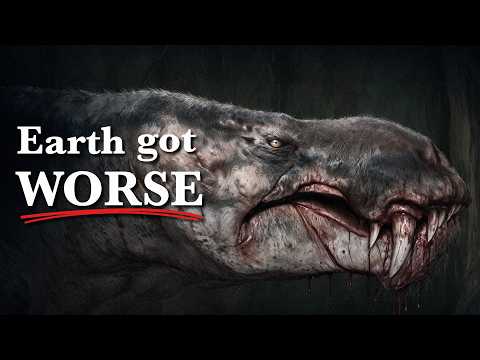
Around 234 million years ago, the hot, dry supercontinent of Pangaea entered a climate crisis that lasted nearly two million years. In the Italian Alps, rocks from before it hold no dinosaur footprints at all. A few million years after it, dinosaurs make up more than 90 percent of the tracks.
▶ WATCH NEXT: Why a 10,000-Pound Robot Can Land on a Lak...
▶ FULL SERIES PLAYLIST: Why on Earth: Full Nature & Science Docume...
Before the rain, the land belonged to squat, parrot-beaked rhynchosaurs, tusked dicynodonts, and crocodile-line predators known as pseudosuchians, while the earliest dinosaurs stayed small, rare, and penned into the southern latitudes. Then, partway up red Triassic cliffs in England, Germany, and Morocco, geologists found a dark band of river sand and gray mud, in places with coal and fossil tree resin. Known as the Carnian Pluvial Episode (about 234 to 232 million years ago), it is linked to the Wrangellia flood basalts: at least a million cubic kilometers of lava erupted far out in the Panthalassa Ocean and later carried onto the edge of Alaska and western Canada.
In this video: the three chemical fingerprints pointing to Wrangellia (light carbon, mercury, and osmium) and why the case is strong but not closed; how river mud and dead zones brought down the old reefs of the Tethys while modern-style coral reefs rose; how peat swamps ended the Triassic coal gap; what scientists found in 70,000 tiny droplets of Italian amber; what synchrotron scans of fossil droppings from Poland show about who ate what; and why footprints need a cold, critical eye.
CHAPTERS
0:00 The gray scar in the red cliffs
2:18 Pangaea before the rain: who ruled the dry world
5:45 The Wrangellia trigger and its three fingerprints
10:40 One wet layer, everywhere geologists looked
12:57 When the rain reached the sea
15:19 The coal gap closes, and 70,000 amber droplets
17:36 What the droppings really show
20:32 The dinosaur breakout: Argentina and the Dolomites
25:14 How the rain shut off, and the dawn of the modern world
SOURCES
Simms & Ruffell (1989), Geology — doi.org/10.1130/0091-7613(1989)017%3C0265:SOCCAE%3E2.3.CO;2
Dal Corso et al. (2020), Science Advances — doi.org/10.1126/sciadv.aba0099
Bernardi et al. (2018), Nature Communications — doi.org/10.1038/s41467-018-03996-1
Lu et al. (2021), PNAS — doi.org/10.1073/pnas.2109895118
Mazaheri-Johari et al. (2021), Scientific Reports — doi.org/10.1038/s41598-021-96890-8
Tomimatsu et al. (2021), Global and Planetary Change — doi.org/10.1016/j.gloplacha.2020.103387
Sun et al. (2016), Earth and Planetary Science Letters — doi.org/10.1016/j.epsl.2016.03.037
Zhao et al. (2025), Nature Communications — doi.org/10.1038/s41467-025-61262-7
Klausen et al. (2019), Geology — doi.org/10.1130/G45507.1
Schmidt et al. (2012), PNAS — doi.org/10.1073/pnas.1208464109
Griffin et al. (2022), Nature — doi.org/10.1038/s41586-022-05133-x
Qvarnström et al. (2024), Nature — doi.org/10.1038/s41586-024-08265-4
Sulej & Niedźwiedzki (2019), Science — doi.org/10.1126/science.aal4853
ABOUT THIS VIDEO
This video was researched and written by Why on Earth for educational purposes. The rain was not one nonstop storm: researchers describe about four humid pulses, and some interiors may have grown drier. The Wrangellia link is the leading explanation, not a settled verdict, because the basalts are hard to date precisely. Footprint percentages come from the Southern Alps, and the diet evidence comes from Poland, mostly millions of years after the rain. Dinosaur-dominated ecosystems took some 30 million more years.
Narrated with an AI voice.
AI-generated scenes are artist's impressions based on scientific descriptions, not real footage; real photos, maps, and footage are credited below.
Image and footage credits (full list with links in the pinned comment):
• CC BY 4.0 — Qvarnström et al. (2024), Marie-Lan Taÿ Pamart, Ola Myrin, Olivier Dugornay / Ifremer, Armin Reindl, Bilovitskiy, Desojo et al. (2020), Haunost et al. (2021), Ifremer, Jeffrey Beall, Korinna, Margulis-Ohnuma et al., Skoracka et al. (2018), Tavo Romann
• CC BY 2.0 — James St. John, mark byzewski, Alicia Nijdam, Dallas Krentzel, Frank Kovalchek, Grand Canyon National Park, jxandreani, Kabacchi, Kentaro Ohno, UCL Mathematical & Physical Sciences, Zion National Park
• CC BY 3.0 — Hannes Grobe / AWI, Bionerd, Heiko Sonntag
• CC BY 2.5 — Tony Wills
• Public domain / CC0: NASA (Blue Marble, MODIS, Landsat, ISS and Space Shuttle photos), NOAA / National Science Foundation (West Mata undersea eruption), USGS, U.S. National Park Service, BLM Alaska, Simon Cobb and other Wikimedia Commons contributors
• Stock footage: Pexels and Pixabay contributors
Music: Artlist (licensed) · YouTube Audio Library — When We Found The Horizon (Late Night Feeler, end screen)
#dinosaurs #triassic #earthhistory