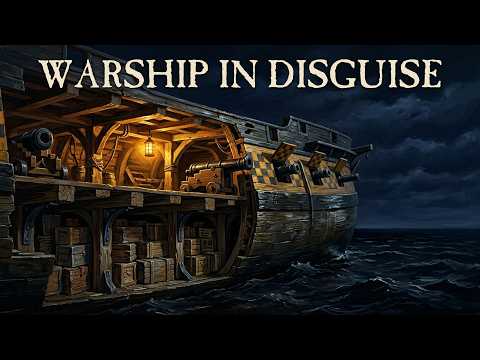
How did a pine-planked merchant ship with a deck barely thirteen and a half feet wide carry twice the cargo of an armed foreign galleon, sail with a third of the crew, and legally erase half of its royal customs tax at the cannon-lined throat of the Baltic Sea?
In this feature-length naval engineering and maritime history documentary, we dissect the 1595 Dutch Fluyt—the pear-shaped cargo hull designed by Pieter Janszoon Liorne at Hoorn that turned King Frederick II's 1567 Elsinore Sound Toll formula against itself. Drawing on the Sound Toll Registers Online (1.8 million recorded passages from 1497 to 1857), Cornelis Corneliszoon van Uitgeest's 1597 wind-powered crankshaft sawmill patent at Zaandam, Nicolaes Witsen's 1671 Aeloude en Hedendaegsche Scheeps-Bouw en Bestier, Cornelis van Yk's 1697 De Nederlandsche Scheeps-bouw-konst Open Gestelt, Sir Walter Raleigh's 1603 Observations Touching Trade and Commerce, Sir William Petty's 1676 Political Arithmetick, and deep-water Baltic archaeological surveys of the 1636 Gulf of Finland Fluyt wreck and the 1709 Dalarö wreck Anna Maria, we trace how an unarmed, flat-bottomed machine captured 45% of all European shipping—and why that same disarmament became a fatal strategic trap in the First Anglo-Dutch War (1652–1654).
Primary Sources & Archival References:
• Sound Toll Registers Online (STRO, Rigsarkivet Copenhagen / University of Groningen, 1497–1857; 1567 Lastgelt deck-beam formula & 1647 Christianopel Treaty re-measurement)
• Nicolaes Witsen — Aeloude en Hedendaegsche Scheeps-Bouw en Bestier (Amsterdam, 1671; Fluyt hull ratios, shell-first clamping cleats & timber dimensions)
• Cornelis van Yk — De Nederlandsche Scheeps-bouw-konst Open Gestelt (Delft, 1697; Zaandam shipyard ergonomics & pine vs. oak construction)
• Cornelis Corneliszoon van Uitgeest — States-General Patent for the Wind-Powered Crankshaft Sawmill (December 1597; Het Juffertje, 1596)
• Sir Walter Raleigh — Observations Touching Trade and Commerce with the Hollander, and Other Nations (1603; 10–12 vs. 30 crew comparison)
• Sir William Petty — Political Arithmetick (written c. 1676, published London 1690; European merchant fleet tonnage breakdown: Dutch 900,000 tons / 45%)
• Badewanne & Finnish Heritage Agency — 2020 Gulf of Finland 85 m Anoxic Fluyt Wreck Survey (1636 'Swanen') & Vrak Museum Dalarö Survey (1709 'Anna Maria')
Plotting a course through history’s darkest waters.
Welcome to Dead Reckoning. In navigation, "dead reckoning" is the process of calculating your current position by using a previously determined location. In history, it’s how we trace the fatal missteps, the bloody mutinies, and the tactical blunders that left thousands at the bottom of the sea.
We don't just recount maritime myths; we investigate the brutal reality of the Age of Sail. From the golden era of piracy and outlaw empires to the chilling mysteries of ghost ships and uncharted shipwrecks, we dissect the logic and the madness behind history's most terrifying maritime events.
Expect cinematic storytelling, tactical breakdowns, and deep dives into the weird, dark, and unforgiving history of the ocean.
Subscribe and join us as we navigate the abyss. The sea reveals its secrets only to those who dare to look.
━━━━━━━━━━━━━━━━━━━━
Visual & Archival Disclosure: The illustrations in this documentary are AI-generated oil paintings that interpret verified historical and naval engineering records; they are not period images.
Which ship, gun deck, or forgotten naval engineering gamble should we board next? Tell us in the comments below.
#NavalHistory #AgeOfSail #MaritimeHistory
0:00 - The 13.5-Foot Deck at Kronborg & The Sound Toll Paradox
3:15 - Pieter Janszoon Liorne (1595) & The Pear-Shaped Hull Geometry
9:22 - The Wind-Sawmill of Zaandam & Shell-First Assembly Line
15:19 - 12 Men vs. 30: Pulley Ergonomics & Pine Hull Economics
20:44 - 900,000 Tons: How the Fluyt Captured 45% of European Shipping
27:20 - 85 Metres Deep: Baltic Ghost Wrecks (1636 Swanen & 1709 Anna Maria)
32:38 - The Unarmed Monopoly Trap: 1,500 Prizes & The 1653 Warship Decree