Oldest Bible Manuscripts
1.2M views · Mar 4, 2022 · Education

Comments · 3.8K
@UsefulCharts · 4 years ago (edited) · pinned
Start your 14-day free trial with MyHeritage: <a href="https://bit.ly/UsefulChartsMyHeritage">https://bit.ly/UsefulChartsMyHeritage</a>
136
@soloexperiencer · 4 years ago (edited)
I am not at all religious, but I always enjoy these "biblical" videos immensely, simply due to the amount of careful research put into them, and the precise and calm manner it is presented in. Science at its best. Excellent work, Mr Baker, as always!
1.7K
@harrisonshone7769 · 4 years ago
The sheer amount of historical information that has been lost and will likely never be found again is depressing. Even preserving the smallest fragment surviving from a source over 1700 years old is an absolute treasure.
881
@rickandbonnie4689 · 2 years ago
Since the Church Fathers quoted books in the NT, it would be nice to have a chart of their manuscripts.
285
@giordy9013 · 4 years ago
I really couldn't ever get bored of those videos about biblical history, hope you'll do many more, like this on biblical and apocrypha scrolls or about a specific book just like a deeper presentation of what you already did with the series who wrote the bible, you're really good at explaining and entertaining
743
@ThePerfectPlan007 · 4 years ago (edited)
There are many important points overlooked here. Papyrus (Plant material) Manuscripts would hardly last even 200 years under normal conditions but due to Egypt's dry condition somehow it survived other adversities like wars, termites and fire. While the Vellum Manuscripts made out of animal skin can last 1000s of years but it was very costly. So to write something the size of the complete bible on vellum was a grand project which only the imperial roman empire could afford. That's why all the complete Bible manuscripts comes after 313 AD when constantine legalized christianity. Before that the Diocletian Persecutions of 303 AD damaged many House Churches and the Papyrus manuscripts kept within them. This also has led to the destruction of a number of manuscripts before 303 AD.
275
@wkmac2 · 3 years ago
I'm not a theist but really enjoyed this presentation. Regardless of belief, the Bible has played (and still does) a huge role for good or bad in shaping western or European culture and on that, the book or rather IMO A Library in a single volume, its history, origins and its contextual criticism should be of great value and time well spent. Some years back I discovered the British Museum's website with Codex Sinaiticus and found it a valuable resource, even for those like myself who lack any expertise with such older text and unfamiliar language. Can't encourage people of faith or lack of faith more to spend a minute or two taking a look at this marvelous text from humanity's past.
6
@spellman007 · 4 years ago
10. Masoretic Text (Codex Leningradensis) <br>9. Four Great Uncials (Codex Vaticanus)<br>8. Bodmer Papyri (p66 &p75 ) <br>7. Chester Beatty Papyri (p46)<br>6. Magdalen Fragments (p64 & p67)<br>5. Oxyrhynchus Papyri (p90 & p104)<br>4. Rylands Papyri (p52) <br>3. Nash Papyri <br>2. Dead Sea Scrolls<br>1. Ketef Hinnom Scrolls
209
@rachel_sj · 4 years ago (edited)
I can watch Useful Charts talking about genealogy charts, timelines, and then pivot to talking about ancient manuscripts for hours!<br><br>Such a fascinating topic and I think more people (esp people who read the Bible) need to watch this video!!
332
@bill2731 · 4 years ago (edited)
Thank you, this information is very helpful!
21
@freakout3516 · 4 years ago (edited)
<a href="https://www.youtube.com/watch?v=TvmAaXUKkco&t=539">8:59</a> Something I'd like to share because I feel like people might be curious.<br><br>The process employed by the Nestle-Aland to determine what is most likely to be original is called textual criticism and hinges on the base assumption that text is important. <br><br>And because text is important, it has a tendency to grow. It is assumed that ancient scribes would be hesitant to strike words out of what for them would be the holy word of God. Rather their tendency would be towards expanding the text to make something more clear.<br><br>So if you have a section of text with multiple versions, the one you would assume to be the original is the one that's shortest and most difficult to understand. Because a scribe coming to that section to copy it would, if anything, add words onto it to clear up a possible misunderstanding, rather than taking a long, easy verse and cutting words out until it's difficult to read. <br><br>For example if you have a section where Jesus is quoted as saying "If you can do *this*" but it's not clear if he is referring to something earlier in the text or to the instruction he is just about to give. You might add in the verb you think he meant after "this" to make sure the reader doesn't misunderstand. (This example is a little unwieldy but I promise it makes sense in Greek) <br><br>That's the big one. But of course, you also consider which versions have the most textual evidence. So a variant of a verse that you find on a single papyrus and nowhere else, while not guaranteed to be an error, it'd be questionable why this papyrus is the only one with this variant version if it really was the original everybody else copied from.<br><br>You also consider textual families, or text-types. As scribes from specific regions keep copying off of the same manuscripts and then later scribes copy their copies, they inherit certain errors or quirks and by tracking these inherited errors across multiple manuscripts, you can begin to understand how two texts might be related. <br>So for example there's a family of 600+ minuscule manuscripts that Nestle-Aland tends to value fairly low in terms of how original they are. As all these manuscripts are products of organized, institutionalized Byzantine copying schools. So while they represent the dominant text used in the Middle Ages by the Byzantines, they're all dependent on one another, so their sheer number adds little to support their originality.<br><br>Codex Sinaiticus and Vaticanus for example are considered to be part of the Alexandrian family of texts. Whereas the Codex Alexandrinus uses the Byzantine text type in its Gospels but the Alexandrian in the rest of the books. Usually something that will be a good indicator of a verse's originality is if multiple text families agree on its wording.<br><br><br>Those are the big ones, I think.<br><br><br><br>EDIT: Thought of one more thing.<br>There's certain sources of error that are so commonly seen that if you can make an argument that a textual variation is the result of that type of error, you've pretty much already won the argument.<br><br>The big one I remember is if you have a bit of text in a manuscript where on a page two lines end on the same word, there's a fair chance that a scribe might skip the lines between. Because if the scribe just finished a sentence that ended in "called" for example, when he looks back up his eyes will be scanning for "called" starting at the bottom of the page. So if a later line also ends with that word, he might just keep going from there and skip everything inbetween the two instances of that word.<br><br>Another one is copying a version from a different gospel. So especially within the Synoptic Gospels Matthew, Mark and Luke, their wordings often differ and sometimes in really benign ways on really benign things. So if the scribe has had a lot of Matthew read to him throughout his life, even when copying Luke he might slip up and go "Okay i Know how this line ends" and end up inserting Matthew's version into Luke.<br><br><br>TL;DR: The most originalest variant of any given verse, according to Nestle-Aland, will be the one that is old and well documented by reliable independent manuscripts and which is shorter and more difficult to fully understand than the other documented variants without being the result of an error.
307
@maximilianborst5441 · 4 years ago
I study history and religious education at a university in germany and what you presented in your video is 100% congruent to what professors tell us. I'm happy to see such high quality content.
205
Up next
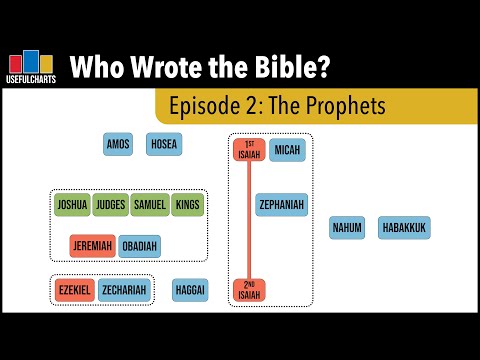
Who Wrote the Nevi'im? (Prophets)
UsefulCharts · 695K views

English Bible Translations Family Tree
UsefulCharts · 942K views

Old Testament Textual Criticism
UsefulCharts · 175K views
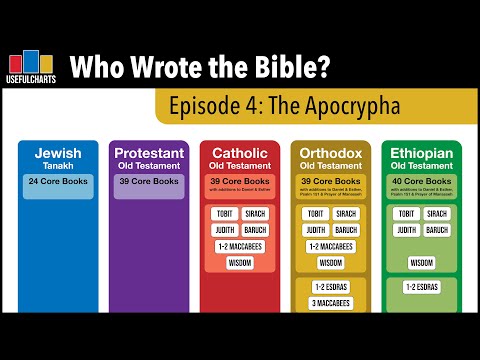
Who Wrote the Apocrypha? (Deuterocanon)
UsefulCharts · 624K views

New Testament Textual Criticism
UsefulCharts · 193K views

28 Historical Figures Mentioned in the New Testament
UsefulCharts · 512K views

Who Wrote the Ketuvim? (Writings)
UsefulCharts · 448K views

What Is the Best Bible Translation?
ReligionForBreakfast · 992K views

Does Bronze Age Archaeology Support the Bible?
UsefulCharts · 438K views

Who Wrote the Book of Revelation?
UsefulCharts · 458K views

The Dead Sea Scrolls // Ancient History Documentary
History Time · 7.5M views
Who Wrote the Qur'an? | What Sources Were Used?
UsefulCharts · 2.9M views

Who Wrote the Epistles?
UsefulCharts · 402K views

The Complete History of the Jews (Documentary)
The Entire History · 469K views

After Collapse: The World of the Early Iron Age
Dig. · 681K views

Biblical Genealogy (Full Series)
UsefulCharts · 651K views

Who Wrote the Gospels?
UsefulCharts · 718K views

The Rapture Isn't in the Bible (Data Over Dogma Classic)
Data Over Dogma · 5.6K views

The OLDEST copy of Scripture ever found! (Even older than the Dead Sea Scrolls)
Expedition Bible · 3.4M views

Introduction to the Bible (Full Series)
UsefulCharts · 3.1M views