Caribbean British guy reacts to cool facts about the turkish language reaction turkey culture
2.6K views · Sep 30, 2025 · People & Blogs

Comments · 24
@Etrulicus · 1 year ago
The issue of language reform is widely misunderstood. The language spoken by the court and in diplomacy was different from the language spoken by the public. We can still understand a Turkish folk poem written in the 12th century.
16
@Sakib458 · 1 year ago (edited)
She's asian. But she's fluent or maybe not fluent but good in a lot of languages like Chinese, English, French, German, Arabic, Turkish, Persian. She's a multicultural language channel
3
@Sultan_Alparslan_HAN · 1 year ago
<a href="https://www.youtube.com/watch?v=RmGhG4Exbgo&t=372">6:12</a> We came from the region called "Turkestan," which is today known as the Turan countries. Furthermore, the lands within the borders of China and within the Mongolian region today were inhabited by the ancient Turks. The Mongols and Chinese were further east. Over time, due to wars, the Turks expanded westward, and the Chinese and Mongols moved into the vacated areas to their west. (Uyghur Turks still live in China today.) <br>In fact, a long, long time ago, the Asian nations were a single state. This was during the time of Noah's son, Japheth. In those days, there were no states as we know them today; they were only united as tribes. Then the population grew, and people migrated and dispersed, resulting in different languages and traditions, different scripts, and consequently, new cultural classes. The nations that appear to have very different cultures today (Chinese, Mongol, Turkish, Japanese, Korean) were actually related thousands of years ago.
@oyuncuhayri5711 · 1 year ago
<a href="https://www.youtube.com/watch?v=RmGhG4Exbgo&t=69">1:09</a> she is not turkish because her pronunciation shows it
@baruto1353 · 1 year ago
Can u continue with the usual series? Like Sengoku Jidai , Crusade, Caesar and so on.
@omerbaran7270 · 10 months ago
Merhaba. Bir soru soracağım ve konu netleşecek:<br>Siz bir Karayiplisiniz ve ABD'de (USA) yaşıyorsunuz.<br>Neden Karayip dili veya Amerikan dili değil de İngiliz dili kullanıyorsunuz. Siz İngiliz değilsiniz ki!
@cemyildiz7842 · 1 year ago
Some notes:<br><br>* Lunga franca? Turkish can be lunga Turco i guess :)<br><br>* She is not Turkish, she cannot pronounce Turkish words proper either.<br><br>* There are some Asian looking Turkish people especially around Eskisehir city. Basically not Turks but Turkic languages are originated somewhere between Mongolia and China. <br><br>* Not only Korean, Mongolian or Japanese but Niger-Congo languages have similarities with Turkic languages. It doesn't mean that those languages are related. <br><br>* Turkish and German long words are something else. In German writing system, there are compound words. Many words can be written as a single word in German. For instance Arbeiterunfallversicherungsgesetz is compound version of Arbeiter-unfall-versicherungs-gesetz (Workers' Compensation Insurance Act), as it defines a single concept, they make it one single word. Long Turkish words are about suffixes and but in daily life the longest words can be generally that long: "gerçekleştiremeyeceğimden" (stem: gerçek), "kandırılamayacak" (stem: kan), "koşuşturmacalardan" (stem: koş) etc.<br><br>* And when we put suffixes, we need to pay attention to vowels. And we try to not to move our lips and tongue so much within the word. Again if you check my example Turkish long words, you will see that the, in the first example "gerçekleştiremeyeceğimden", the wovels are just e and i, in the second example it is just a and ı even they have several suffixes for each.
@Sultan_Alparslan_HAN · 1 year ago
<a href="https://www.youtube.com/watch?v=RmGhG4Exbgo&t=170">2:50</a> There's no such word in Turkish. It's a made-up word; its main purpose is that such a word can be created with suffixes. But we don't use such a word; we can make up similar words if we want, because Turkish is like a Lego, a long statement that adds suffixes to the end. You could make up dozens of such long words with the right suffixes, but you'd have to spend hours trying to do it. Why bother? I'm 42 years old, I went to two universities, and I've never seen a word like this. I saw it in a foreign video on YouTube. :)) Some people like to sit around and mess around with things like that.
@Sultan_Alparslan_HAN · 1 year ago (edited)
<a href="https://www.youtube.com/watch?v=RmGhG4Exbgo&t=550">9:10</a> The Seljuk Turks ruled Persian lands for 1,000 years, which is why our language contains many words of Persian origin. Furthermore, due to the Arabs' aid in the Battle of Talas between the Chinese and the Turks in 752 CE and their efforts to prevent a Chinese invasion, friendship between Arabs and Turks emerged. Turks are a very loyal people, never indifferent to kindness. From this date on, Arab merchants were allowed to travel freely in Turkish lands, and Arab travelers were allowed to explore Turkish lands and write tourist books. When these books were translated into Turkish and Islam rapidly spread among the Turks, religious words entered the Turkish language. The vast majority of Turks did not embrace the so-called language reform after 1923. This was largely due to the fact that it was a reform movement based on the discomfort of secular republicans with Islamic vocabulary.<br><br>Furthermore, Ottoman Turkish is a very rich language of science and literature, boasting millions of words. Therefore, modern Turkish struggles to produce scientific words, and uses the names of scientific inventions without translating them into their foreign names. Or it invents new names as abbreviations, such as SİHA (armed unmanned aerial vehicle (Silahlı İnsansız Hava Aracı)).
@craymyla · 1 year ago
The original homeland of the Turks is Central Asia.<br>More specifically, most historians point to the region around the Altai Mountains, the Orkhon–Selenga Valley, and Ötüken (in today’s Mongolia and southern Siberia)
@omerbaran7270 · 10 months ago
İngilizce dilinin Dünya çapında yaygın olmasının sebebi, Dünyanın her yerinde İngilizlerin yaşıyor olması değil.<br>Örneğin siz Karayip Adalarındansınız, İngiliz değilsiniz. Arjantin, Portekizlilerin ülkesi değil ama Portekizce konuşulur. Bunlar gibi örnek çok.<br>İngilizler Dünyanı çeşitli yerlerinde sert bir sömürgecilik yürüttüğü için, kendi dillerini oralarda kullanılmaya zorlamıştır. <br>Biz Türkler de gittiğimiz yerleri o şekilde yönetseydik, Orta Avrupa'dan Çin'e kadar, Sibirya'dan Orta Afrika'ya kadar herkes Türkçe konuşuyor olurdu. <br>Örneğin 400 yıl kadar yönettiğimiz Batı Avrupa (Balkanlar) ülkeleri, bugün kendi dillerini konuşabiliyorsa ve kendi dinlerini yaşayabiliyorsa, Türklerin, İngilizler gibi sömürgecilik yapmamasındandır.
@Abeturk · 1 year ago
29+ tenses in turkish language <br>Istanbul Turkish verb conjugations <br>A= To (towards /~for) >for words with a thick vowel in the last syllable <br>E= To (towards /~for) >for words with a thin vowel in the last syllable <br>Okul=School <br>U (ou)=it’s that/ the <br>Mak/Mek (umak/emek)= aim /exertion (activity purpose /effort process)> machine/mechanism <br>(verb)>Git-mek= to Go ( getmek)= effort to go > to get there <br> <br>1 .present continuous tense (right now or soon, currently or nowadays) <br>Used to describe current actions or some events planned for specific times <br>YOR-mak =to tire ( to try ,engage in) >Yor= go onto it too much (yorgunum=I’m tired) <br>A/E Yormak=(to tire the mind)> to arrive at an idea of what it is <br>I/U Yormak= be completely preoccupied with this <br>"Used with the suffixes -ı/i/u/ü + “yor" <br> <br>positive <br>Okula gidiyorsun ( you are going to school)= Okul-a Git-i-Yor-u-Sen >School-to Go-to-Try that-You <(please read backwards) <br>Evden geliyorum ( I'm coming from home)= Ev-de-en Gel-i-yor-u-Men >(from Home I’ try to Come)=Come-to-try that-Me <when-at-Home< <br> <br>negative <br>A) Mã= Not B) Değil= Un-equivalent <br>examples <br>A: Okula gitmiyorsun ( you’re not going to school)= Okul-a Git-Mã-i-yor-u-Sen >You don't try to Go to school <br>B: Okula gidiyor değilsin ( you aren't going to school)=Okul-a Git-i-yor değil-u-sen >You aren't try..to Go to School <br> <br>Question sentence: <br>Mã-u =Not-it> is not it? <br>Used as the suffixes = Mu / Mü / Mı / Mi ? <br> <br>Okula mı gidiyorsun? ( Are you going to school?)= Okul-a Mã-u Git-i-yor-u-sen (To-school/ Not-it / You-try-to-go)>Are you going to school or somewhere else? <br>Okula gidiyor musun? ( Do you go to school?)= Okul-a Git-i-yor Mã-u-sen (To school /Try-to-go /Not-it-you)> Do you (try to) go to school (regularly/usually)? <br>Okula sen mi gidiyorsun?= Are you the one going to school? <br> <br>2 .simple extensive tense (used to express our own thoughts on a subject) <br>(always, since long, sometimes, currently, sooner or later, if possible/ inşallah) <br>positive <br>VAR-mak = to arrive at /be there <br>(var= ~being there) Used with the suffixes -ar/-ır/-ur >for thick vowels <br>ER-mek= to get at /to reach <br>(er=~achieve ) Used with the suffixes -er/-ir/-ür >for thin vowels <br> <br>examples <br>Okula gidersin (You get <s>a chance</s> to go to school)= Okul-a Git-e-er-u-sen=You(ll) get to go to school <br>Gölde balık tutarsınız ( Göl-de balık tut-a-var-u-sen-iz) = You (all) have the chance to fish in the lake <br>Bunu kolayca satarız (Bu-n’u kolay-ca sat-a-var-u-weñ-iz) =~We are likely to sell this easily <br>Bunu görebilirim (I can see this) = Bu-ne’u Gör-e-Bil-e-er-u-men =I'm able to see what this is <br> <br>Question sentence: <br>In interrogative sentences it means: isn't it so /what do you think about this topic? <br>Okula gider misin? (~Do you get to go to school?) Okul-a Git-e-er Mã-u-Sen =You get to go to school, not it?=How about you going to school? <br>Okula mı gidersin? =~Where'll you go? to school or somewhere else. <br> <br>negative <br>Mã= Not <br>Bas-mak = pass over/ tread on/ dwell on (pas geç= pass by > vaz geç=give up) bas git=get out of here <br>Ez-mek = crush/ run over (ez geç= never think about the outcome > es geç= stop thinking about) <br>Mã-bas=(No-pass/ Na pas)> (give up on/not to dwell on) >the suffix "MAZ" (for thick vowel) <br>Mã-ez=(Don’t/ Doesn’t)> (to skip/ avoid) >the suffix "MEZ" (for thin vowel) <br>for the 1st person singular and 1st plural is only used the suffix “Mã” ,except for questions <br> <br>examples <br>Okula gitmezsin (you won't/don't go to school)= Okul-a Git-mã-ez-u-sen =You skip going to school <br>Babam bunu yapmaz (My dad does not do this)= Baba-m bu-n’u yap-mã-bas =My dad doesn't dwell on doing this <br>Bugün okula gitmem (I won't go to school today)> Okul-a Git-mã-u-men =I don't (have to) go to school <br>Bugün okula gidemem (I cannot go to school today)> Okul-a Git-e-er-mã-u-men =I don't get (a chance) to go to school <br>Kimse senden (daha) hızlı koşamaz (Nobody can run faster than you)=Kimse sen-den daha hızlı kaş-a-var-ma-bas <br>Bir bardak su almaz mısın? (Won't you have a glass of water)/ Bir fincan çay al-ma-bas mã-u-sen-iz =Do you (really) give up on getting a cup of tea? <br> <br>3.simple future tense (soon or after) <br>Used to describe events that we are aiming for or think are in the future <br>Çak-mak = to tack, to fasten, to keep in mind , to hit them together (for thick vowel) <br>Çek-mek=to pull, to take time, to feel it inside, to attract, to will (for thin vowels) <br> <br>positive.. <br>Okula gideceksin (You are going to go to school)= Okul-a Git-e-çek-u-sen = You take (time) to Go to school <br>Ali kapıyı açacak (Ali will open the door)= Ali Kapı-y-ı Aç-a-çak = Ali takes (on his mind) to open the door <br> <br>negative <br>A. Okula gitmeyeceksin (You won't go to school)=Okul-a Git-mã-e-çek-u-sen =You don't take (time) to go to school <br>B. Okula gidecek değilsin (You are not going to go to school)=Okul-a Git-e-çek değil-u-sen =You won't go to school and nobody is demanding that you <br> <br>4 .simple past tense (currently or previously) <br>Used to explain the completed events we're sure about <br>Edû = done / Di = anymore <br>Used as the suffixes= (Dı /Di /Du/ Dü - Tı /Ti /Tu /Tü) <br> <br>positive <br>Okula gittin = You went to school = Okul-a Git-di-N <br>İki yıl Ankara'da kaldım= I stayed in Ankara for two years <br>Okula mı gittin ? (Did you go to school)= Okul-a Mã-u Git-di-n> You went to school or somewhere else? <br>Okula gittiniz mi ? (~Have (all)you gone to school)= Okul-a Git-di-n Mã-u> You went to school or not? <br> <br>negative <br>Okula gitmedin =You didn't go to school (Okul-a Git-mã-di-N) <br>Henüz İstanbul’a var-ma-dı-k =We haven't arrived in Istanbul yet <br>Bugün pazara gitmediler mi? =Didn't they go to the (open public) market today? <br>Dün çarşıya mı gittiniz? =where Did you go yesterday, to the (covered public) bazaar? <br>Akşamleyin bakkala (markete) gitti mi? =Did s/he go to the grocery store in the evening? <br> <br>5 .narrative/reported past tense (for now or before) <br>Used to describe the completed events that we're unsure of <br>MUŞ-mak = ~to inform (umuş/umur/umrat=perception/expectancy/hopes > muştu=gospel) <br>that means >I’ve been informed/ I heard/ I found out/ I noticed/ I got it <br>used as the suffixes= (Mış/ Muş - Miş/ Müş) <br> <br>positive <br>Okula gitmişsin= I heard you went to school <br>Yanlış birşey yapmışım= I realized I did something wrong <br> <br>negative <br>A. Okula gitmemişsin (I heard that you didn't go to school)=Okul-a Git-mã-miş-u-sen = You apparently didn't go to school <br>B. Okula gitmiş değilsin (Okul-a Git--miş değil-u-sen) =~You haven't gone to school <br>In a question sentence it means: Do you have any info about/ have you heard/ did you notice/ does it look like that/ is it true? <br>İbrahim dün okula gitmiş mi? =Did you (know)hear whether Abraham went to school yesterday? <br>İbrahim bugün okula mı gitmiş? =I heard Abraham went to school today, is it true? (or somewhere else) <br> <br>6.Okula varmak üzeresin =You're about to arrive at school <br>7.Okula gitmektesin (You're in /process of/ going to school) ~you’ve been going to school <br>8.Okula gitmekteydin =~You had been going to school =Okula gidiyor olmaktaydın <br>9.Okula gitmekteymişsin =I noticed you've been going to school <br>10.Okula gidiyordun (Okula git-i-yor er-di-n) = You were going to school <br>11.Okula gidiyormuşsun (Okula git-i-yor er-miş-sen)=I noticed you were going to school (at the time or right now) <br>12.Okula gidiyor olacaksın (Okula git-i-yor ol-a-çak-sen)=You’ll be going to school <br>13.Okula gitmekte olacaksın (Okula git-mek-de ol-a-çak-sen)=You’ll have been going to school <br>14.Okula gitmiş olacaksın (Okula git-miş ol-a-çak-sen)=You’ll have gone to school <br>15.Okula gidecektin (Okula git-e-çek er-di-n)=You were gonna go to school>~I thought you were going to school <br>16.Okula gidecekmişsin (Okula git-e-çek er-miş-sen)=I heard that you'll go to school >~I learned you'd have gone to school <br>17.Okula giderdin (Okula git-e-er erdin)=You used to go to school >You'd have got a chance to go to school <br>18.Okula gidermişsin (Okula git-e-er ermiş-sen)=I heard you used to go to school> I realized that you’d get to go to school <br>19.Okula gittiydin (Okula git-di erdin)= I had seen you went to school >I remember you had gone to school <br>20.Okula gittiymişsin = I heard you went to school -but if what I heard is true <br>21.Okula gitmişmişsin = I heard you've been to school -but what I heard didn't sound very convincing <br>22.Okula gitmiştin (Okula git-miş er-di-n)= you had gone to school <br>23.Okula gitmiş oldun (Okula git-miş ol-du-n)= you have been to school <br> <br>Dur-mak=to remain in the same way/order/layout <br>Durur=remains to exist / keeps being / seems such <br>used as the suffixes=(Dır- dir- dur- dür / Tır- tir-tur-tür) <br>(in official speeches these suffixes are used only for the 3rd singular and 3rd plural person) <br>its meaning in formal speeches> it has been and goes on like that <br>Bu Bir Elma = This is an apple <br>Bu bir elmadır= (bu bir elma-durur)= This is an apple (and keeps being) <br>Bu Bir Kitap = This is a book <br>Bu bir kitaptır= (bu bir kitap-durur)= This is a book (and it continues to be so) <br>informal meaning in everyday speech>it seems/ likely that/ remained so in my mind <br>Bu bir elmadır= (bu bir elma-durur)=It seems this is an apple <br>Bu bir kitaptır= (bu bir kitap-durur)=This appears to be a book <br>Bu bir elma gibi duruyor=(looks like an apple this is )>This looks like an apple <br>Bu bir kitap gibi duruyor=This looks like a book <br> <br>24.Okula gidiyorsundur = You probably go to school <br>25.Okula gidiyordursun = You were probably going to school <br>26.Okula gideceksindir=You'll probably go to school <br>27.Okula gidecektirsin = You would probably (gonna) go to school <br>28.Okula gitmişsindir = You probably went to school <br>29.Okula gitmiştirsin = You had probably gone to school
Up next
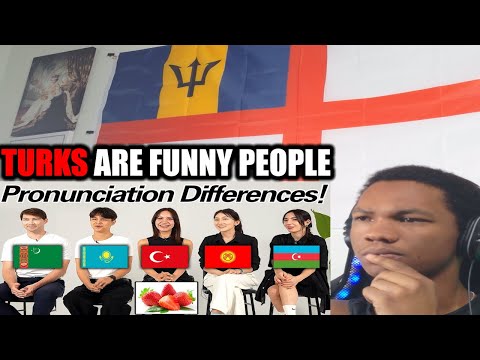
British caribbean guy react to The Sound of the Turkic Languages reaction turkish reaction turkey
Bajan Englishman · 5K views

Why the WORLD Laughs at Americans! 🌍🇺🇸😭 | American Reacts
Runaway American: Europe Reactions · 78K views

"I Wasn't Expecting Something Like This in Istanbul!" British Couple Shocked on the Turkish Metro!
Dünyayı Şaşırtan Türkiye · 43K views

Lauren Reacts! *So much I didn't know!* Turkic peoples/countries EXPLAINED!-Geography Now
AmericansLearn · 22K views

Nobody Expected Cillian Murphy To Be THIS Awkward
Mercazoids · 177K views

IShowSpeed Meets The Craziest Magician In Turkey 😭
NoahSensei · 7.6M views

CLUELESS AMERICANS IN EUROPEAN HOSPITALS--"it only gets worse"
Western Lens · 142K views

British caribbean guy react to Can turkish understand turkic languages reaction
Bajan Englishman · 2K views

What Is the Oldest Language in the World? Top 10 Living Languages Ranked
Airlearn Language Show · 1.5M views

Wait… European Schools DON'T Do This?! (American Reacts)
MoreJps · 496K views

HISTORY TIME! TARİH ZAMAN! TURKISH WAR OF INDEPENDENCE (Türkçe altyazı)
JT Vlogs · 85K views

Turkish Airlines Best Commercials Compilation | Foreigner Reacts
Cead Reacts · 24K views

British caribbean guy react to 10 Facts About the Turkish Language reaction turkey reaction history
Bajan Englishman · 6.3K views
Americans React to Turkish Airlines Advertisements! (Türkiye: A Country Of Wonders)
TriFate Extended · 58K views

Word Differences Between Arabic & Urdu & Persian & Turkic Languages!! l Shocking Similarity!
World Friends · 1M views

American Reacts: 12 Things You Get for Free in Germany That Cost Americans Thousands!
SofiaFromBoston · 77K views

Vet Reacts! *The Story Of Ataturk* The Turkish Century | From Hittites to Atatürk Part 3
AmericansLearn · 15K views

AMERICAN Tourists Can't Believe This is Normal In Europe—it's Insane
Based Pecherroni · 100K views

This Romanian Comedian Has NO Mercy for Americans
CeleVox · 501K views

İtalyan Tepkisi 🇹🇷 Fatih Sultan Mehmet Han Aslında Kimdi?
AV REACT SHOW · 88K views