“Give Me Neither Poverty nor Riches” Memorial of Saint Pius of Pietrelcina, Priest | September 23, 2026
“Give Me Neither Poverty nor Riches”
Memorial of Saint Pius of Pietrelcina, Priest | September 23, 2026
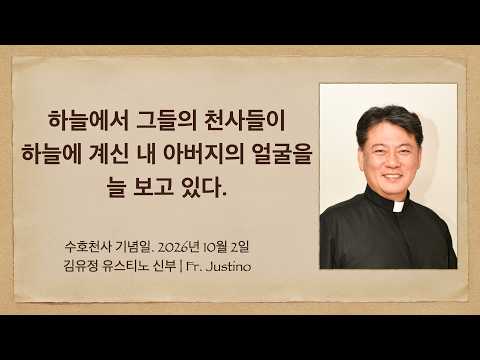
Fr. Justino Kim Yu-jeong | Fr. Justino
#Thomastivi #Fr.KimYujeong #Homily #KoreanListening #koreanhomily #koreanlistening
[View Manuscript]
Proverbs 30:5-9; Luke 9:1-6
Come, Holy Spirit
Today is the Memorial of Saint Pius of Pietrelcina, Priest. The saint, known as ‘Fr. Pius of the Stigmata,’ was born in 1887 in the village of Pietrelcina, Italy.
Having entered the Capuchin Order of Friars Minor, one of the religious orders following the spirituality of Saint Francis, and been ordained a priest at the age of 23, the saint lived a life of devotion through the offering of the Holy Mass, the Sacrament of Confession, prayer, and spiritual guidance. He is particularly known for having received the "Stigmata," the physical manifestations of the wounds of the crucified Jesus, a suffering he endured for 50 years.
However, the reason the Church canonized Saint Pio is not because of this special phenomenon known as the Stigmata. It is because he offered that suffering to God, prayed throughout his life, and gave himself up for his neighbors. Saint Pio, who simply called himself a "poor, praying religious," stated that prayer is "the highest apostolate a soul can practice in the Church of God" (Epistles 2:70).
https://www.vatican.va/content/france...
On September 22, 1968, after presiding over a solemn Mass commemorating the 50th anniversary of receiving the Stigmata, he received the Sacrament of Confession and renewed his vows at dawn the following day, September 23, and then received the Sacrament of Anointing of the Sick. He then passed away, leaving behind the words, “I see two mothers.” These two mothers were the Blessed Virgin Mary and his own mother.
In today’s First Reading from Proverbs, a character named Agur prays: “I ask You for two things. Please grant them to me before I die.” These two things are spiritual and physical; the spiritual one is a request to become a thoroughly truthful person. He prays as follows: “Keep falsehood and lies far from me.”
The second carnal petition is as follows: “Do not make me poor or rich, but grant me only my appointed food.” Although people today do not explicitly pray to God to “make me rich,” a closer look at the content of their prayers reveals that they often ultimately pursue “wealth.”
Proverbs explains the reason for asking not to make me poor or rich as follows: “Otherwise, when I am full, I will become an unbeliever and say, ‘Who is the Lord?’ Or I will become poor and steal and defile the name of my God.”
It is not easy for a wealthy person to rely on God. This is because they have someone else to rely on. We often hope that everything we lack will be satisfied, but once all our needs are met, we may end up saying, “Who is the Lord?” Our needs must be met by the Lord, not by anything else.
Furthermore, we must not become so destitute that we resort to stealing. If you steal, you will defile the name of God. Ultimately, the prayer, “Do not make me rich, nor make me poor,” is offered not for one’s own needs, but for the glory of God.
We know of another prayer that connects “scheduled food” with “the name of God.” It is the Lord’s Prayer. While Proverbs prayed on a personal level, Jesus expands this to a cosmic level.
In order for “the Father’s name to be hallowed,” I must not have too much money. This is because people might ask, “Who is the Lord?” Nor must I have nothing to eat to survive. That is why we ask, “Give them their daily bread,” and we must look around to see if there are any neighbors without daily sustenance and share our food with them. By doing so, “the Father’s name will be hallowed.”
In today’s Gospel, Jesus says as He sends out the twelve disciples: “When you go out, take nothing with you—no staff, no travel bag, no bread, no money, and no extra clothes.” This is not so much a message about ‘poverty,’ but rather a message to rely solely on God’s guidance.
Jesus tells us to accept the hospitality of those who show us kindness, but to be prepared to be rejected by others.
The instruction, “When you enter a house, stay there until you leave,” is a warning to guard against trying to curry favor with the wealthy who can offer more comfortable hospitality, and to preserve the original intent of service.
Jesus’s instruction to live simply and rely solely on God while proclaiming the Gospel is a call to live a lifestyle different from the practices of some religious figures and philosophers of the time who pursued their own interests by flattering people with sweet words.
On March 17, 2018, Pope Francis, visiting Pietrelcina, the hometown of Saint Pio, said the following:
** “Who are the ‘little ones’ who know how to accep...