Test and try: Macintosh Centris 610 (with a "sassy" recap)
116K views · Nov 15, 2023 · Science & Technology

Comments · 695
@VE5SAR-HamaRamaDingDong · 2 years ago
Your ability to "chat" with your audience as you do your work is amazing - it's almost like we're there with you having a conversation! Excellent YT skillset, Adrian.
242
@JayBlueWhisper · 2 years ago
Adrian is the Bob Ross of recapping, the random chatting is great.
144
@marinahildebrand5868 · 2 years ago
Hi Adrian,<br>According to my research, the so-called capacitor plague is caused by chemical decomposition of the electrolyte. Hydrogen gas is being formed, causing the safety valve to spew out whatever electrolyte is left in the capacitor. The electrolyte itself mainly consists of water, ethylene glycol and boric acid. Other types of acid or bases may be present too. From a chemists point of view: you should consider using a double treatment, first with a mild base like a solution of sodium carbonate (soda), followed by another treatment with a mild acid like white vinegar or even citric acid. Generally I would prefer citric acid over vinegar as citric acid is just more capable of complexing metal ions.
142
@X-OR_ · 2 years ago
Take that "This Does Not Compute" !!
11
@gemedetvideo · 2 years ago
FYI, If you replace electrolytic capacitors with ceramic capacitors you really should use ceramic capacitors that are rated for at least 2-3 times the voltage the capacitor will see. The reason is ceramic capacitors actually have lower capacitance the closer they get to their rated voltage. The loss of capacitance is often severe - 60% or more if they are operated near their rated voltage. <br><br>Using a capacitor rated for a higher voltage mitigates this by shifting the operating voltage further down so the capacitance ends up close to the expected value while in circuit. <br><br>Some manufacturers of ceramic capacitors (such as Murata) publish charts showing exactly how much the capacitance drops in relation to rated voltage and operating voltage for each model capacitor.
62
@05Forenza · 2 years ago
I'm consistently impressed at how I can watch a video for more than an hour and be engrossed the entire time. It's so rare I find someone who can do that!
67
@ricdintino9502 · 2 years ago
While you're taping over the SIMM sockets, you might want to slap a piece on the CPU socket too if you're going to leave the CPU out while you're doing solder work on the board.
20
@questionablecommands · 2 years ago
This video has made me realize that it's absurd that I'm intimidated by recapping a board when I've built several keyboards using SMD diodes.
13
@michaelhill2844 · 2 years ago
The Bob Ross of ancient computers. "That happy little capacitor lives right there."
3
@mikewifak · 2 years ago
This is completely wrong. You’re supposed to lift the caps off with a levitation spell and use melted gummy bears for flux. Duh
24
@RudysRetroIntel · 2 years ago
Twist and press down is the best way to remove those caps. Fully agree! Thanks for sharing
99
@mattsword41 · 2 years ago
Intro "just a quick video"<br><glances at run time><br>😂😂<br>Love your long videos Adrian :) Always a highlight in the day when you upload 😀<br>Best wishes from the UK
17
Up next

0073 There can't be many of these in North America: The KC 85/3
Adrian's Digital Basement ][ · 60K views

0057 A mystery data recorder, a hurt Sun SPARCstation IPC and a MEGA little TV
Adrian's Digital Basement ][ · 73K views

A very rotten Macintosh Plus
Adrian's Digital Basement · 64K views

0079 I'm at a loss for words when I first see this Tandy 4000 computer
Adrian's Digital Basement ][ · 125K views

What Happened to Compaq? The Texas Startup That Took the PC From IBM
The Gadget Attic · 979 views

Testing 12 mystery PC floppy drives
Adrian's Digital Basement ][ · 74K views

PC archeology: Mystery 486 Mini-Tower
Adrian's Digital Basement · 131K views

Testing and repairing a mysterious Amiga "art project"
Adrian's Digital Basement · 155K views

A "greedy" Mac IIci overclock, testing video cards and a motherboard
Adrian's Digital Basement ][ · 49K views
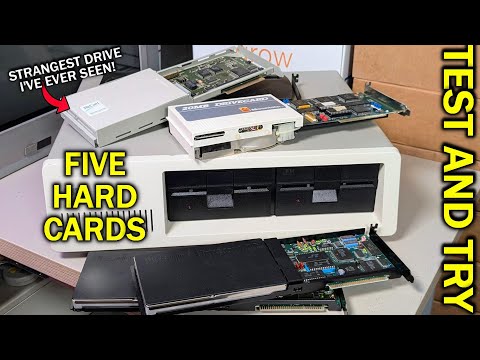
Test and try: Five (probably broken) hard cards #autopsy
Adrian's Digital Basement ][ · 70K views

It's Over: Bonds COLLAPSE to WORST Levels Since 2002 - Netherlands BANS Microsoft
House of El · 242K views

Let's try to get the SWTPC 6800 computer working
Adrian's Digital Basement · 107K views

Did I waste $10 on this S-VHS VCR?
Adrian's Digital Basement ][ · 196K views

My Dream Power Hammer Restoration! Part 10
Alec Steele · 1.1M views

A big box of mystery computer parts
Adrian's Digital Basement ][ · 209K views

PC Archeology: Not just another normal IBM PC XT clone (Handwell PC-401)
Adrian's Digital Basement · 139K views

Troubleshooting and repurposing the Agfa Compugraphic 9000PS
Adrian's Digital Basement · 71K views

0069 There is so much "freakin' awesome!" in this video (PicoMEM, Hayes RetroModem and more)
Adrian's Digital Basement ][ · 70K views

What mysterious retro goodies can we find inside these boxes?
Adrian's Digital Basement · 136K views

HDMI video from your Apple II with this cheap and simple project (A2DVI)
Adrian's Digital Basement · 101K views

Cleaning hurricane damaged Retro Computers & CRTs
LGR · 318K views

0076 A binocular TV, the wiggle method rocks on Mac parts, and some awesome old print ads
Adrian's Digital Basement ][ · 39K views

The Zeos 386SX was a speedy and competitive motherboard
Adrian's Digital Basement ][ · 60K views

PC archeology: Treasure hunting inside old PCs
Adrian's Digital Basement · 166K views

Commodore Amiga 1080 monitor resurrection
Adrian's Digital Basement ][ · 51K views

0078 A broken Book 8088 laptop, Voodoo 2 frustration and some TV parts
Adrian's Digital Basement ][ · 44K views