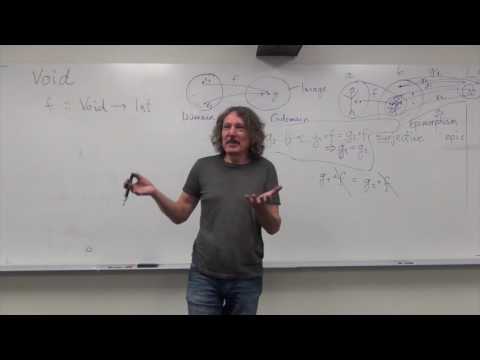
Category Theory 2.1: Functions, epimorphisms
147K views · Sep 1, 2016 · Science & Technology

Comments · 239
@MikeJfromVA · 6 years ago
These videos are so fun and relaxing. Bartosz Milewski is my Bob Ross and morphisms are my happy little trees.
208
@ew3995 · 10 years ago
thank you thank you , utterly brilliant, it feels like ive been waiting for this level of explanation for a very long time.
89
@usethefooorce · 7 years ago (edited)
<a href="https://www.youtube.com/watch?v=O2lZkr-aAqk&t=1970">32:50</a> A good way to think about injectivity and surjectivity is that for an injective function, each element in the codomain is mapped to by <b>at most one</b> element in the domain (i.e. zero or one). For a surjective function, each element in the codomain is mapped to by <b>at least one</b> element in the domain. If both of these are true (for a bijection / isomorphism), each element in the codomain must be mapped to by <b>exactly one</b> element in the domain, since that is the overlap of those two inequalities. (This also assumes that there are no elements in the domain that do not map to at least one element in the codomain, which is the other condition required by injectivity / "1-to-1 mapping" that is not covered by the statement "each element in the codomain is mapped to by at most one element in the domain".)
42
@kevon217 · 2 years ago
By far the most intuitive explanation I’ve come across, appreciate it!
2
@isaachester8475 · 2 years ago
This is amazing. I have very little experience in set theory aside from the very basics, and also no experience in computer science (I am a beginner in programming) but I was able to understand this lecture clearly. I take that to mean you are very thorough and very good at simplifying/explaining things! I appreciate that you don’t just assume knowledge and instead go over every detail with examples! Thank you for posting this on YouTube for free. I’m someone who is curious about mathematics but has no time or money to enroll in a course right now, so things like this are truly a blessing.
8
@gametable7086 · 1 year ago
8 years on and these lectures are still an excellent resource
1
@dmitriykorolevich2208 · 8 years ago
Thanks a ton for these, Bartosz. A comment about non-injective functions representing abstraction and non-surjective functions representing model was particularly insightful.
34
@dysdurtyobjkyivxcvud9871 · 6 years ago (edited)
<a href="https://www.youtube.com/watch?v=O2lZkr-aAqk&t=85">1:25</a> operational semantics <br><a href="https://www.youtube.com/watch?v=O2lZkr-aAqk&t=111">1:51</a> denominational semantics <br><a href="https://www.youtube.com/watch?v=O2lZkr-aAqk&t=167">2:47</a> function<br><a href="https://www.youtube.com/watch?v=O2lZkr-aAqk&t=189">3:09</a> pure function<br><a href="https://www.youtube.com/watch?v=O2lZkr-aAqk&t=200">3:20</a> partial functions<br><a href="https://www.youtube.com/watch?v=O2lZkr-aAqk&t=251">4:11</a> purity test - memoizable - idempotent<br><a href="https://www.youtube.com/watch?v=O2lZkr-aAqk&t=380">6:20</a> what are building blocks of composability ?<br><a href="https://www.youtube.com/watch?v=O2lZkr-aAqk&t=456">7:36</a> expanding on functions<br><a href="https://www.youtube.com/watch?v=O2lZkr-aAqk&t=480">8:00</a> category sets<br><a href="https://www.youtube.com/watch?v=O2lZkr-aAqk&t=510">8:30</a> relation - subset of pairs of [set]elements, a subset of cartesian product. <br><a href="https://www.youtube.com/watch?v=O2lZkr-aAqk&t=620">10:20</a> cartesian product of pairs<br><a href="https://www.youtube.com/watch?v=O2lZkr-aAqk&t=700">11:40</a> discriminating functions from relations<br><a href="https://www.youtube.com/watch?v=O2lZkr-aAqk&t=755">12:35</a> this one is bad for function -- cannot be mapped to relation<br><a href="https://www.youtube.com/watch?v=O2lZkr-aAqk&t=796">13:16</a> total functions - all elements must be mapped into from set1 into set2<br><a href="https://www.youtube.com/watch?v=O2lZkr-aAqk&t=840">14:00</a> domain of function - starting set.<br><a href="https://www.youtube.com/watch?v=O2lZkr-aAqk&t=860">14:20</a> codomain - subset ussually called image of the function<br><a href="https://www.youtube.com/watch?v=O2lZkr-aAqk&t=1087">18:07</a> isomorphism<br><a href="https://www.youtube.com/watch?v=O2lZkr-aAqk&t=1170">19:30</a> elevation from element language to categorical language expressed in terms of composition and identity<br><a href="https://www.youtube.com/watch?v=O2lZkr-aAqk&t=1410">23:30</a> (2) reasons disqualifiying isomporphism <br> a. set f[a,b] <s>> same element -</s> not inveritble<br> b. image does not fill whole codomain<br><a href="https://www.youtube.com/watch?v=O2lZkr-aAqk&t=1590">26:30</a> invertable ? counter-image<br><a href="https://www.youtube.com/watch?v=O2lZkr-aAqk&t=1627">27:07</a> "fibration" <br><a href="https://www.youtube.com/watch?v=O2lZkr-aAqk&t=1670">27:50</a> non-isomorphic sets increase entropy<br><a href="https://www.youtube.com/watch?v=O2lZkr-aAqk&t=1869">31:09</a> mathemeticians language divergence<br>" injective function does not collapse things" "monic" or monomorphic<br><a href="https://www.youtube.com/watch?v=O2lZkr-aAqk&t=1952">32:32</a> surjective - covers the whole set b from set a "epic" "epimorphism"<br>if something injective and surjective both they are isomorphic<br><a href="https://www.youtube.com/watch?v=O2lZkr-aAqk&t=2310">38:30</a> define an epimorphism without talking about elements
92
@naayou99 · 8 months ago (edited)
<a href="https://www.youtube.com/watch?v=O2lZkr-aAqk&t=2130">35:30</a> This is what makes Bartosz's style unique. This philosophical approach is very crucial to understand defintions in category theory.
1
@tomx1337 · 6 years ago
<a href="https://www.youtube.com/watch?v=O2lZkr-aAqk&t=2580">43:00</a> so "g1 after f = g2 after f" means that they are the same in the sense that they both end up in the same set? because i cant see how its true otherwise
7
@dutch3883 · 6 years ago (edited)
I took a few days to understand the last part about why Epimorphism make this statement true [G1oF = G2oF -> G1 = G2] .<br>For those who still struggling like me, I hope this explanation can help you.<br>If function is not Epimorphism then f(a) will cover only some part of b. <br>Example: "a" is set of Integer, "b" is set of integer and let f be f(x) = 2x. <br>In this case f(a) will map only from "integer"(a) to "even number"(some part of b). <--- this f function is inverse of Epimorphism<br>This will make "odd number"(another part of b) left unmapped. <br> Let G1 be a conditional function that [if x is even G1(x) = x + 1 and if x is odd G1(x) = x+2] and<br> Let G2 be another conditional function that [if x is even G2(x) = x + 1 and if x is odd G2(x) = x+3] <--- G1 and G2 are different in only odd number part of b.<br>You can see that from my example FoG1 = FoG2 = 2x + 1, but G1 doesn't equal to G2.<br>On the other hand, if f(a) is Epimorphism, we will not be able to find a condition (like even number in example) that allow to generate G1 and G2 that can negate this statement [G1oF = G2oF -> G1 = G2]<br>So that make [G1oF = G2oF -> G1 = G2] true for all Epimorphism function and could be used as its definition.
27
@edmundcape · 10 years ago
Bartosz - I've been binging on your videos after been a reader of your blog for a couple of months. I've taught Neuroanatomy to medical school students at McGill and Harvard; you are an amazing speaker and thinker. I look forward to your book bringing together Haskell, Category theory and the meaning of life! :-) Merci beaucoup! - E
61
Up next
Category Theory 2.2: Monomorphisms, simple types
Bartosz Milewski · 88K views

Category Theory 1.2: What is a category?
Bartosz Milewski · 287K views

Category Theory 1.1: Motivation and Philosophy
Bartosz Milewski · 391K views

Category Theory 6.1: Functors
Bartosz Milewski · 65K views

Category Theory 3.1: Examples of categories, orders, monoids
Bartosz Milewski · 94K views

The joy of abstract mathematical thinking - with Eugenia Cheng
The Royal Institution · 76K views

Category Theory 8.2: Type algebra, Curry-Howard-Lambek isomorphism
Bartosz Milewski · 24K views

Category Theory 5.1: Coproducts, sum types
Bartosz Milewski · 44K views

What is Group Theory? — Group Theory Ep. 1
Nemean · 1.1M views

Anthropic Took On the Riemann Hypothesis. Here’s What Actually Happened
Ellie Sleightholm · 497K views

(Co)Products: motivating category theory
Joseph Newton · 63K views

Crowd Goes WILD as Hikaru TRAPS Magnus Carlsen’s Queen
GM CHESS LESSONS · 108K views

Category Theory for the Working Hacker by Philip Wadler
Lambda World · 99K views

Richard Feynman: Can Machines Think?
Lex Clips · 2.4M views

Category Theory 10.1: Monads
Bartosz Milewski · 70K views

Trump Falls Asleep on Live TV, Tells the Truth for First Time & Our Favorite Foxtrotter Guillermo!
Jimmy Kimmel Live · 4.1M views

EU Tells USA To BACK OFF! Dutch BAN Microsoft, Bonds COLLAPSE, Trump PANICS
House of El · 247K views

Brian Beckman: Don't fear the Monad
jasonofthel33t · 414K views

Category Theory 3.2: Kleisli category
Bartosz Milewski · 75K views

But what is the Riemann zeta function? Visualizing analytic continuation
3Blue1Brown · 5.3M views

27 Unhelpful Facts About Category Theory
Oliver Lugg · 474K views

Lecture 1: Invitation to topos theory
metauni · 14K views

A Crash Course in Category Theory - Bartosz Milewski
ScalaIO FR · 101K views

A Sensible Introduction to Category Theory
Oliver Lugg · 564K views

Category Theory in Life - Eugenia Cheng
Lambda World · 112K views