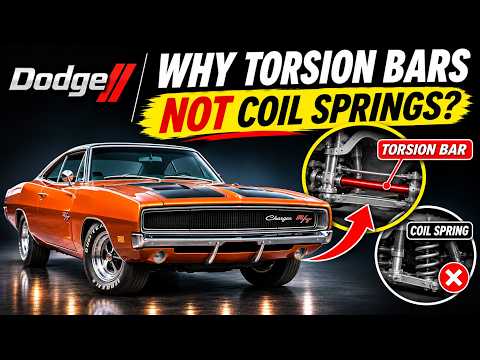
Why did torsion bar suspension disappear from American passenger cars, and how did coil springs and MacPherson struts take over?
For decades, torsion bar suspension was one of the most innovative technologies in American automotive engineering. From classic Chrysler luxury sedans and Plymouth family cars to legendary Dodge Chargers and Hemi-powered muscle cars, these simple steel bars helped define the handling and performance of Detroit's golden age.
But during the 1970s and 1980s, torsion bar suspension gradually disappeared from mainstream American passenger cars, replaced by coil springs, MacPherson struts, and new suspension designs better suited to smaller, front-wheel-drive vehicles.
So why did automakers abandon a suspension system that had served American drivers for generations? And why does torsion bar technology still survive in modern heavy-duty pickup trucks?
In this automotive history documentary, we explore the rise and fall of torsion bar suspension, how this unique mechanical system worked, and why changing automotive engineering eventually pushed it out of the passenger car market.
The story begins with the fundamental physics of torsion bars. Unlike conventional coil springs that compress under load, a torsion bar absorbs suspension movement by twisting a solid steel rod. This ingenious design allows a vehicle to support its weight while reducing the need for bulky suspension springs in the engine compartment.
We examine the early development of torsion bar technology and the groundbreaking 1955 Packard Torsion-Level Ride system, an ambitious suspension design that connected front and rear suspension movements and used an automatic leveling mechanism.
Then came Chrysler's revolutionary Torsion-Aire suspension, introduced for the 1957 model year.
From the Plymouth Fury and Dodge Coronet to the Chrysler New Yorker, torsion bars became an important part of Chrysler's engineering identity, offering a distinctive combination of ride comfort, handling, and suspension packaging.
During the American muscle car era, torsion bar suspension also provided an important engineering advantage. By eliminating the need for conventional front coil springs, Chrysler engineers gained valuable engine compartment space for powerful V8 engines.
This design became closely associated with legendary Mopar muscle cars, including the Dodge Charger, Plymouth Road Runner, and Plymouth Barracuda, as well as Chrysler's famous 440 big-block and 426 Hemi V8 engines.
But the automotive industry was about to change.
The 1973 oil crisis, stricter fuel economy standards, and growing demand for smaller automobiles encouraged American manufacturers to rethink traditional rear-wheel-drive vehicle architecture.
We investigate how the rise of front-wheel-drive platforms, transverse engines, and compact unibody construction created new challenges for traditional longitudinal torsion bar suspension systems.
You'll discover why MacPherson struts became increasingly popular, how their compact design helped automakers package smaller cars more efficiently, and why Chrysler eventually moved away from torsion bars on its mainstream passenger vehicles.
We also explore the final years of classic torsion-bar-equipped Chrysler sedans, including the Dodge Diplomat, Plymouth Gran Fury, and Chrysler Fifth Avenue.
But torsion bar suspension never completely disappeared.
Today, torsion bars continue to serve important roles in certain heavy-duty pickup trucks, including Chevrolet Silverado HD and GMC Sierra HD models, where their strength, compact installation, and suitability for demanding front suspension applications remain valuable.
Finally, we compare torsion bars, coil springs, and MacPherson struts, examining their mechanical differences, packaging advantages, maintenance considerations, and impact on automotive suspension design.
The disappearance of torsion bars from American passenger cars represents more than the replacement of a suspension component. It marks a major transformation in Detroit's engineering philosophy, from large rear-wheel-drive cruisers and high-performance muscle cars to compact, fuel-efficient modern vehicles.
Discover how torsion bar suspension worked, why it faded from American passenger cars, and why this remarkable mechanical invention continues to survive beneath some of America's hardest-working trucks.
Subscribe for more documentaries about forgotten automotive technology, classic American cars, Mopar muscle car history, vintage suspension engineering, and the inventions that transformed Detroit's golden age.
QUESTION: Do you prefer the classic torsion bar suspension found on vintage Chrysler and Dodge vehicles, or modern coil spring and MacPherson strut systems? Have you ever owned a torsion-bar-equipped Mopar or heavy-duty pickup truck? Share your experience in the comments!
#TorsionBarSuspension #MoparHistory #AutomotiveHistory #ClassicCars #ForgottenCarTechnology