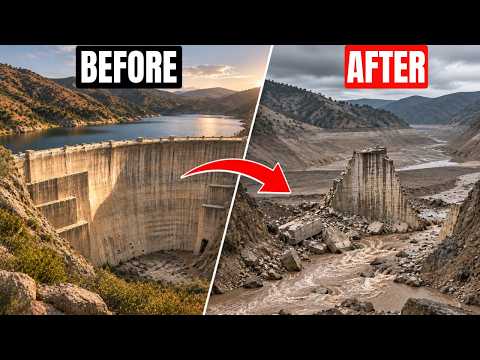
In August 1975, Typhoon Nina stalled over Henan, China, triggering the catastrophic collapse of the Banqiao Dam—the deadliest structural failure in civil engineering history (with estimates up to 230,000 dead). How does a dam fail like that, and why did every disaster in this forensic engineering documentary give a physical warning first?
This investigation breaks down the five mechanisms of dam failure—overtopping, internal erosion (piping), foundation failure, spillway collapse, and reservoir landslides—across six historic disasters: Banqiao Dam, Teton Dam, St. Francis Dam, Malpasset Dam, Oroville Dam, and Vajont Dam. Drawing directly from official forensic inquiries, we examine how gravity dams, concrete arch dams, and earthfill embankment dams fight hydrostatic pressure, pore water uplift, and seepage—and which failure mode is the hardest to catch in time.
• Banqiao and Shimantan Dams, Henan Province (August 1975): A 1,000-year design flood, sluice gates cut from twelve to five, severed communications, and a cascading overtopping failure that breached 62 dams.
• Teton Dam, Idaho (5 June 1976): A US Bureau of Reclamation zoned earthfill embankment dam with a wind-blown silt core, a key trench in jointed volcanic tuff, and no filter zone. A seep turned cloudy at 07:00; internal erosion (piping) breached the dam at 11:57 on its first filling.
• St. Francis Dam, California (12 March 1928) & Malpasset Dam, France (2 December 1959): Two catastrophic foundation failures. William Mulholland's curved concrete gravity dam gave way on weak schist and red conglomerate, killing at least 431 people. Thirty-one years later, André Coyne's doubly curved thin arch dam at Fréjus lost its left abutment to hydrostatic uplift in the gneiss behind a geological fault.
• Oroville Dam Spillway Incident, California (February 2017): High-velocity flow and slab uplift tore open the main concrete chute, forcing water over the unlined emergency spillway weir and triggering the evacuation of 188,000 people.
• Vajont Dam, Italy (9 October 1963): A 262-metre double-curved concrete arch dam that withstood a 250-metre megatsunami when 260 million cubic metres of Monte Toc collapsed into the reservoir, destroying Longarone and killing nearly 2,000 people.
Which of these five failure mechanisms do you think is the hardest to catch in time?
CHAPTERS
00:00 - The 5 Warnings Every Dam Failure Gives
01:02 - Dam Physics: Gravity, Arch & Embankment Dams vs. Uplift & Seepage
04:26 - Overtopping Failure: The 1975 Banqiao Dam Collapse
10:30 - Internal Erosion & Piping: The 1976 Teton Dam Failure
18:18 - Foundation & Abutment Failure: St. Francis Dam (1928) & Malpasset Dam (1959)
26:29 - Spillway Failure: The 2017 Oroville Dam Crisis
30:07 - Reservoir Landslide & Megatsunami: The 1963 Vajont Dam Disaster
33:56 - Which Dam Failure Mechanism Is the Most Dangerous?
More from Stress Fracture
(Next investigation: The 2017 Oroville Dam spillway failure — link to be added at upload)
SOURCES & FORENSIC REPORTS
Independent Panel to Review Cause of Teton Dam Failure, report to the US Department of the Interior and State of Idaho (1976); US Department of the Interior Teton Dam Failure Review Group, Failure of Teton Dam: A Report of Findings (1977); US GAO on the Teton emergency plan; Graham (2008), USBR; Report of the Commission appointed by Governor C. C. Young to investigate the causes leading to the failure of the St. Francis Dam (1928); Engineering News-Record, March 1928; J. David Rogers on the St. Francis geology; ARIA (French Ministry of Ecology) record of the Malpasset failure; Independent Forensic Team Report, Oroville Dam Spillway Incident (2018); Human Rights Watch (1995) on Banqiao; Costa (1985) via US Bureau of Reclamation Best Practices (D-3); Association of State Dam Safety Officials (ASDSO). Corrections, records and family history are welcome in the comments.
MUSIC
'The Encounter' by Scott Buckley - released under CC-BY 4.0. www.scottbuckley.com.au
#damfailure #civilengineering #engineeringdisasters
Archive photographs and film in this video are public-domain works of US federal agencies, works whose copyright has expired, or released free of rights; satellite imagery is courtesy of NASA and the USGS. Diagrams and 3D reconstructions are our own and are labelled as reconstructions. Stress Fracture is not affiliated with any agency named. © Stress Fracture