Osmosis and Water Potential (Updated)
3.9M views · Jun 27, 2018 · Education

Comments · 1.5K
@AmoebaSisters · 7 years ago (edited) · pinned
UPDATE: Having a hard time with osmosis diagrams (like the one at <a href="https://www.youtube.com/watch?v=L-osEc07vMs&t=334">5:34</a>) and understanding those terms hypertonic and hypotonic? We have a YouTube Short for that! <a href="https://www.youtube.com/watch?v=nrwCvHyWkjI">https://youtu.be/nrwCvHyWkjI</a><br><br>We like to pin clarifications & corrections at the top of our videos! We are so appreciative of feedback we receive as it helps us continue to improve. In this video, we say the word "molecules" several times. Chemically speaking---the term "molecule" may be ok when referring to water but <b>not</b> salt. Salt is formed by ionic bonds [not <b>molecular</b> (covalent) bonds like you would see in water] so we removed that statement. We also had removed a statement regarding the size of salt affecting its ability to cross a membrane: this video does not mention that salt disassociates in water, so the fact that a salt compound is larger than a water molecule is <b>not</b> the correct reasoning. Just to add: in our cell transport video, we mention ions generally cannot travel across the membrane unassisted, which would be more relevant to this. We also notice in the comments that people have questions about the diagram at <a href="https://www.youtube.com/watch?v=L-osEc07vMs&t=334">5:34</a>. Many textbooks, in our experience, focus on the solution the cell is placed in only. Our diagram at <a href="https://www.youtube.com/watch?v=L-osEc07vMs&t=334">5:34</a> actually labels both the cell (as either hypertonic or hypotonic) AND the solution (as either hypertonic or hypotonic). If assuming no added pressure, look for the area that is hypertonic. It may be the cell that is hypertonic or it may be the solution that is hypertonic. <b>But as the diagram shows, the hypertonic area (assuming no pressure) is where the net movement of water will go.</b> We try to include addressing the cell as well as its surrounding solution, because Pinky noticed her students otherwise tended to memorize terms corresponding to swelling or shrinking, which turned out to hurt understanding. Hope that helps! :)
600
@Bailey5.9 · 6 years ago
I like how my teacher gives us these to watch instead of accually teaching us
2.5K
@esha1854 · 6 years ago (edited)
bet you're watching this a day before your exam 😭
7.2K
@duai7090 · 6 years ago
When YouTube can teach you better than your professor.<br>I can’t describe how thankful I’m, you saved my grades
1.4K
@Isabellahellastella · 8 months ago
Can a production company give them an animated series pls
62
@taestea6390 · 7 years ago
currently in a Amoeba Sister marathon for finals
1.2K
@Coton_Candy · 3 years ago
That fact that two random amoebas on the internet can do a better job of teaching than my teachers
219
@robertaroveta4755 · 6 years ago
Can she be my teacher you literally taught me more in 9 mins than my teachers in 8 weeks
217
@Henkitori · 7 years ago
Who else is studying for a test. Ap bio anyone?
1.7K
@jgdevelops8440 · 5 years ago
I'm taking a college Anatomy and Physiology class and still use these videos as a reference for recalling generalized info. Honestly these are great videos for teaching purposes and are great at engaging your target audience, I'm thoroughly impressed and hope to see consistency through the upcoming years.
507
@TomahawkH · 7 years ago
A fun way to demonstrate osmosis at home is with Umibudo (sea grapes.) Umibudo is packed in super salty water, which makes them shrivel up (by osmosis.) When you rehydrate them in fresh water, you can see them swell up as the water rushes in by osmosis! Osmosis right before your eyes!
116
@alexandarbezanovski5192 · 7 years ago
My college class made this so much more complicated than it needed to be. You guys do such a great job at explaining!!! I've been watching your videos since high school and you never disappoint amoeba sisters!
94
Up next

Enzyme Examples, Cofactors/Coenzymes, Inhibitors, and Feedback Inhibition
Amoeba Sisters · 1.3M views
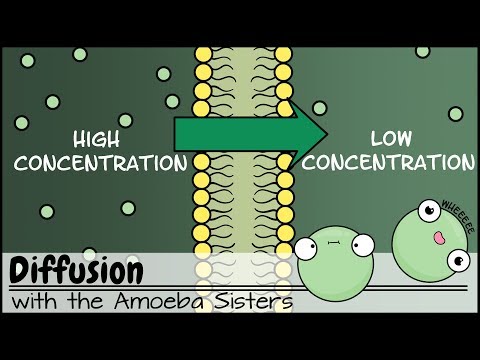
Diffusion
Amoeba Sisters · 2.8M views
Cell Biology | Passive & Active Transport | Endocytosis & Exocytosis
Ninja Nerd · 1.6M views

A-Level Biology - Osmosis - Water Potential | Osmosis in Animal & Plant Cells (2027/28 exams)
Cognito · 31K views

Ecology Review: Food Chains & Webs, Relationships, Nitrogen & Carbon Cycles, Effects on Biodiversity
Amoeba Sisters · 823K views

Avengers: Doomsday | Final Trailer | In Theaters December 18
Marvel Entertainment · 33M views

What is the Most Toxic Pokemon Strategy?
WolfeyVGC · 1.1M views
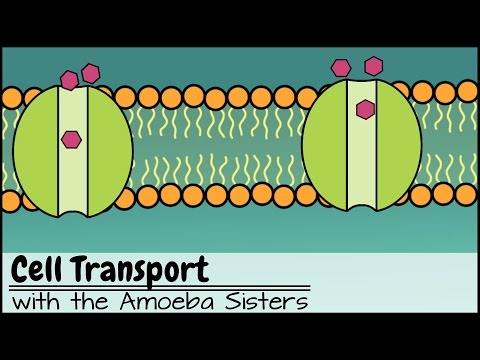
Cell Transport
Amoeba Sisters · 8.4M views

AI Just Crossed the Terrifying Line - Now What?
Kurzgesagt – In a Nutshell · 24M views
Diffusion and osmosis | Membranes and transport | Biology | Khan Academy
Khan Academy · 2.2M views

Action Potential
Amoeba Sisters · 808K views

Dying Is Complicated
Kurzgesagt – In a Nutshell · 6.2M views

Cell Membrane Structure & Function
Ninja Nerd · 861K views

This cell just changed biology
Grist · 1.6M views

Diffusion and Osmosis - Passive and Active Transport With Facilitated Diffusion
The Organic Chemistry Tutor · 330K views

What Is Osmosis? | The Dr. Binocs Show | Best Learning Videos For Kids | Peekaboo Kidz
Peekaboo Kidz · 8.9M views
Sodium Potassium Pump
Amoeba Sisters · 2M views

Cell Organelles - Explained in a way that finally makes sense!
Siebert Science · 1.6M views
Urinary System & the Nephron - Anatomy and Physiology (Made EASY!)
Organized Biology · 90K views

Water potential
Khan Academy · 131K views