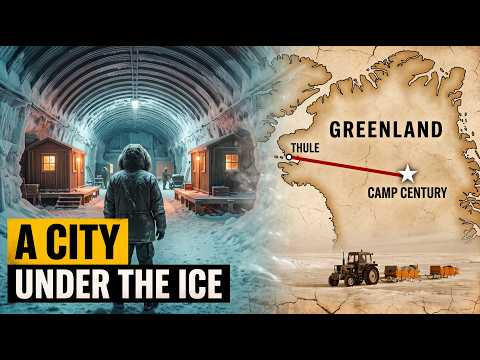
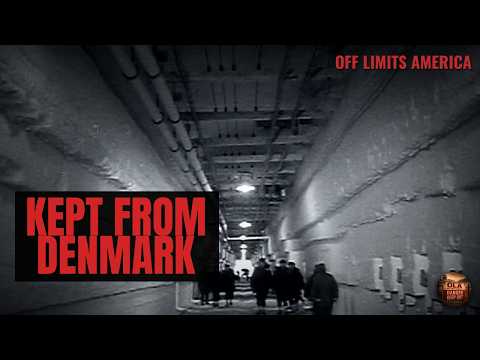
In 1959, the U.S. Army built a real city under Greenland's ice. It had streets, bunks, a chapel and a nuclear reactor, and the Army put it on television. What it did not put on television was a far bigger idea: Project Iceworm, a plan to hide 600 nuclear missiles under the ice and keep them moving by rail.
The missiles never came. Camp Century was real, but the Iceworm network was a proposal that was studied and never deployed. Then the ice began to crush the city, Denmark's policy stood in the way, and in 1963 the plan was rejected. The Army left, assuming snow would bury the site forever.
This is the true story of Camp Century: the reactor under the snow, the secret plan the Danish government was not told about, the Inughuit families moved for the base next door, the lost sediment found in a Copenhagen freezer in 2019, and what the waste left behind means in a warming Arctic.
Drawings of the unbuilt missile network are conceptual reconstructions. They are not military drawings, and no Iceworm missile was ever deployed.
Subscribe to Edge of the Known for more stories from the edge of the record.
Chapters
0:00 The city beneath the ice
1:17 Why Greenland mattered
2:59 Building an impossible outpost
4:37 A nuclear-powered city
6:16 The plan called Iceworm
7:41 Why the idea looked attractive
9:08 The ice refuses to stand still
10:45 A political problem under the snow
12:20 Why the missiles never arrived
14:07 The scientific discovery left behind
15:38 A buried legacy in a warming Arctic
17:21 What the ice kept secret
Sources: E. F. Clark, Camp Century: Evolution of Concept and History of Design, Construction and Performance, U.S. Army CRREL Technical Report 174 (1965). A. Kovacs, Camp Century Revisited: A Pictorial View, June 1969, CRREL Special Report 150 (1970). W. Colgan et al., The abandoned ice sheet base at Camp Century, Greenland, in a warming climate, Geophysical Research Letters (2016). K. H. Nielsen et al., City under the Ice (2014). P. Bierman et al., The Cryosphere (2024). Firn Evolution at Camp Century, Greenland: 1966–2100, Frontiers in Earth Science (2021). NASA Earth Observatory, New View of the "City Under the Ice" (2024). lex.dk, Camp Century. Danish Supreme Court decision of 28 November 2003.
Archival media:
Film: The Big Picture: City Under the Ice, U.S. Army, National Archives 111-TV-514 (public domain; silent excerpts).
U.S. Army and Cold Regions Research and Engineering Laboratory: report photographs, layout plan, PM-2A images, drill and ice core photographs.
U.S. Air Force: Thule Air Base, Minuteman. U.S. Navy: Polaris, USS George Washington. Danish Government: Viggo Kampmann portrait. JFK Library: Kennedy and Kampmann.
NASA: IceBridge photograph, UAVSAR, Camp Century radar image (Michala Garrison, Jesse Allen, Chad Greene, Joseph MacGregor).
Maps: Natural Earth (public domain). Illustrations and animation: original, including the Stick Teacher presenter. Narration: Google Cloud Text-to-Speech. Sound effects: original. Fonts: Oswald, IBM Plex Sans and Patrick Hand (SIL Open Font License).
Music:
"Cylinder Seven" by Chris Zabriskie is licensed under a Creative Commons Attribution 4.0 license. https://creativecommons.org/licenses/...
Source: http://chriszabriskie.com/cylinders/ Artist: http://chriszabriskie.com/
"Dark Walk" by Kevin MacLeod is licensed under a Creative Commons Attribution 4.0 license. https://creativecommons.org/licenses/...
Source: http://incompetech.com/music/royalty-... Artist: http://incompetech.com/
"Darkest Child" by Kevin MacLeod is licensed under a Creative Commons Attribution 4.0 license. https://creativecommons.org/licenses/...
Source: http://incompetech.com/music/royalty-... Artist: http://incompetech.com/
"The New Order" by Aaron Kenny.
"A Quiet Thought" by Wayne Jones.