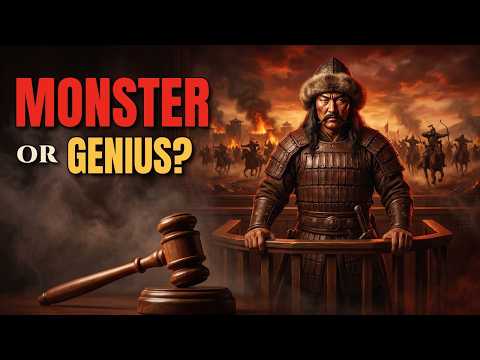
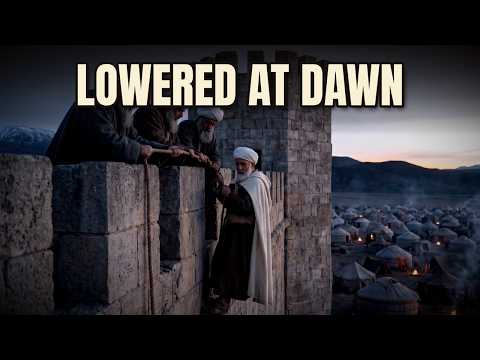
The Mongol Empire reaches the gates of Baghdad in 1258. Witness the final moments of the Abbasid dynasty as history shifts forever.
In February 1258, Caliph al-Mustasim faced Hulagu Khan in a confrontation that dismantled the heart of Islamic civilization. This account follows the events leading up to the Siege of Baghdad , providing a look at the military expansion that defined the era.
Understanding the geography and political collapse of this period offers context for the wider reach of the Mongol Empire . These records detail how the fall of a major power center reshaped the map of the medieval world.
Subscribe for weekly historical breakdowns, and comment which era you want to explore next.
CHAPTERS
The Mongol Empire reaches the gates of Baghdad in 1258. Witness the final moments of the Abbasid dynasty as history shifts forever.
In February 1258, Caliph al-Mustasim faced Hulagu Khan in a confrontation that dismantled the heart of Islamic civilization. This account follows the events leading up to the Siege of Baghdad, providing a look at the military expansion that defined the era.
Understanding the geography and political collapse of this period offers context for the wider reach of the Mongol Empire. These records detail how the fall of a major power center reshaped the map of the medieval world.
Subscribe for weekly historical breakdowns, and comment which era you want to explore next.
0:00 The caliph and the tray of gold
2:00 Temüjin
2:51 Genghis Khan
3:10 The Mongol war machine
4:21 China and the west
4:39 Otrar: the murdered caravan
5:23 Bukhara
6:13 Samarkand, Merv, Nishapur
6:42 Ibn al-Athir: "Would that my mother had not borne me"
7:10 From the Kalka to the Indus
8:23 The empire grows
9:05 Baghdad, city of learning
10:30 The last caliph
10:53 Möngke and Hulagu
12:05 Alamut and the Assassins
12:59 The letters
13:37 No one came
14:03 Three armies
14:37 The flood trap
15:11 The palisade
15:32 The engines
16:00 The Ajami tower
16:23 Escape and surrender
17:09 The sack
17:42 The treasure
18:01 The death of the caliph
18:24 Marco Polo's version
18:47 Who was to blame?
19:10 How many died?
19:39 The books
20:07 The end of a line
20:44 The Ilkhanate
21:52 Syria, 1260
22:21 Qutuz and Baybars
23:18 Next: Ain Jalut
Maps are schematic: routes, camps and the plan of Baghdad are approximate. Casualty figures from medieval writers (800,000 to 2 million) are not reliable; modern estimates vary widely, as the film explains. Stories that rest on one account or on much later writers (the tray of gold, Marco Polo's tower, the Tigris black with ink) are labelled as such on screen.
SOURCES (selection)
Ata-Malik Juvayni, Tarikh-i Jahangushay (trans. J. A. Boyle, 1958) · Rashid al-Din, Jami' al-tawarikh · Ibn al-Athir, al-Kamil fi al-tarikh (Arabic text) · Saadi, elegy for al-Musta'sim (Ganjoor) · Encyclopaedia Iranica, "Hulagu Khan" · J. A. Boyle, "The death of the last Abbasid caliph" (1961) · David Morgan, The Mongols (1986) · Peter Jackson, The Mongols and the Islamic World (2017) · Michal Biran on Baghdad's libraries after 1258 · Timothy May, The Mongol Empire (2018).
PICTURES
Wikimedia Commons, with thanks to the institutions and photographers. CC BY-SA: 26D (Kalyan Minaret, CC BY-SA 4.0); Makaay31 (Mustansiriya, CC BY-SA 3.0); Coopypasted (Otrar, CC BY-SA 4.0). CC0: ImanFakhri (Alamut); The Met (paiza); American Numismatic Society (dinar of Hulagu). Public domain: Diez Albums, Staatsbibliothek zu Berlin; Rashid al-Din, Jami' al-tawarikh (BnF); Juvayni manuscripts (1438); Syriac Bible (British Library); Chinggiskhannama (British Museum); Hedwig Codex (Getty); Livre des merveilles; Hayton, Fleur des histoires (BnF); al-Wasiti, Maqamat (1237); Tevarih-i guzide (1562); Yuan imperial portraits (National Palace Museum); Illustrated Chronicle of Ivan the Terrible; Bodleian MS Huntington 214; Guy Le Strange (1900); dinar of al-Musta'sim (DrFO.Jr.Tn). NASA Blue Marble; Natural Earth.
Music: original score (VSCO 2 Community Edition samples, CC0) and the channel's music library.
#Mongols #History #Documentary