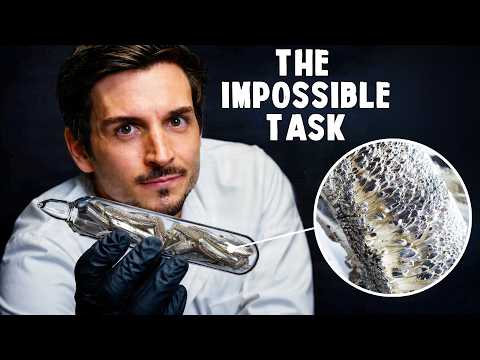
DIY Cooling Fibers Successfully Made!
978K views · Jul 27, 2024 · Science & Technology

Comments · 5.5K
@Nighthawkinlight · 2 years ago (edited) · pinned
Ad: Check out my sponsor and remove your personal information from the web at <a href="http://joindeleteme.com/nighthawk">JoinDeleteMe.com/nighthawk</a> and use code NIGHTHAWK for 20% off. <br>DeleteMe international Plans: <a href="https://international.joindeleteme.com/">https://international.joindeleteme.com</a><br><br>This video ended up being quite a lengthy string of experiments that does finally land on success in the end. There are a number of things I'd like to try now that I've made cooling fibers, first of all to increase the scale of production so I can test various applications for clothing. Using PLA has some great advantages for its ability to biodegrade (under the right circumstances) and also an extremely favorable emission spectra in the infrared range for radiative cooling. The fibers made in this video I think could be suitable as is for certain semi rigid clothing items like hats, but possibly are too brittle for very flexible items like shirts. The brittleness might eventually be resolved by modifications on how the fibers are processed, or by mixing the PLA with plasticizers or another more stringy plastic. Of course I also have many more things to try to increase cooling performance further! Let me know what you'd like me to try next in this series. Check the video description for a link to the complete radiative cooling series to see my other videos on this topic.<br>- Ben
276
@PrivateLZG · 2 years ago
Him saying "I have a really good feeling about this" at minute 25 while the video is 1.5 hours long is never a good sign
3.2K
@xanthirus · 2 years ago (edited)
fun fact, fiberglass insulation is made with basically a large heavy duty water cooled cotton candy machine, also pla pellets are significantly cheaper than the filament in bulk, and would be easier to feed
2K
@Knasen3 · 2 years ago
Not sure you're still seeing comments here but I'll give it a try. I'm writing this at the 1 hour mark, as you asked for suggestions. I work with research on fibre spinning processes, mainly "wet spinning". The cold process you're after is called "solution spinning", specifically. The idea is to extrude the solution straight into a coagulation bath, in your case water. This would also wash out the lubricant right away. But what you need is to draw, or stretch the fibres while extruding in order to orient the chains. The process you are replicating with the cotton candy machine would be "melt blowing", which is typically used for production of non-woven materials. Let me know if you have some questions regarding how to process this at a larger scale and I'll help you out.
473
@First_Take. · 1 year ago
This guy is going to have the coolest merch in the future😊
18
@bob11223 · 2 years ago
Despite your worry of people not liking the "extended" video format, I for one enjoyed seeing more of the process and would not mind seeing more of it.
810
@ojaimark · 2 years ago
I'm obsessed with this whole passive cooling saga. I think it's kind of a shame you didn't happen to have any fiber artists around to bounce ideas off of for this one. Seems like you got a bit focused on recreating fiberglass when in my opinion you're basically just rediscovering the process of how we figured out how to make yarn and faux wool from polymers like polyester and acrylic. They do it by cold extruding the polymer though thread sized holes relatively high up off the ground so that by the time it falls to the ground the solvent has sufficiently evaporated and the thread is cured. Then they take those threads and spin them into yarns. You were basically half way there with the fiberglass mat technique you landed on. By the looks of the final polymer mixture I'd bet you could have done a gravity fed extrusion by just elevating a foil pan with a few holes and letting it drip out. From there you can make mats of jumbled fibers or if you're feeling real adventurous you could try spinning it into yarn. If you did manage to do that I'd be happy to test it out and make some knit or woven samples to test the passive cooling with. Just saying.
1K
@claysparrows · 2 years ago
you call your process "semi scientific" but testing your hypotheses, failing, and trying again is as pure of science as it can get. just because you're not using fancy equipment with very fine control over experimental conditions in a lab doesn't mean you're not being scientifically rigorous. this channel has really reconnected me to my love of science, so thank you and please keep going!
202
@KavinPreston-g7e · 20 hours ago
<a href="https://www.youtube.com/watch?v=G8YBV7GoF_s&t=1276">21:16</a> Hey man I like the idea, BUT when your material was in the liquid form with the solvent I notices the stringing was mutch easier to achieve WHICH IS WHY I think you should use the same method as wigs use, a brush like toll dipped into the liquid material then flung or simply pulled straight upward causing the solvent to evaporate and the material to harden as the material drips off(plus gove me some credit I may make a video attempting this method myself)
1
@Maxwell_Twist · 2 years ago
As a school bus driver, it would be great if we could put that paint on top of school busses.
170
@render1802 · 2 years ago (edited)
As someone who lives on the sweltering Gulf Coast, where the humidity is so high that sweat doesn't evaporate, I love, love, love your alternative cooling series! AND you're doing humanity a huge favor by making it freely public knowledge. Thank you so much, sir!
252
@IlusysSystems · 2 years ago
I was working a very boring job in a factory, so during free time I have accidentally created spiderweb shooting machine using compressed air and T pneumatic fitting. It was super simple:<br>I have dissolved PMMA in acetone, Then I got air gun for blowing air with 6mm nozzle. Connect T fitting to the nozzle and perpendicular to nozzle connect hose to plastic in solution. This makes vacuum by venturi effect and sucks the dissolved plastic. The effect is, that the solvent evaporates super quickly and you shoot out fibers.<br>Because the air is pressurized to about 7 bars, it shoots the fibers long distances, so this may not be best approach for your application.
279
Up next

Making Opals for Free Air Conditioning
NightHawkInLight · 1.5M views

Homemade Machine Turns Bioplastics Into Cooling Fabric
NightHawkInLight · 771K views

18 Drawers Later... Casting Isn't Easy
Pask Makes · 834K views

Solar Is Much Simpler Than You Think! | Off-Grid Solar Explained
Smarter Sparky · 1.5M views
I Sealed a Glass-Destroying Metal in Glass
Advanced Tinkering · 592K views

DIY Potato Aerogel: Free Cooling from Your Kitchen?
NightHawkInLight · 759K views

DIY Fireworks From Kitchen Ingredients (mostly): Senko Hanabi Masterclass
NightHawkInLight · 154K views

My Next Masterpiece!!! I Built a Tool Post Milling Spindle
Marius Hornberger · 1M views

Speedrunning 30yrs of lithography technology
Breaking Taps · 1.9M views

I Learned the Downsides of Cooling Roof Paint
NightHawkInLight · 1M views

2 Hours of Ancient History That Sounds COMPLETELY Fake
Professor Historian · 1.3M views

What Happens When You Mix (Almost) All the Alkali Metals?
Advanced Tinkering · 908K views

How Solid Copper Cuts Through Tank Armor Like Water
VEIN Material · 1.6M views

Turning a $150 AC Into a Super-Efficient Geothermal Unit!
Tech Ingredients · 2.8M views

An Inventor's Attempt to Make "Heat Batteries" With Suspicious Ingredients
NightHawkInLight · 556K views

Why Is Plutonium So Incredibly Dangerous?
Sleep On Physics · 44K views

I Over-Engineered this Machine, cause Manufacturers Didn't
Marius Hornberger · 3.1M views

Nature's Incredible ROTATING MOTOR (It’s Electric!) - Smarter Every Day 300
SmarterEveryDay · 4M views

Strawberries make surprisingly GIANT Bubbles (Best DIY Bubble Recipes)
NightHawkInLight · 467K views

I Tried Building A SUPERSONIC Propeller
Michael Rechtin · 1.5M views