Greg Tang Fluency & Reasoning 2
32K views · Jun 4, 2026 · People & Blogs

Comments · 25
@Nursemidratz · 1 month ago (edited)
A week ago I would have looked at that first problem sideways. Today I solved it in 10 seconds because I saw a picture. I’m 37 😂 Thank you
2
@cwijesuriya · 2 months ago
The way he dose it is mind blowing.
2
@JPT · 2 months ago
Respect, now I can learn my grand children math, something I didn't understand. Below the summary with timestamps (Ai generated):<br><br> <br>Here is a breakdown of the core strategies, explained with the teacher's methodology and relevant timestamps. <br> <br>### 1. Visualize Before You Solve: The Bar Model Strategy <br><b>*Timestamp:*</b> `<a href="https://www.youtube.com/watch?v=FSF0L4Zy9sM">00:00</a>` – `<a href="https://www.youtube.com/watch?v=FSF0L4Zy9sM&t=405">06:45</a>` <br> <br>The speaker begins by challenging the standard approach to word problems like <b>"27 is 3/4 of what number?"</b> <br>* <b>*The "Old Way" (Algebraic):*</b> Students immediately translate this to $27 = \frac{3}{4}x$. They then perform mechanical steps (multiply by 4, divide by 3) without understanding <b>what</b> the numbers represent. <br>* <b>*The "New Way" (Visual/Bar Model):*</b> <br> * Draw a single bar representing the unknown number ($x$). <br> * Divide the bar into <b>*4 equal parts*</b> (since the denominator is 4). <br> * Shade <b>*3 of those parts*</b> to represent the $\frac{3}{4}$. <br> * The problem states those 3 parts equal 27. <br> * <b>*Reasoning:*</b> If 3 parts = 27, then 1 part must be $27 \div 3 = 9$. <br> * Since the whole bar has 4 parts, the total is $9 \times 4 = 36$. <br> <br><b>*Why this works:*</b> It forces the brain to "see" the relationship between the part and the whole. The speaker notes that parents and students alike find this "shockingly easy" because it relies on intuitive logic rather than abstract rules. This method applies to fractions, ratios, and algebraic reasoning. <br> <br>> <b>*Key Takeaway:*</b> Don't jump to equations. Draw a picture (Bar Model/Tape Diagram) first. If you can visualize the pieces, the math solves itself. <br> <br>### 2. Number Sense: Breaking Numbers Apart (Number Bonds) <br><b>*Timestamp:*</b> `<a href="https://www.youtube.com/watch?v=FSF0L4Zy9sM&t=405">06:45</a>` – `<a href="https://www.youtube.com/watch?v=FSF0L4Zy9sM&t=750">12:30</a>` <br> <br>The speaker argues that "Number Sense" is the ability to break numbers apart and put them back together flexibly. <br>* <b>*The 10-Frame:*</b> Use visual grids of 10 to teach addition. Instead of counting up, students see that <b>*8*</b> needs <b>*2*</b> to make 10. <br> * <b>Example:</b> $8 + 6$. Break the 6 into $2 + 4$. <br> * Move the 2 to the 8 to make 10. <br> * Now you have $10 + 4 = 14$. <br>* <b>*Flexibility in Subtraction:*</b> When subtracting across zeros (e.g., $800 - 145$), the standard algorithm requires complex "borrowing" chains. <br> * <b>Strategy:</b> View 800 as **80 tens**. <br> * Take one ten away to get <b>*79 tens*</b> and convert it to **10 ones**. <br> * Now you have 79 tens and 10 ones. The subtraction becomes straightforward. <br> <br><b>*Why this works:*</b> It prevents students from getting lost in algorithmic steps. It teaches them to look at the <b>value</b> of the numbers, not just the digits. <br> <br>### 3. Mental Math & Division: The "Number Bond" Approach <br><b>*Timestamp:*</b> `<a href="https://www.youtube.com/watch?v=FSF0L4Zy9sM&t=750">12:30</a>` – `<a href="https://www.youtube.com/watch?v=FSF0L4Zy9sM&t=1215">20:15</a>` <br> <br>The speaker demonstrates how to perform complex division mentally by breaking the dividend into "friendly" numbers that are easily divisible by the divisor. <br>* <b>*Example:*</b> $91 \div 7$ <br> * Don't try to do it in one step. <br> * Break 91 into $70 + 21$ (both divisible by 7). <br> * $70 \div 7 = 10$. <br> * $21 \div 7 = 3$. <br> * $10 + 3 = 13$. <br>* <b>*Scaling Up:*</b> This works for huge numbers too. For $192 \div 16$: <br> * Break 192 into $160 + 32$. <br> * $160 \div 16 = 10$. <br> * $32 \div 16 = 2$. <br> * Answer: 12. <br> <br><b>*Why this works:*</b> It turns division into a series of simple subtraction and addition steps, leveraging known multiplication facts rather than long division algorithms. <br> <br>### 4. The 11s Trick: Understanding Patterns vs. Memorization <br><b>*Timestamp:*</b> `<a href="https://www.youtube.com/watch?v=FSF0L4Zy9sM&t=1215">20:15</a>` – `<a href="https://www.youtube.com/watch?v=FSF0L4Zy9sM&t=1590">26:30</a>` <br> <br>The speaker introduces the "11s trick" (e.g., $11 \times 54 \rightarrow 594$) but emphasizes <b>*understanding why*</b> it works, not just memorizing the pattern. <br>* <b>*The Logic:*</b> $11 \times 54$ is the same as $(10 + 1) \times 54$. <br> * $10 \times 54 = 540$. <br> * $1 \times 54 = 54$. <br> * $540 + 54 = 594$. <br>* <b>*The Pattern:*</b> When you add $540 + 54$, the middle digit (9) is simply the sum of the outer digits ($5+4$). <br>* <b>*Regrouping:*</b> If the sum is $10$ or more (e.g., $11 \times 75$), the pattern requires carrying over, just like standard addition. <br> * $7+5=12$. Write the 2, carry the 1 to the 7. Result: 825. <br> <br><b>*Why this works:*</b> It builds confidence and shows students that math has logical structures. If they understand the *why*, they can handle the exceptions (regrouping) without panic. <br> <br>### 5. Advanced Reasoning: Singapore Math Problems <br><b>*Timestamp:*</b> `<a href="https://www.youtube.com/watch?v=FSF0L4Zy9sM&t=1590">26:30</a>` – End <br> <br>The speaker presents complex geometry problems (Grade 5 level in Singapore) that look impossible algebraically but are solvable with **visual reasoning**. <br> <br>* <b>*The Overlapping Shapes Problem:*</b> <br> * <b>Scenario:</b> A rectangle, triangle, and square overlap. Shaded areas are fractions of the whole shapes. Total area is known. Find the unshaded area. <br> * <b>Strategy:</b> Assign a variable unit ($x$) to the shaded area. <br> * If shaded is $\frac{2}{9}$ of the rectangle, the whole rectangle is $9x$ (shaded is $2x$, unshaded part is $7x$). <br> * If shaded is $\frac{1}{7}$ of the square, the whole square is $14x$ (since $2x$ is $\frac{1}{7}$, total is $7 \times 2x$). <br> * By expressing all shapes in terms of $x$, you can set up a simple equation based on the total area given. <br> * <b>*Result:*</b> You solve for $x$ and find the answer without complex algebraic formulas. <br> <br>* <b>*The "Half Area" Insight:*</b> <br> * <b>Scenario:</b> Find the shaded area of a rectangle given the area of a triangle inside it. <br> * <b>Strategy:</b> Recognize that any triangle with the same base and height as a rectangle has exactly <b>*half*</b> the area of that rectangle. <br> * This allows you to deduce the area of unshaded regions instantly by subtracting known areas from the "half" total. <br> <br><b>*Why this works:*</b> It teaches students to look for <b>*relationships*</b> (ratios, halves, parts-to-whole) rather than just plugging numbers into formulas. <br> <br>### Summary of the Teacher's Philosophy <br>1. <b>*Visual First:*</b> Always start with a picture (Bar Model) to understand the problem. <br>2. <b>*Number Flexibility:*</b> Break numbers apart (Number Bonds) to make calculations easier. <br>3. <b>*Reasoning Over Algorithms:*</b> Understand <b>why</b> a method works before memorizing the steps. <br>4. <b>*Early Foundation:*</b> These skills must be built in K-5. If a student is behind by 4th or 5th grade, it is very difficult to catch up because they lack the foundational "number sense." <br> <br>The ultimate goal is to create students who are not just "good at math" (following rules) but who can <b>*think mathematically*</b> (solve novel problems).
2
@cwijesuriya · 2 months ago
I can,t believe how smart he is.
1
@lilyludovic7634 · 4 months ago
Thanx mr Tang im 33 and I thought I was good at mental calculation you just make this better thanx again
6
@silvermine2033 · 3 weeks ago
Thank you!
@graphene77 · 4 months ago
Mr. Tang, please, do you have an online course on the subject?
10
@chiomaumunna4832 · 4 months ago
Yes.<br><br>I am of the Igbo tribe from Nigerian and we call 14 " iri Na ano"= ten and four.<br><br>We use combinations like that in our numbering system<br><br>20= iri abuo( two tens).
3
@dorisalim8626 · 5 months ago
Fun fact the chinese actually named 14 10 4
3
@andrezzamonica2835 · 4 months ago
Thank you Mr. Tang, this is gold. 🇧🇷
@kbstrong9775 · 2 months ago
I am so lost at <a href="https://www.youtube.com/watch?v=FSF0L4Zy9sM&t=2442">40:42</a> <br>After he asked what the number bond for 12 was and got 800… can’t get past that one
@heated1333 · 4 months ago
Really Really cool, thank you super much for putting value out there with this video <3!!
Up next

Zverev 🇩🇪 - Alcaraz 🇪🇸 - Finale | ATP Finals 2026 | Highlights - Sky Sport Tennis
Sky Sport Tennis · 141K views

What Happens In 7 Nights If You Talk To Yourself Before Bed? | Carl Jung
The Crimson Scroll · 3.6K views

Math Fluency & Reasoning with Greg Tang
Tang Math Games · 80K views
Greg Tang - Ratio and Proportions
Tang Math Games · 84K views
5 MUST-Know Skills Before You Start Algebra (Make Algebra EASY)
UltimateAlgebra · 151K views

Greg Tang Talk - Math Makes Sense!
Tang Math Games · 71K views

Solving Quadratics Explained (x = 3 Works. What's the Other Answer?)
GCSEZ · 25 views

The most beautiful formula not enough people understand
3Blue1Brown · 1.6M views

Multiplying fractions: why does the rule work?
Eddie Woo · 64K views

Making sense of Math | Greg Tang | TEDxAmoskeagMillyard
TEDx Talks · 112K views
Greg Tang Math Grades 5 8 Word Problem Progressions
Tang Math Games · 38K views

How did they crack the Riemann Hypothesis? - Numberphile
Numberphile · 474K views
Greg Tang - Math Makes Sense! TEDx
Tang Math Games · 445K views

Barack Obama Being Funny for 25 Minutes Straight
Fumble Planet · 190K views

I finally saw quantum physics with my own eyes... (It's spookier than I expected)
Veritasium · 21M views

Greg Tang teaches multiplication
Tang Math · 34K views

Simon Cowell HATED This Song... Until She Sang It and WON BGT!
Golden Voices · 6.1M views

The Frequency of God 963 Hz - Attract love, protection, wealth, miracles and blessings without limit
Frequency Harmony · 1.6M views

How Newton Calculated Pi in Just One Afternoon
STEM in Motion by Gaurav · 1.2M views
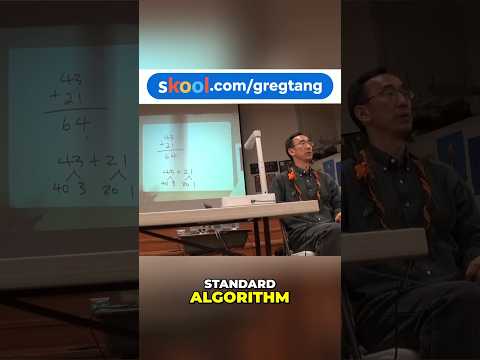
Understanding Math: Addition & Subtraction Explained
Tang Math Games · 55K views