5 Ways To Generate A Sine Wave (Analog)
184K views · Mar 14, 2024 · Science & Technology

Comments · 246
@justovision · 2 years ago
Side note: Using a light bulb to create a stable sine generator was the idea behind Hewlett Packard's first product and they continued manufacturing them in basically the same form into the 70s. I have a 201c from the early 70s on my shelf that still works well.
228
@jyoutishmanroychoudhury3324 · 2 years ago
Learned all this in my bachelor's in Electrical Engineering, which was mostly from a theoretical a numerical point of view, but after watching the applications of it and the simple explanation gave a clear understanding of it. Thanks for making this video, keep up the good work!
83
@InssiAjaton · 2 years ago
A little note about the original pronounciation of Mr. Wien’s name. It was not “wine”. Maybe closer to English spelling would result from “ween”. Probably useless to try making any change, considering that the name of the city — Wien — is in English world also modified to Vienna… Just my today’s rattle!
66
@yottakm3764 · 2 years ago
I needed a Sine wave to go threw me so I plugged my self into the wall
6
@drgazter · 2 years ago (edited)
Please make a video about “negative resistance devices”.<br>You can theoretically make a sine oscillator with just a LC tank circuit and a tunnel diode.<br>Another device that can work is called a “lambda diode”. It’s basically either two JFETs or a JFET/BJT pair that has a I/V curve looking like a capital lambda symbol.<br><br>Speaking of other sine wave generator designs:<br>1.) Triple inverter hysteresis oscillator making a triangle wave over a capacitor followed by an integrator opamp active filter.<br>2.) Emitter-Coupled LC Oscillator, which is harder to explain but it’s basically an attenuated LC tank hooked to an “anti-current mirror” differential amp setup made from two NPN BJTs. Since the common emitter pointing in a constant current sink thing makes the opposite BJT do the opposite thing compared to the BJT in which we feed the LC signal, it acts to increase the oscillation with each swing. However, due to the current limiting element and due to dampening, the oscillation stays a clean sine wave. Furthermore, this oscillator is more exact than the Colpitts or the Hartley variants because it only uses one inductive element and one capacitive element. With like 3 resistors, 2 BJTs, an L and a C, this is one of the simplest oscillator designs besides the tunel diode oscillators.<br>3.) Double active integrator filter inverter loop. Very similar to phase locked loops except you have an active non-inverting proportional-integrator-derivative filter in series with an active integrator filter. It has 3 resistors, 3 identical capacitors and 3 opamps. One of the resistors on the derivative side of the pid needs to be a few ohms lower than the rest (for stability and to avoid saturation).<br>4.) Emitter-Coupled Crystal oscillator (yep, there are those too). Same as the one above but the LC + R is replaced with a crystal.
8
@foureyedchick · 4 months ago
I got an idea: Make a 6Mhz crystal oscillator with a 6Mhz crystal. Pump it through 5 7490 decade counters in series. Go from 6,000,000 to 600,000 to 60,000 to 6,000 to 600 to 60 Hz.Filter the 60Hz square wave into a sine wave with an LC filter. Amplify the HELL out of the tiny sine wave with a car subwoofer amp. Hook up a transformer at the speaker terminals. Connect an outlet to the output of the transformer through a fuse. You got a low-drift UPS for your computers, TVs, etc.
1
@wernerfritsch6436 · 2 years ago
A common way to generate a sine wave used in analog function generators is to generate a triangular wave by switching a current source on a capacitor and then distort the triangular wave to a sine wave with a ladder of diodes and resistors. The THD is not that good (typ. 0.5%), but it is easy to vary the frequency.
44
@dalenassar9152 · 2 years ago
GREAT VIDEO!<br><br>I once made a "variable" sine wave oscillator with a switched-capacitor filter IC. With this filter chip (the mf-10) the output center frequency is determined by a square-wave input. I just varied the square-wave input (10x the output filtered frequency), and got a completly variable sine out, just by varing the input of a 555 timer. This allowed the the output sine frequency and amplitude to be independently varied with an op-amp at the output.<br>thanks again for the video!!
17
@jagmarc · 2 years ago
I've done every one of these in past when I was a designer. There's quite a few things can do with each circuit that makes the sine purer and output level more stable, but most real applications don't need them. The JFET agc is temperature sensitive output level, can get two orders more stability by using a bandgap reference plus long tail pair
3
@ViniciusMiguel1988 · 2 years ago
I wish you had compared phase noise and total harmonic distortion between all of them , because is the most important factors if you need a sine wave oscillator
3
@Neverforget71324 · 2 years ago (edited)
<a href="https://www.youtube.com/watch?v=EhMk6DUbbPk&t=489">8:09</a> My home made sine wave generator uses the Wein bridge configuration with a full wave rectifier to control the JFET... it can generate Sine waves from 1.5 Hz up to about 130KHz and has a ridiculously low distortion (less than 0.05% between 1.5 and 20KHz and about 0.1% above that. So, it definitely is possible to make this work.
5
@jamesmorton7881 · 2 years ago
Where is the twin Tee notch ? It provides very low distortion, stability, and simplicity using an OPAMP. Very good presentation. <br>Check out Analog Devices DDS (direct digital synthesis) for the ultimate in range. Programmed with SPI or I2C. Follow it up with a multiplying DAC for amplitude control.
4
Up next

How To Simulate Your Circuits - LTSpice, Falstad, Pspice
Sine Lab · 23K views

#380: Circuit Fun: Twin-Tee Oscillator - low distortion op amp sine waves
w2aew · 57K views

EEVblog 1771 - A Tricky OpAmp Exam Question
EEVblog · 293K views

Filtering Square Waves to Sine Waves - Simply Put
Simply Put · 83K views
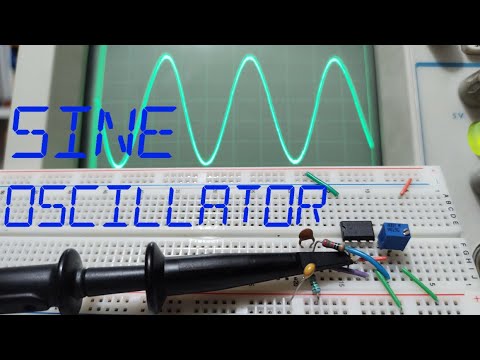
How to Make a Sine Wave Oscillator /w an OpAmp (Wien Oscillator)
5VLogic · 50K views

How a Failed British Computer Company Built a $30 Billion Empire
Computer Secrets · 645 views

WHY Put A Coil Across The Capacitor? Here's Why!
Mr Carlson's Lab · 296K views

How a 555 Works as a Timer.
PKAE Electronics · 266K views

Function/Waveform Generator || DIY or Buy
GreatScott! · 438K views

Never Do THESE 5 Things With Your Hi-Fi Amplifier (#1 Can instantly IMPROVE your sound.)
Honest HiFi · 6.1K views

Operational Amplifiers No 11 Oscillator
Vocademy - Electronics Technology · 20K views

This analog circuit can sound like any drum
Moritz Klein · 328K views

EU Tells USA To BACK OFF! Dutch BAN Microsoft, Bonds COLLAPSE, Trump PANICS
House of El · 114K views

The SHOCKING Truth About The Pyramids No One Tells You
The Diary Of A CEO Clips · 4.6M views

Build A Simple Sine Wave Oscillator
The AudioPhool · 88K views

Does it suck? Chinese DIY Pure Sine Wave Inverter || Sinusoidal PWM (SPWM) Tutorial
GreatScott! · 1M views

Designing an analog delay effect from scratch (BBD)
Moritz Klein · 335K views

How to make a Sine Wave Generator
learnelectronics · 132K views

Why Is a Magnetron So Dangerous?
Grandpa Walter · 311K views

5 Voltage References You Can Make! - Diode, Bandgap, and More!
Sine Lab · 15K views

#61: Op amp oscillators, integrators, and waveforms
Radio Physics and Electronics · 50K views

🚨 PLÖTZLICH ESKALIERT DIE RUNDE! Lisa Eckhart sagt EINEN SATZ – PUBLIKUM RASTET KOMPLETT AUS!
Scharfer Blick · 24K views
The simplest DIY audio oscillator? not a 555 chip. reverse avalanche
LOOK MUM NO COMPUTER · 403K views

The Current State of Siri AI
SAMTIME · 16K views

How Newton Calculated Pi in Just One Afternoon
STEM in Motion by Gaurav · 823K views
How INDUCTOR's work & How to make your own
Schematix · 1M views