Amtrak Pacific Surfliner from San Luis Obispo to San Diego - Apparently a Trip Report
70K views · Nov 18, 2026 · Entertainment

Comments · 451
@bsquiklehausen · 5 days ago
not watching until there's narration and expertise
430
@vince3851 · 5 days ago
A tier line but S tier conductor.
240
@Unmannedperson · 5 days ago
<a href="https://www.youtube.com/watch?v=DMk--63SHOs&t=466">7:46</a>: Hi, bird foamer here. I can confirm that those are, in fact, birds. Hope this helps!
144
@peterkazmir · 5 days ago
Wow. I thought this was a train trip report, but we've got ROCKETS. I don't think Jeb has ever had any rockets.
142
@cheesebuger13 · 5 days ago
This is the last Miles in Transit video before GTA 6
120
@Leetfin · 5 days ago
last time I was this early we had a nationwide ground stop
109
@avaaasimar4730 · 5 days ago
This is a very chatty conductor, quite nice I love kerning random details about exactly why actions are occurring
122
@LeeBee-v1g · 5 days ago
To give context, the railroad was built where it was because the inland line they built first kept getting destroyed.<br>The original California Southern (1880–82) went up the coast only to Oceanside, then turned inland through Temecula Canyon along the Santa Margarita River toward San Bernardino. That was supposed to be the main line. Locals warned them the canyon floods. They built next to the creek anyway. The winter of 1883–84 washed the railroad apart — ties floated to the ocean. Santa Fe rebuilt it. Another flood in 1891 ended the argument.<br>So the Surf Line through San Clemente and San Juan Capistrano (1888) was Plan B: shorter, almost flat, cheap, no tunnels. The coast was empty ranchos (later Camp Pendleton). Easy to grab a thin strip of beach/bluff. There is no hidden LA-Basin-style valley one mile inland — just the San Onofre Hills and Santa Ana Mountains. The next inland option was the flood canyon they’d already tried. That’s also why I-5 still hugs the water through Pendleton.<br>Worse: the Del Mar bluffs weren’t even the first alignment. The 1881 track sat a block inland. In 1910 Santa Fe moved it onto the cliffs for a gentler grade and fewer crossings.<br>It made sense when the coast was empty and this was a secondary Santa Fe branch. Now it’s the second-busiest passenger corridor in the country, sitting on a disappearing shelf. Inland land existed. An inland grade that would stay put did not. From Del Mar through Encinitas, Carlsbad, and Oceanside you’re not looking at a hidden valley. You’re looking at mesas cut by lagoons — San Dieguito, San Elijo, Batiquitos, Agua Hedionda, Buena Vista. Those are drowned canyons. At the coast they’re narrow enough to trestle. A mile or two inland they get wider, wetter, and you have to climb in and out of every one of them. That’s more dirt, more bridges, worse grades.<br>In 1881 this wasn’t a string of cities. It was ranchos and a few beach hamlets. The wagon road already followed the shelf that became Highway 101. The railroad took that same shelf to Oceanside, then turned inland toward Temecula — which is the inland route they did build, and it flooded.<br>Del Mar makes it obvious. The first track was a block inland. In 1910 Santa Fe moved it onto the bluffs because that alignment was flatter and had fewer crossings. They didn’t get stuck on the cliff by accident. They chose the cliff.<br>Oceanside, Carlsbad, Encinitas, Solana Beach later grew up around those tracks. Moving the line inland now means tunnels, lagoons, and houses. In the 1880s it would have meant fighting hills and marshes for no gain.
22
@mmrw · 5 days ago
John was so chill
50
@bob-t3z8v · 5 days ago
The cat train
100
@weeze_the_juice · 5 days ago
shouts out to the birdwatching timestamper guy
25
@Jeff-g1i7x · 5 days ago
<a href="https://www.youtube.com/watch?v=DMk--63SHOs&t=1803">30:03</a> Because ocean water is salty, and thus a better conductor of electricity, when it gets into the track bed it can act as a shunt and show that signal block as occupied in the system. So even though the dispatcher knows there is no train within that block, any train going through must be at restricted speed and prepared to stop short of any obstruction.
81
Up next

Exploring North America's Easternmost City! (St. John's, NL)
Miles in Transit · 92K views

Old trams waste power on purpose. Here's why (*this is mostly an excuse for a tram driving contest)
Tom Scott · 540K views
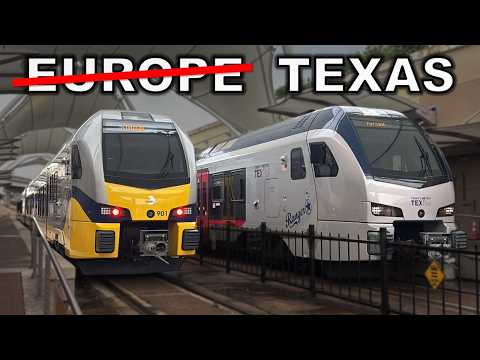
Why Texas is betting on European trains
Trains Are Awesome · 123K views

It's a Fiber Optic Christmas (or... was)
Technology Connections · 2M views

The robot that wants to take control of your life
Drew Gooden · 3.3M views

1939 Europe vs. Modern Africa — Who Would Win?
Wars That Didn't Happen · 387K views

I Went to the Only National Park with an Amtrak Station
Adam · 138K views

Trump Pressures Nvidia to Reinstate CEO Jensen Huang & He Tries to Explain Calling Putin His Friend
Jimmy Kimmel Live · 1.5M views

How To Fly in a Zeppelin (and How MUCH it'll Cost You...)
SteveMarsh · 273K views

Montgomery - Least Used Amtrak Station in West Virginia
Miles in Transit · 112K views

How to Get VIA Rail's Cheapest Sleeper Ticket
Miles in Transit · 79K views

I Fell for Copenhagen’s Biggest Scam. Did You?
Evan Edinger · 104K views

The Least-Used Train in New York (feat. Avery the Cuban American)
Classy Whale · 33K views

City Rail Link Deep Dive!
Taitset · 39K views

I Rode the Longest Peter Pan Bus Trip
Miles in Transit · 113K views

Exploring an Abandoned 1.2 Million Sq. Ft. Corporate Fortress - Empty for a Decade
The Proper People · 540K views

The Russian Air Force is Losing Control of the Sky
Cappy Army · 488K views

Amtrak Adirondack from Montreal to New York - Apparently a Trip Report
Miles in Transit · 109K views

I Crossed America’s Busiest National Park on its Busiest Day
Adam · 251K views

She Changed Their Bar Results
LegalEagle · 1M views