Can I make an A/C out of clay? (2.0)
745K views · Jul 31, 2024 · Howto & Style

Comments · 1.3K
@kristalburns3490 · 2 years ago (edited)
What you are making is really a swamp cooler. A swamp cooler cools by evaporation. So as long as everything is porous and soaks up water and has the air flow, it will cool. I think you should 3.0 this project but I think you need to K.I.S.S. this project. You don't need the pump. You need a reservoir and surface area for air to flow over for evaporation to occur. Humidity is always an issue when it comes to using a swamp cooler. Plants love the humidity or running a dehumidifier helps because when it is time to stop cooling this way you have to make sure everything dries or you come into a mold problem.
3.1K
@revelware · 2 years ago
This is so solarpunk. I like to think of this kind of technology as "Pruning the Tech Tree," or optimizing for high-tech outcomes using the shortest path through the tech tree. I don't think the future of invention will be in increasingly complex solutions, but in increasingly simple ones.
1K
@TheHopefulReset · 2 years ago
It’s not a total fail. I live in Michigan USA. One of our biggest problems is dry air during winter—since our houses are closed up and the furnaces dry out the air. It can be so bad that it damages your house. Not to mention that it is extremely uncomfortable—dry skin, painfully dry eyes etc. As a result, people spends tons of money on humidifiers. What you have created is far more aesthetically pleasing than a mass-produced humidifier. So BRAVO!
1.5K
@danielcoffey4972 · 2 years ago
My grandmother had a fountain that ran for years and years in her living room that utilized this same concept. I was obsessed with it as a child. It looked like a dollhouse-sized section of a terra cotta tiled roof and it just continuously recycled water and used a little tiny fan to help the evaporation (she used it to "keep her plants moisturized"). During the dry fall and winter she had to frequently water it along with her plants to keep it going. :)
424
@andreafeelsfantastic · 2 years ago (edited)
If you leave them detachable you would be able to take them apart to clean in case mold developed or if minerals from hard water started clogging it
866
@runwords_ · 2 years ago
Suggestions for 3.0. These changes will retain the current aesthetic while improving performance and ease of manufacturing. <br>1. Remove the flat bottoms of each layer <br>2. Leaving the the top partially open instead of a closed donut <br>3. Stack each donut onto the groove of the previous layer instead of hanging from a central cone <br>4. Separate the stand from the collection basin <br>5. Minimize water overflow<br> <br>Due to its large surface area and uneven drying rate, the flat bottoms of the current design are the main source of cracking. By removing the bottoms and not sealing the tops, each layer can stack loosely onto one another and allowing for micro adjustments to be made if the water distribution is uneven. The very top cap is essentially an inverted bowl with a hole in the center for the pump tube to distribute water evenly.<br> <br>By leaving the tops of each donut open, you encourage water to funnel into the next layer instead of flowing on the outside which is not optimal. Fired clay is a fantastic material for cooling since porosity = high surface area = faster evaporation. A layer of water negates this property so minimizing water overflow is key. We want just enough water to wick moisture evenly throughout the structure without the appearance of dry spots or looking soaking wet. <br> <br>Making the cone stand separate from the basin provides the benefit of reducing cracking and giving a place to hide the water pump. Alternatively, the stand doesn't have to be a cone at all. The bottom donut can have short but sturdy legs attached to it to support the weight of all pieces above it. Doing this exposes the interior surface for additional airflow and cooling.<br><br><br>Pros: <br>- Easier to throw and trim <br>- Reduced complexity <br>- Reduced weight <br>- Decreased chance of cracking <br>- Much more adjustable <br>- Increased performance <br>- Easier to clean/disinfect <br><br>Cons: <br>- Less stable; more pieces = easier to topple (glue can help with the bottom stand) <br>- Adjustable = more time fine tuning level/flow* (more below) <br> <br>*The biggest issue you'll find is controlling the rate water seeps into the next layer since each layer isn't always the same size as the previous one. The big rings will drain much quicker than the small rings. To solve this tiny holes can be poked in the bottoms of the rings to increase flow. As a general rule smaller rings will need more holes than bigger rings. These holes can be sealed with silicone for adjustment.<br><br>I have more minor improvements and ideas for this including a method to help with the stability issue but this is already getting long so I'll leave those for later if you're interested. Let me know what you think!
479
@bernard832 · 2 years ago
<a href="https://www.youtube.com/watch?v=D0iUNsG4AMc&t=1260">21:00</a> you can see the second crack in that piece when you're applying the bisque fix. Good learning experience, next one will be better!
642
@cmclaren7 · 1 year ago
I grew up in Houston, Texas in the 1950s. The only "air conditioners" were water towers that cascaded water over fans that blew air into the house. These contraptions were housed in wooden louvered tall boxes (towers). My brother and I would cling to the outsides of towers to cool off. They weren't the greatest, but they were better than nothing. Your project reminded me of those water towers.
92
@geneard639 · 2 years ago
I am from Mobile Alabama, the Capital of Musts, Molds, Mildews, Funguses, etc. STACK THEM DO NOT ATTACH THEM! You made a 'Swamp Cooler', they do work but the do put a lot of humidity into the air. Humid Air, Dust (mostly human dander) and any horizontal or vertical surface will grow Musts, Molds, Mildews, Funguses, etc. and they LOVE THE DARK. Cleaning Musts, Molds, Mildews, Funguses, etc. off of even a well glazed surface is an issue if you have access. Musts, Molds, Mildews, Funguses, etc. will actually EAT into everything you come across. Also Legionnaires Disease LOVES moist dark places.... and it got its start in a hotel's Swamp Cooler and is a known killer.
603
@xingcat · 2 years ago
I just absolutely love that this project, despite the issues, was something you saw through to the end, experimented to see if it worked, and showed us everything, cracks and all. And I hope you make another version of this, because it's a really beautiful object in itself. No tips from me...I have no idea how it'd work any better, but I'm here to see the process of what you make next!
78
@tianamatson · 2 years ago
I'm actually really impressed that it cooled down the room as the day got warmer.
8
@JanusXX · 1 year ago
Ah yes the good old evaporator. Works great in the Sahara Desert and other low air moisture environments. You could try making a vase with the most surface area you can, and then add a fan pointing directly to it. There is also the small vase inside big vase and water between them design, it has the bonus property of getting really cool inside the inner vase, so you can store your fruit in it so it lasts longer.
1
Up next
How to upcycle broken pottery into a mosaic
Pottery to the People · 81K views

I made a chair out of clay
Pottery to the People · 139K views
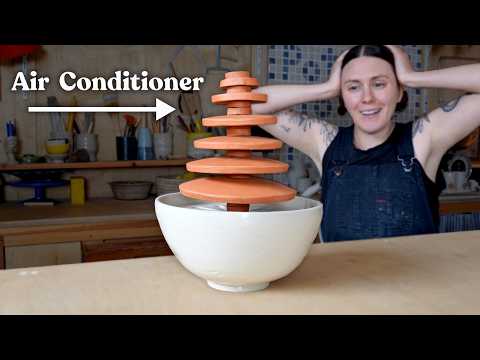
Can I make an A/C out of clay? (3.0)
Pottery to the People · 457K views

Throwing the large and small bowls of the spiral chip and dip
Amy Palatnick · 289 views

Teapot Workshop with George Dymesich
Orchard Valley Ceramic Arts Guild · 741K views

Can I make pottery like Florian Gadsby?
Pottery to the People · 252K views

7 Beginner Kiln Mistakes That Can Ruin Your First Firing
Pottery With Silas · 344 views

Making a hinged box out of clay 🫣
Pottery to the People · 62K views

Digitally Fabricating An Edible Vase: Blender + Photogrammetry
Tiny Spoon · 4.9K views

The Most Inbred Habsburg Ever Born - And His Body Paid The Price
Bizarre History · 2.6M views

Saggar Firing Pottery
The Pottery Wheel · 146K views

I made a chess set out of candles
Pottery to the People · 53K views

Why I made 56 ceramic horses
Pottery to the People · 63K views

Paper Marbling in Florence, Italy with Rajiv Surendra
Rajiv Surendra · 104K views

Make Your Own DIY Olla Irrigation For Cheap or Free!
Andy Ward's Ancient Pottery · 171K views

Trying the Throwdown Challenge Ep. 2 // oxides & design flaws
Pottery to the People · 106K views

How The World's Most Expensive Colors Are Made
Business Insider and Insider Art · 3.7M views

TRADITIONAL CLAY PITCHER: The clay invention for COOLING WATER | Traditional pottery
Eugenio Monesma - Documentales · 210K views
Making furniture out of clay
Pottery to the People · 90K views

Can I make a functional oven? (pt. 1)
Pottery to the People · 52K views