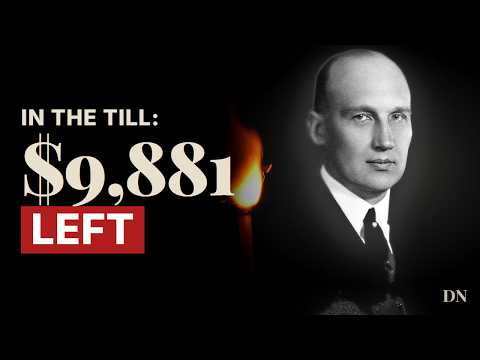
How did Hugo Stinnes buy 4,500 companies with worthless money? The true story of Weimar hyperinflation, the 1923 German money collapse, and the "Inflation King" who got rich while the mark died.
Weimar Republic hyperinflation explained: why a loaf of bread cost 200 billion marks, and why inflation always moves wealth from savers to borrowers.
In November 1923 one US dollar cost 4.2 trillion German marks. Savers, pensioners and widows with war bonds lost everything. But one industrialist, Hugo Stinnes, borrowed paper marks, bought coal mines, steel mills, ships, newspapers and banks, and paid his loans back in money that was worth nothing. Time magazine called him "the New Emperor of Germany". Then Germany fixed its money in a matter of weeks with the Rentenmark, Stinnes died in April 1924, and his empire of about 4,500 businesses fell apart within a year. This documentary follows the whole machine: borrow, buy real things, wait. Then it asks the uncomfortable question: in a world of slow inflation, are you the saver or the borrower?
Chapters
0:00 A loaf of bread: 200 billion marks
1:05 A coal boy from the Ruhr
2:00 Building the machine
3:06 A war paid with paper
3:57 The first crack
5:15 Why not just stop printing?
6:16 Inflation: savers lose, borrowers win
7:14 Two brothers
8:14 Step one: borrow
9:18 Step two: buy real things
10:27 Step three: wait
11:13 The New Emperor of Germany
12:11 1922: the mark breaks
13:02 Soldiers in the Ruhr
14:47 The printing presses run
15:49 Wages paid twice a day
16:51 $1 = 4.2 trillion marks
17:44 4,500 businesses
18:51 Who really paid
20:01 The Rentenmark miracle
21:12 The men who stopped the presses
22:12 The trap closes
23:14 Death of the Inflation King
24:02 The empire collapses
25:51 The bill for everyone else
26:38 Was he a villain?
27:36 The rules haven't changed
28:25 The biggest borrower today
30:19 What Stinnes got wrong
31:42 The lesson
Sources: Columbia Encyclopedia (6th ed.), "Stinnes, Hugo"; Deutsche Biographie / German and English Wikipedia articles on Hugo Stinnes, the Stinnes–Legien Agreement, the Occupation of the Ruhr, the Rentenmark and Hyperinflation in the Weimar Republic (with their cited literature); Federal Reserve Bank of Richmond Economic Review (1980) and Journal of Economic History on Reichsbank discounting; Time, 17 March 1923; US Bureau of Labor Statistics (CPI, June 2022); US Treasury Debt to the Penny.
This is an educational history documentary, not financial advice. Some scenes use AI-generated reconstructions; archival photos are from Wikimedia Commons and the German Federal Archives (Bundesarchiv).
Music: "Hidden Agenda", "Lightless Dawn", "Crypto", "Floating Cities", "Investigations" by Kevin MacLeod (incompetech.com)
Licensed under Creative Commons: By Attribution 4.0 License
http://creativecommons.org/licenses/b...
Image credits (Wikimedia Commons):
CC BY 2.0: muelheim (Rutger van der Maar); muelheim-2 (Rutger van der Maar); colliery (Rutger van der Maar)
CC BY 3.0: berlin-1920s (Willy Pragher); berlin-1920s-2 (Willy Pragher); stinnes-share (Dr. Karl-Heinz Hochhaus)
CC BY 4.0: hamburg-port-2 (unknown); grocery (Tessa Bury); wage-packet (scan: OSRA.Ackermann); wage-check (scan: OSRA)
CC BY-SA 2.0 de: reichsbank (Bettenburg)
CC BY-SA 3.0: reichsbank-2 (Jörg Zägel); newspaper (unknown); us-capitol (Martin Falbisoner); federal-reserve (AgnosticPreachersKid); bank-of-england (Diliff); rwe-plant (Teta); reichstag (Loritz); notgeld-basf (Johannes Franz); stinnes-grave (Ruesterstaude)
CC BY-SA 3.0 de: reichstag-1920-2 (Bundesarchiv); ruhr-occupation (Bundesarchiv); stresemann (Bundesarchiv); hitler-putsch-2 (Bundesarchiv); hotel-adlon (Bundesarchiv); unemployment-1920s (Bundesarchiv); inflation-2 (Bundesarchiv); inflation-3 (Bundesarchiv); inflation-4 (Bundesarchiv); coal-mine-ruhr (Bundesarchiv); coal-mine-ruhr-2 (Bundesarchiv); steel-mill (Bundesarchiv); steel-mill-2 (Bundesarchiv); stinnes-portrait (Bundesarchiv); stinnes-portrait-2 (Bundesarchiv); wallpaper (Bundesarchiv); money-bags (Bundesarchiv); money-bags-2 (Bundesarchiv); notzeit (Bundesarchiv); crowd-shop (Bundesarchiv); stinnes-funeral-2 (Bundesarchiv)
CC BY-SA 4.0: stinnes-legien (Bain); rentenmark-coin (Шивва Рудра); house-us (Michael E. Arth); billion-overprint (Wolfmann); coin-200 (Radler22)
Subscribe to Deep Answers for real history, real numbers, explained simply.
#hyperinflation #weimarrepublic #economichistory