Nobody Ever Told You What the Fourier Series Actually Does
3.2K views · Aug 27, 2026 · People & Blogs

Comments · 3
@CraigNull · 3 weeks ago
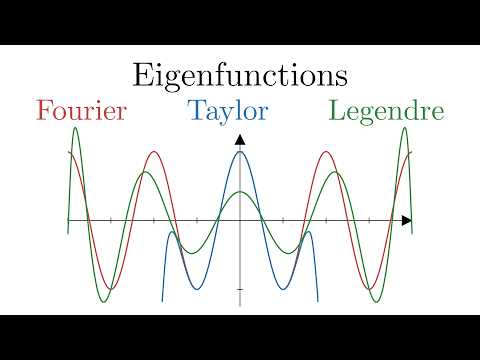
"The universe hums in circles"<br><br>I'd rephrase this as, the universe *can be expressed with circles*. But it can also be expressed in many other ways too, in an exactly analogous matter.<br><br>This idea, that an arbitrary function or wave can be decomposed into a sum of a given sequence of fundamental functions, is not unique to sines and cosines. There are also orthogonal sequences of polynomials, wherein any function on an interval can be expressed as a sum of those specific polynomials. Examples are Hermite polynomials, Chebyshev polynomials (in the appropriate context in which orthogonality applies, anyway. Chebyshev polynomials are for functions restricted to [-1, 1], for instance).<br><br>You can make orthonormal sequences of triangular waves, then express any function as a sum of those. Off the top of my head I don't recall the convergence or smoothness criteria, because it sounds dicey to express a smooth function as a sum of jagged ones. But you'll still get pointwise convergence, at least. Does that mean the universe hums in triangles? Maybe so, if you find triangle functions innately appealing.<br><br>In fact, you can start with ANY sequence of linearly independent functions you like, f1, f2, f3, ... then, express an arbitrary function F as a linear combination of them, a1f1 + a2f2 + ... in the following manner: first, apply the Gram-Schmidt process to f1, f2, f3, .... to create another sequence of functions, g1, g2, g3, ... that are mutually orthogonal, where g1 = f1, g2 is a linear combination of f1 and f2, and in general gk is a linear combination of f1, f2, ..., fk. Then you can use a Fourier-style integral formula to find the coefficients with which arbitrary function F can be expressed as a linear combination of the g1, g2, g3, ... . Then back-substitute the gk functions for the fk you started with. Thereby, you've expressed an arbitrary function F as a linear combination of any infinite sequence of linearly independent functions you wish. See also the topic of Wavelet Analysis for furtherance of the topic of express arbitrary signals as a sum of arbitrary component pieces.<br><br>The sinusoid of specifically trigonometric functions is not unique in this regard. You might say, they're special because they're prettier, or their origin from circles makes them more natural. It's often useful, specifically because due to the smoothness of these functions, regularity, boundedness over the whole real line, and that they satisfy the simple differential equation y'' + y = 0 (or harmonics thereof), which makes expressing functions as sums of sines and cosines uniquely useful in applications in physics and elsewhere. But within the question of: when can you express an arbitrary function as a sum of a given sequence of functions, and how might you go about it in a simple way, sines and cosines are not distinguished
2
@Marian-r3k · 2 weeks ago
la IA hace los guiones mas aburridos ...
Up next
But what is the Fourier Transform? A visual introduction.
3Blue1Brown · 12M views

Nobody Ever Told You What the Schrödinger Equation Actually Says
Source Code of Reality · 4.2K views

Isolating Harmonics: How Fourier Analysis Breaks Down Reality
SynapticByte · 6.1K views

The Simplest Equation That Creates Chaos
Source Code of Reality · 7.5K views

Nobody Explained the Fourier Transform Like THIS!
Longhand · 1K views
From Heat to Hilbert Space: The Complete Story of Fourier
Animated Math · 74K views

Nobody Explained Sine and Cosine Like THIS!
Longhand · 180 views
Fourier series are much more general than you think
CMMath · 38K views

Why Neural Networks Secretly Rely on This 300-Year-Old Math?
Curiosia · 202 views

EU Tells USA To BACK OFF! Dutch BAN Microsoft, Bonds COLLAPSE, Trump PANICS
House of El · 244K views

The Fourier Series and Fourier Transform Demystified
Up and Atom · 1M views

The SHOCKING Truth About The Pyramids No One Tells You
The Diary Of A CEO Clips · 4.7M views

The Math Formula Physics Cannot Live Without
Animated Math · 68K views
What Powers An Electron? The Answer Will Shock You
The Roger Physics · 360K views

Nobody Ever Told You What E = mc² Is Hiding
Source Code of Reality · 10K views

The Most Beautiful Equation in Mathematics
Source Code of Reality · 8.9K views

Fourier Transform Best Explanation (for Beginners)
Brain Station Advanced · 717K views

The Problem That Took 2,000 Years to Solve | The Birth of Calculus
Source Code of Reality · 5.4K views

Why Is It Always 1/2? (Riemann's Impossible Formula)
ZetaChi · 943 views

Nobody Explained Maxwell's Equations Like THIS!
Animated Physics · 532K views