What if angles were metric?
1.4M views · Aug 14, 2026 · Science & Technology

Comments · 2.7K
@jonathanbuzzard1376 · 1 month ago · pinned
No I never wondered why there was not a "metric" or more correctly decimal version of angles because there is one and every scientific calculator I have ever had going back over 40 years can do them. They are called Gradians, a right angle has 100 of them.
1.6K
@mezzer34 · 1 month ago
I've spent 25 years as a controls engineer. Radians are basically our defacto SI unit. All the maths functions expect them anyway, it makes working out circle stuff easier... just better
3.1K
@scott_the_engineer · 1 month ago
I was not expecting to hear "Bulletproof by La Roux" in the intro. I haven't heard that song in probably 15 years.
599
@coffeeskittlez8205 · 1 month ago
1000 years from now, this will be found on the bottom of the ocean and be the next Antikythera mechanism
1.9K
@lolcat23 · 1 month ago
“These tiny components”<br><br>The watchmaker in me laughs! <br><br>Great vid as usual 💪
228
@TheDoubtEngine · 1 month ago
Err a mil (aka milliradian) An angle equal to 1 metre wide at 1000 metre range is 1-mil.<br><br>This angle unit is used by all NATO armies for measuring/recording angles and is metric.
61
@anj000 · 1 month ago
Damn that intro music. Haven't heard it a while, and I would never in a million years predicted it to be used in video like this.
979
@klikkolee · 1 month ago (edited)
<a href="https://www.youtube.com/watch?v=BMCxCuTc1MA&t=2250">37:30</a> fun fact: without a cellular connection, it can take tens of minutes to get GPS started. This is because the satellites use code division multiple access to be able to share a small set of radio frequencies between satellites. Receiving a CDMA signal requires first "acquiring"* the signal, meaning the receiver is constantly adjusting decoding parameters until it gets an intelligible signal. Acquiring the first satellite can take significant time. Afterward, the messages from the satellite include pieces of an "almanac", which has the information needed to greatly narrow the search for acquiring other satellites. But getting a whole, up-to-date almanac from one satellite takes 12.5 minutes.<br><br>Cellular providers generally broadcast the current GPS almanac to devices on their network, allowing them to skip the slow first acquisition and waiting for the almanac, and quickly acquire satellites.<br><br>clarification based on responses: the "can take" in "can take tens of minutes" is doing a lot of work. As receiver hardware developed, newer chips became capable of acquiring GPS signals faster. However, old chips (GPS or otherwise) tend to have long product lives, so I was expecting the slow GPS fix shown in the video to mean the clock was built with an old GPS receiver chip. However, after watching the video of the clock being made, I saw that it uses a relatively modern chip (NEO-6 family chip, 2010s, in the form of the GT-U7 module), which advertises a time to first fix of 32 seconds. I don't know why it took so much longer in this video. I'd like to point out that achieving this fast fix time requires significant hardware, with the module using the chip advertising "2 million correlators" to achieve this. It also supports being provided with an external copy of the almanac, as phones typically do, and advertises a 3 second time to first fix with an almanac.<br><br>*extra details: a major part of CDMA acquisition is synchronization. CDMA involves mixing the data with high-frequency pseudo-random data. The satellites talk over each other with these mixed transmissions, which each look like noise, but the receiver unmixes the combined mess with a specific satellite's pseudo-random data to get its transmission, and the other satellites' signals stay looking like noise. But the receiver needs to derive this pseudo-random data on its own, and it needs to stay in lock-step with the satellite. If the satellite's RNG is 159 when it transmits a bit, then the receiver's RNG needs to be 159 when it receives that same bit. The receiver knows (or more accurately, can calculate) the RNG sequence, but the receiver needs to guess where in the sequence the signal is at until it guesses right and the data appears.
526
@santherstat · 1 month ago
<a href="https://www.youtube.com/watch?v=BMCxCuTc1MA&t=35">0:35</a> I love "pretengineers". such a fun word
981
@yasnac7576 · 1 month ago
Okay, here's one for you. In 1985 I went to work for Boeing in Ridley Park PA. I was Hired mainly to work on the v 22 osprey development program. At the time I had about 22 years experience in cnc manual machining and theory. I was put into a manual machine shop to start and found out that their prints were a mess. A f*<b>***</b> mess! Here they had inches and metric mixed together on the same print. Angles in degrees minutes seconds and in a new thing they call decimal degrees for Boeing. It was new. I went to my supervisor. He shugged his shoulders and then said make it as best you can. Scott. So I got together with a few of my buddies who had a lot of experience just like I. And we went to the drafting department and asked them why is this so on brand new prints. Well it turns out they were on a tight budget and when the clock red reached a certain time everybody stopped what they were doing and the next shift came in and a different person was working on the print that wanted to use something other than what was on the print. It was a f*<b>***</b> mess. Those first 2 years of v22 development was a s*** show. So they backed off everything. Went back to imperial but angles stayed 100 base. Meaning angles were 45.250 ° they were easy to convert on a calculator. So this prints in the beginnings had many red marks on them. I left that program in 1989 and went over to the ch47 program. Rebuilding Chinook helicopters... No wonder v22 crashed in the beginning
6
@MachiningandMicrowaves · 1 month ago
The hammer-finish on the knob is just wonderful. Another great video. Took me back to seeing La Roux with my grandkids in 2009
2
@NickCombs · 1 month ago
Just to flesh out the discussion on degrees a little, ancient Mesopotamians are said to have favored numbers that maximize divisors for easy calculations. Sixty has a great many: 1,2,3,4,5,6,10,12,15,20,30,60. This logic also carries over to our timekeeping with hours, minutes, and seconds.<br><br>There is also an interesting biological explanation for the 12 hours. They would use their thumbs to point to the segments of their other fingers to count. 4 non-thumb fingers x 3 segments is 12.
154
Up next

The Most Beautiful Ridiculous Thing I've Ever Made
Clough42 · 358K views
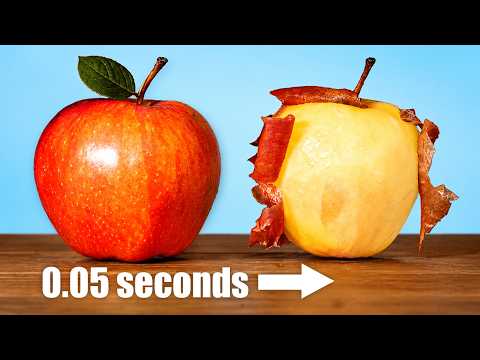
I made an apple peel itself
Stuff Made Here · 3.5M views

#37 4-jaw chuck, grinding the jaws
Po Mojemu · 62 views

You can't buy this, so I Built it myself
Marius Hornberger · 473K views

The Scariest Chart in Electrical Engineering
Veritasium · 5.9M views

Recreating a 370 Year Old Clock - That Runs SILENTLY
Many Vices · 80K views

The Horror Of Dune's Spaceships
The Art Of Storytelling · 5.4M views

I Bought the $100,000 Amazon Van You’re Not Supposed to Own… Now I Know Why
Rich Rebuilds · 4.1M views

Police Demanded A Password; It Deleted The Phone
LegalEagle · 1.4M views
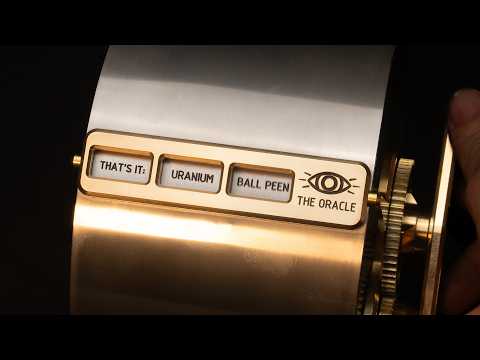
I made a mechanical counter, but it's a little bit different.
Not An Engineer · 1M views

I FINALLY Cut Granite with my Ancient Egyptian Drill
IntoTheMap · 442K views

Are gears that bend, better?
Not An Engineer · 844K views

This is Why They Don't Make These Anymore...
Alec Steele · 5.3M views
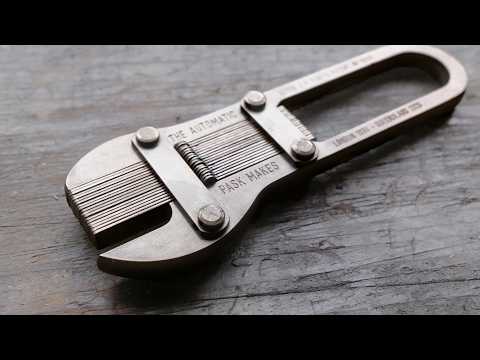
Why Was This 1896 Tool Forgotten?
Pask Makes · 1.3M views

Nothing Packs a Bigger Punch in a Smaller Package Than a Strain Wave aka Harmonic Drive Transmission
driving 4 answers · 497K views

Making the Fastest Blade on the Internet
Inheritance Machining · 2.1M views

How does a Hammond organ make a sound? I built one to find out.
Uri Tuchman · 461K views

When you audition without giving a f**k
ScreenPuff · 12M views

The Grid That Doubles the Strength of the Ground
Practical Engineering · 917K views

I Spent 500 Hours Making This Tool... And I Had to Let It Go
NBR Works · 336K views