#772 Basics: Switching Power Supplies (part 1 of 2)
576K views · Apr 22, 2021 · Science & Technology

Comments · 549
@119988al · 11 months ago
Being in the elecronics industry for over 50 years, I can say that this guy is a very good teacher. He takes the time to explain the concept before digging into the actual circuit. Great Job !
17
@diamondhands2 · 9 months ago
This is INCREDIBLE. Massive thanks from a struggling electronics engineering student. I'm not "required" to understand how any of this works but it's giving me some much needed context to everything I'm studying. Thank you for reminding me why I'm studying this stuff. :)))
7
@jj74qformerlyjailbreak3 · 3 years ago
This channel could never get enough credit for all the work you’ve done here on YT. <br>Best switcher video I’ve seen. <br>Thanks
35
@ponymoore6140 · 3 years ago
At kast I understand how a Switching Power Supply works - thank you.
5
@bobkozlarekwa2sqq59 · 5 years ago
You’ve done a great job simplifying switching power supplies something that I’ve been somewhat intimidated about
65
@Leo-pd8ww · 5 years ago
I've been looking for a while now for a clear top down approach of power supply basics exactly like this. Explained very well. I really like the approach, thank you!
69
@MathuraSingh-x3p · 2 months ago
Great teacher; .explains wonderful.
2
@Wranorn · 1 year ago
One of the best videos explaining each component, stage, and why it works.
3
@irgski · 3 years ago (edited)
Very good explanation of one of the “mysteries” of electronics - AC to DC switching power supplies!<br>A few comments/suggestions:<br>1) You forgot to show the “AC side” GND symbol/connection to the “-“ side of the bridge. This is typically designated with a different and unique GND symbol to signify that it is DIFFERENT than the GND potential on the “DC side”.<br><br>2. The “DC Side” GND symbol should be unique and distinct from the AC side GND. They should NEVER be connected together. <br><br>3. You should highlight the main reason for both the transformer and optoisolator is to create a galvanic isolation between the AC and DC sides of the circuit to prevent stray currents, emi noise and, to safely separate and isolate the high voltage AC and rectified DC from the low voltage DC side of the circuit.<br><br>4. Finally, perhaps a mention should be given for connecting an oscilloscope to this circuit..esp the AC side and how this should be done with a high voltage differential probe or a battery powered scope that can handle high voltages.<br><br>And finally,<br>5. SAFETY FIRST when working with high voltage AC or DC circuits. Preferably use an isolation transformer and a VARIAC.<br><br>Final note: Y” caps failure mode is “open” and “X” caps fail shorted..which would cause the AC line fuse to blow.<br>These caps control and minimize the common mode voltages and currents.
15
@ovalwingnut · 4 years ago
Wonderful talk. At the risk of sounding "to adult" :) I'd like to say I don't think many things in life are as Noble as passing your experience(s) forward to others. It [is] a form of immortality. I don't think we would have succeeded as a species without this one (very) important self-sacrificing attribute. You are a "good human" IMSA Guy. Live long and prosper. Cheers.
22
@ahmedgaafar5369 · 4 years ago
what a freaken lucid explanation...!!! well done man.
2
@amigo4558 · 3 years ago
Step by step guide and explanation on how an eliminater works. I have a good number of adaptors, not functioning. I shall try to put them in order with your guidance. Thank you so much.
1
Up next

#773 Basics: Switching Power Supplies (part 2 of 2)
IMSAI Guy · 32K views

Faulty Switching Power Supply: Complete Repair in Practice
Eletrônica Brothers · 339K views

This SMPS Power Supply Has No OptoIsolator or TL431. How Does It Work? Switch Mode Repair
Learn Electronics Repair · 20K views

Someone Cloned My Product And Did A Terrible Job Of It
Clough42 · 317K views

Everything is Better: GaN vs Silicon Power Supplies
ElectrArc240 · 821K views

Linear DC Power Supplies - Designing & Building Custom DC Power Supplies
DroneBot Workshop · 1.3M views

Power Supply Troubleshooting and Repair Tips
Mr Carlson's Lab · 1.5M views

How To Find The Faulty Component On A PCB Without Schematics : A Very Practical Repair Example!
Learn Electronics Repair · 482K views

What Happened to Litz Wire? The Strange Wire That Made Radio Coils More Efficient
Fallen America FM · 52K views

Nobody Saw China's New CD Players Coming - Now They're Selling Like Crazy
Snap Shift · 177K views

Small Signal Amplifiers
Vocademy - Electronics Technology · 796K views

Diagnosing a faulty PSU
bigclivedotcom · 470K views

Explanation of all The Components of a Switched-Mode Power Supply and its Operation
ElectroRobotics · 28K views

How A Switch Mode Power Supply Really Works? Inside an SMPS
NOBTRONIX · 137K views

Every Component of a Switch Mode Power Supply Explained
ElectrArc240 · 1.1M views
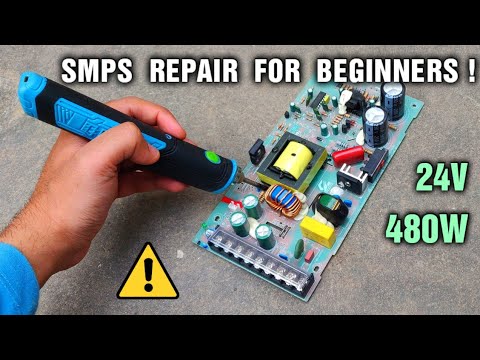
24 Volt 480W SMPS Power Supply Repair - Step By Step
Mr Electron · 344K views

Switched-Mode Power Supply – Complete Lesson (It's not as complicated as it seems)
Eletrônica Brothers · 231K views

#711 Basics: Power Supply (part 1 of 5)
IMSAI Guy · 71K views

You Will Never See an LED Bulb the Same Way Again (Complete Guide)
Eletrônica Brothers · 369K views

A Noise-Free DIY Switching Power Supply - How Hard Can It Be?
element14 presents · 102K views