Inside the ALCO Factory: How America Built the Locomotives That Powered a Nation
57K views · May 22, 2026 · People & Blogs

Comments · 40
@micheltherriault7063 · 3 months ago
During WWII Alco was ordered by the US government to produce only steam locomotives . On the same time , EMD produced and improved their own diesel-electric locomotive who gave them a giant leap forward the competition. After the war , Alco rushed the production of their own passenger and freight locomotives. Their own faithful customers have lost confidence in Alco’s products mainly due to the infamous 244 engine. Launch too early without completely tested . The customers turned back and choose EMD instead. The damage was done even after the arrival of the 251 engine, the best engine they had made, the last years was a suite of bad and badder decisions who’s leading to the end .
5
@williamh.jarvis6795 · 4 months ago (edited)
Beginning at the <a href="https://www.youtube.com/watch?v=9_bOMfGIEO8&t=180">3:00</a> mark I know where the "Manchester Locomotive Works" was located, in the City of Keene, NH. The structure still stands. The structure was last used as a mini mall/shopping center. (The Center of Keene, located between Emerald Street and Gilbo Avenue.)
6
@kellyswoodyard · 4 months ago
The 636's that were built in Australia, for use in the iron ore mines in the Pilbara worked there for over 20 years, 2 loco's dragging 26,000 tons of iron ore, about 300 odd miles, from mine to port, 24/7/365. Those iron ore producers only gave up on them because they couldn't get spare parts. In Sydney, A.E. Goodwin and Son, were the first company outside of America to get a licence to build ALCo loco's. The New South Wales government owned rail system were 100% ALCo for decades. South Australian government railways also ran a decent sized fleet of ALCo loco's. Prior to the diesel electric units, there were many ALCo steam loco's used in every state in the country.
2
@LostEmpires-p6b · 3 months ago
What an incredible history, but such a heartbreaking ending. A truly bittersweet story.
2
@MrMopar413 · 4 months ago
I can relate. I worked for a company- Wagner Mining Equipment Co in Portland Oregon started by Eddie Wagner one of I think 7 sons that their father had and they family roots go back to Idaho. The father moved the hole family from Idaho to Portland Oregon I’m not sure around 1920 and was involved in concrete construction business. Then somehow they got into equipment manufacturing and started Wagner Tractor Company. They built a 3 wheeled front end loader that had a fixed mast head a front bucket that would turn on a dime called Scoopmobile. Then around WW2 . All the lifting and bucket tilt was steel cable and winch operated. Then sometime around WW2 they redesigned it to be completely hydraulic operated lift system. The Scoopmobile had side arms that the operator could disconnect from the wheel hubs and you could pull it behind a dump truck- no trailer needed. They where vary popular. Then at the same time they developed the Mix-mobile that was a concrete mixer mounted on a truck chassis that you see today back in the 30’s. And at the same time they developed a 4 wheel drive articulating farm tractor to. They also after WW2 where the first to develop a hydraulic log stacking machine that could in one swoop grab a complete load of logs from a log truck and unload it in one operation. With all this going on. A underground mining company approached Eddie Wagner and asked could you build a 2yard front end loader , rubber tired , center articulated diesel powered machine to be used in underground mining -??? He said yes within about 1.5 years he had 2 machines built for them, this was 1948. That was the brith of or start of Wagner Mining Equipment Co . And the trademark Scooptram. I’d like to mention that Eddie Wagner only completed the 8th grade but could out think a college level engineering. There was some disagreement in the family so Eddie broke off from the family business across the street from the log stacker plant to build a new plant and Wagner Mining Equipment Company around 1955. Over the years he came up with innovative, designs for underground mining equipment that moves blasted out or rock to be transported above ground. His inventions were revolutionary. The company grew and expanded then in 1973 Eddie Wagner went public with a stock offering to raise Capital to expand the plant. That’s when PACAR of Kenworth and Peterbilt took control of the company. More machines were designed and built over the years. I hired on in 1988 then around 1990.PACAR sold it to Atlas Copco of Sweden. The operation continued in Portland till it was announced in 2002 that Atlas Copco would be closing the plant and moving it to Sweden. Through these years in Portland, I work on the shop floor and final assembly as a diesel mechanic. The company was a union shop and we survived by a lot of stupid stuff that management would come up with over the years. The plant was closed the last day for me as a final mechanic March 15, 2004, the last teamster that was the shipping clerk and three machines were shipped out on March 16 of 2004. The product line still exist today under the umbrella of Atlas Copco in their division now named EPIROC. Myself as an employee in final assembly the last year was really tough as we built a final machines. They literally tore the equipment inside the plant, machines and stripped the walls of hose reels, piping, etc., to be liquidated at the auction within a few days after the plant closing. So I can kind of relate to the story. Main thing, management makes stupid mistakes and doesn’t listen to the employees on the shop floor.
7
@frankschultz4170 · 3 months ago
Starting at <a href="https://www.youtube.com/watch?v=9_bOMfGIEO8&t=937">15:37</a> - Now THAT is some "streamlined shrouding"!!!
@Frank-hh5uy · 3 months ago
ALCO was in Auburn, NY and I grew up next to the building which had about 5,000 workers. Now it is an abandoned buildings and torn down buildings. But Micron will build a new plant 35 miles away and maybe some people could rebuild ALCO/ Bombadier.
@wdxwm300 · 3 months ago
Erie Pa GE transportation was in business since 1910 sold Westinghouse air brake Wabtec and still in business making locomotives
1
@timbloemenbuurt6581 · 3 months ago
Funny that the opening shot is in a British locomotive works.
2
@MarkCinque-uq9kh · 2 months ago
Cool look at that one, <a href="https://www.youtube.com/watch?v=9_bOMfGIEO8&t=128">2:08</a>
@frankschultz4170 · 3 months ago
Starting around <a href="https://www.youtube.com/watch?v=9_bOMfGIEO8&t=1138">18:58</a> - Yep, those locomotives look pretty flawless, alright...
@LostIndustrialKingdoms · 1 month ago
Thanks for the video, but the quality needs improvement
Up next

Old American Trains Were Full of Strange Features — What Were They Actually For?
Secret State Files and 4 more · 26K views

The Silent Allis-Chalmers Factory: How a 150-Year Empire Disappeared Without Warning
Old Money Lost · 76K views
The Tragic Fall of America’s Industrial Steel Plant: The Bethlehem Steel Plant, Pennsylvania
Old Money Lost · 52K views

How Steam Locomotive 2102 Produces Thousands of Horsepower
Rail Secrets Unlocked · 57 views

Yellowstone Locomotive: The Forgotten Giant That Rivaled Big Boy
Iron Legacy · 1K views
The History of the Gasoline Engine — The Inventor Who Got It Wrong
Construction Legends · 38K views

Inside the Republic Aviation Factory: From WWII Powerhouse to Forgotten Ruins
Old Money Lost · 19K views

They Built the Atomic Bomb Then Caterpillar Erased Them Forever!
Construction Legends · 52K views

The 5 Most INDESTRUCTIBLE Locomotives Ever Built
Steel on Rails · 12K views

The Rise and Fall of ALCO (American Locomotive Company), the Steam Titan That Lost the Diesel War
Forgotten Engines and Backshift Garage · 39K views

Inside the Fairbanks-Morse Factory: How America Built the Engines That Powered a Nation
Old Money Lost · 9.4K views
ALCo's on the Island
Jordan T · 102K views

Inside the Bucyrus-Erie Factory: How America Built Giants That Could Move Mountains
Old Money Lost · 219K views

Why America Abandoned the Train Routes That Once Connected Its Small Towns
Past Time Travels and The America We Remember · 4K views
The Train That Poisoned Its Own Crew — Union Pacific's Aluminum Streamliner, 1934
Cab Forward · 199K views

Charles Kettering's Electric Starter Ended the Deadly Hand-Crank Era — Then GM Owned His Genius
The Forgotten Inventors · 21K views

The Day The Tractor Became an Industry
TorqueHorse · 24K views

Inside the Philco Factory: How America’s Radio Empire Was Built and Lost
Old Money Lost · 103K views

How Are Nuclear Aircraft Carrier Engines Built? From Reactor to Propeller
Factory Secrets: How It's Made · 31K views
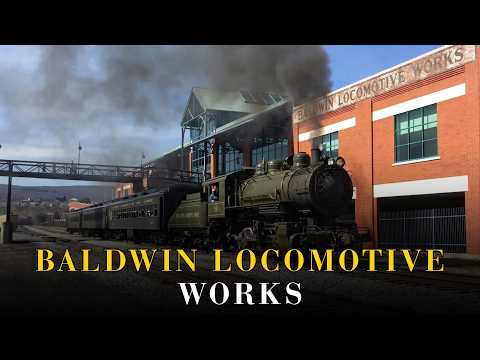
The Baldwin Train Factory: From 70,000 Locomotives to Nothing
Empires Lost · 52K views