Hit Training - Mechanisms of Adaptation - Prof. Gibala
88K views · 6 Oct 2017

Comments · 57
@brickietricks · 4 years ago
I was buying a concept 2 rower for 1,000 euro and martin gibala advocates burpees as the single best exercise if no injurys, tried 10 burpees as fast as you can every minute to total 10 to 15 rounds , didnt bother buying the rowing machine haha, does me now bang out 150 burpees in sets of ten as fast as u can every minute and u dont need a heart rate monitor to know its a hard workout, maybe not for a pro endurance athleate but great for normal people no gym or money required ,brilliant👍
5
@serhiiyankoviy6053 · 5 years ago
I like it
@cv6473 · 7 years ago
Awesome lecture but like @Arjan Meijer H.I.T said: fix the title, please.
1
@JW4REnvironment · 3 years ago
As a layperson (former biology teacher), I find this fascinating research to show how high intensity workouts can lead to clear health benefits despite low time commitments! This is fantastic research to show that the mitochondria respond so clearly to high intensity training. A wonderful comparison of the left leg with the right in the same individuals! Now how can folks in general be informed of such clear benefits for most moderately healthy people? The news media do not seem to do a great job of covering such nifty research, other than science based journalists as smaller media entities like Scientific American versus large entities like Time, Newsweek, or the major radio/television outlets or local news....
@shoehacks · 4 years ago
try continuous training at 70% vo2 max, not 50%.
4
@abbasmukhtar6703 · 4 years ago
This has been a challenging time, and I appreciate you so much Dr Igudia, you have created a life that I thought was lost, thank you so much for curing my Type 2 diabetes
2
@JC.OncoloFit · 1 year ago
You can have a healthy relationship with exercise after cancer.<br>Exercise and fitness doesn’t make you bullet proof against cancer but it’s an amazing tool to improve mental health, build resilience, gain a sense of control, and build confidence in your body.
@ragsSENSEI · 2 years ago
Brilliant presentation Sir. Thank you. God bless you.
@Kataang101 · 5 years ago
Amazing presentation with such thought provoking data on HIIT vs MICT
1
@DavidSmith-gj2dm · 5 years ago
Fantastic work , I’ve got the book , just a question , As an athlete grows fitter , he naturally will be able to make greater inroads in his ability to recover , given his/her increase in strength and performance. Would a reduction in frequency of the stimulus ,ie 3-4 days rather than every other day allow for a continued improvement ? <br>Also is there a possibility that there is a case (in the case of cyclists ) that longer moderate sessions 1hour + allow for the development of a more fluid and therefore more efficient pedalling action is more of a more neurological adaptation than metabolic ? So the body learns to use the more fatigue resistant fibres ,that are more oxidative . <br>I know there is some , but is it all ? <br>Thanks , Dave
1
@TJDASHDASH · 7 years ago
Very well presented!
7
@willjones7132 · 4 years ago
I was just about to go for a ride and do some intervals with long rest in an attempt to simulate a 1-6x6-10 resistance strength training regime, I was thinking 5 min warm up 10 sec on heavy, 2min active recovery, repeat 6-10 times, and cool down 30 mins to facilitate lactate recovery. Pretty interesting to find a video with this; <a href="https://www.youtube.com/watch?v=68LZreG6API&t=936">15:36</a>
1
Up next

High Intensity Interval Training and Periodization - Prof. Rønnestad
ECSS .tv · 56K views

Metabolic Determinants of the Critical Power - Dr. Vanhatalo
ECSS .tv · 15K views
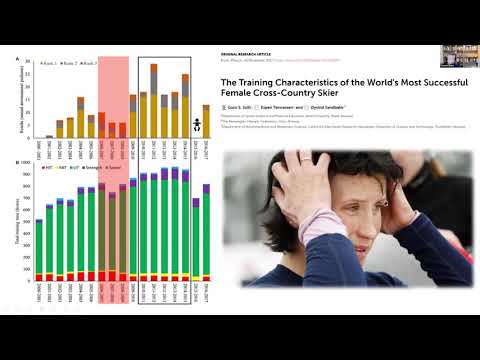
The Holy Trinity of Training Monitoring - Dr. Stephen Seiler
Do North Events · 42K views
The Norwegian Method - Kristian Blummenfelt & Gustav Iden's Winter Lab Testing
Santara Tech · 432K views

Training of the Top-Class Runner - Prof. Jones
ECSS .tv · 19K views

What are the Trainable Components of Endurance Physiology? International Biathlon Union
Stephen Seiler · 58K views

The Most Effective Type of Cardiovascular Training
Institute of Human Anatomy · 1.9M views
How Much Do You Need to Ride to Get Faster? The Science
Dylan Johnson · 367K views

Zone 2 Biochemistry for Biomechanical Energy with Iñigo San Millán — CoachCast Ep 1 Season 5
TrainingPeaks · 79K views

Physiological responses and adaptations to exercise in the heat, George Havenith
The Physiological Society · 9.8K views

Mechanisms of Fatigue During High-Intensity Exercise by Dr. Nathan Townsend
Aspetar سبيتار · 7.9K views

#51 - Maximizing muscle hypertrophy with Dr Brad Schoenfeld
Inside Exercise · 18K views
Long, low intensity endurance sessions: When is Low too low? When is Long too long?
Stephen Seiler · 263K views

How to Increase VO2 Max and How to Improve VO2 Max?
Doctor Yogendra · 339K views

Role of Muscle Glycogen in Exercise Metabolism and Performance - Prof. Graham
ECSS .tv · 8.8K views

What are the Most Effective Intervals? HIIT Science
Dylan Johnson · 526K views

Performance and Training in Cross-Country Skiing - Prof. Holmberg
ECSS .tv · 13K views

It’s never too late – exercise interventions to attenuate age-related muscle loss - Prof. Wessner
ECSS .tv · 33K views

Which Training is Best? HIIT vs Threshold vs Polarized vs Base: the science
FastFitnessTips: Cycling Science! · 174K views
Zone 2 Training: Dose, Frequency, and Duration | Iñigo San-Millán, Ph.D. & Peter Attia, M.D.
Peter Attia MD · 829K views