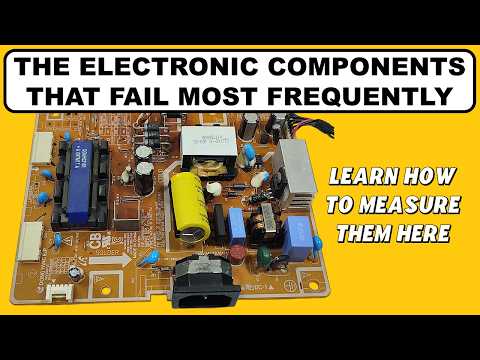
Don't Change Parts Randomly, First Learn to Measure these 5 Components
703K views · Feb 15, 2026 · Education

Comments · 286
@hgchips_IC · 4 weeks ago
The hard part isn't finding a replacement, it's the paperwork. Most industrial customers need the qualification trail, not just the part.
@MJFadeAwayyy · 3 weeks ago
Nice video to learn a little more about control boards 🔥 I’m a HVAC Technician in Alabama 📈
1
@PotteryBoy2001 · 7 months ago
Oh for the days when all the components were big enough to handle. I used to enjoy fixing electronics stuff but I simply cannot deal with all the surface mount stuff.
6
@brianperkins6121 · 9 months ago (edited)
Before measuring a capacitor , set your multimeter to measure DC (Not AC ) at a value higher then the circuits input voltage look at the capacitors rated voltage and set your meter to a value at least that high , then work down if its not auto ranging. , and measure to make sure its not charged ,when handling boards especially any kind of type of switching power supply Always assume caps are always charged so you don't get shocked or damage your test equipment . , always discharge large capacitors through a Resistor of the proper wattage rating and resistance value. shorting them directly out will damage them. Capacitors in tube amps and high voltage circuits like Microwave ovens and Plasma Tv power supply's and photo flash units should be treated like a loaded weapon with extreme respect, as they can easily hold a charge of over 400 volts., microwave oven capacitors are part of there voltage doubler circuit are in a class all there own can easy store a charge in the thousands of volts range and should not be measured with a normal multimeter as that charge is well above the meters rated measuring range, and the probes insulation rating "Will not" protect the user from voltage levels that high ,,. you need special training to safely work with devices like that, .
24
@IsaacJKolo · 9 months ago
First thing is to determine whether the fault is power related or signal related<br>I the power is there, no need to check the bridge rectifier.
13
@bf3272 · 9 months ago
bad solder pins a must check
16
@rinzler9775 · 1 day ago
Thanks - trying to fix an old Sony amp.
@fahey6797 · 7 months ago
I need to get me one of those mult-tim-miter's.
11
@boblevey · 1 month ago
I cannot Believe this!!! This is Amazing!!! Thank you very much for sharing this.. I'll join today!!!
@rogerthat6221 · 2 weeks ago
Very helpful. You have a new subscriber for sure.
@motsiPhathu · 7 months ago
Watching from Johannesburg RSA 🎉 with love and respect. Thanks for the lessons
1
@rogertucker5415 · 9 months ago
the very first component I would check would be fuses
60
Up next
Don't Replace Parts Randomly; First Learn to Measure the Components that Fail Most Frequently.
ElectroRobotics · 612K views

How to Find a Short Circuit FAST 🔥 | Laptop Motherboard Repair
Electronics Repair Basics_ERB · 200K views

Never Search for Your Bed Switch in the Dark Again! (Dual LED Mod)
Peak DIY · 290 views

Are Audiophiles Right? Let's Listen To Capacitors, Resistors, And More!
Mr Carlson's Lab · 139K views

Learn how to make the most of what many people throw away.
Eletrônica Brothers · 727K views

Electronics Tricks for Repairing Electronic Boards
Electro3D · 18K views

Pure Electronics Repair. Learn Methodical Fault Finding Techniques / Methods To Fix Almost Anything
Learn Electronics Repair · 2M views

Faulty Switching Power Supply: Complete Repair in Practice
Eletrônica Brothers · 341K views

How do ALL These Electronic Components Work and How Can you Tell IF they are Damaged?
ElectroRobotics · 3.4K views

The FASTEST Way to Find Shorts on Any Motherboard🔥| Laptop Short Circuit Repair
Electronics Repair Basics_ERB · 586K views

How to Use a Digital Multimeter for Beginners | Voltage, Current, Resistance & Continuity
Gelmar Tech Lab · 1.5K views

Million-Pound Idea With a Safety Pin! A Craftsman Reveals an Unexpected LED Bulb Repair Trick!
SmartTool99 · 2.2M views

How Does a Resistor Actually Work? — Ohm's Law Explained
Weirdward Bound · 181K views

Power Supply Troubleshooting and Repair Tips
Mr Carlson's Lab · 1.5M views

The 12 Most Common Electronics Faults : How To Diagnose And Fix Them
Learn Electronics Repair · 194K views

Easy Electrolytic Capacitor Replacement & Testing Methods
John Salt · 358K views

How To Find The Faulty Component On A PCB Without Schematics : A Very Practical Repair Example!
Learn Electronics Repair · 482K views

How to Tell if a Resistor is Damaged Using a Multimeter
ElectroRobotics · 275K views

How to Solder TINY SMD Components (3 Methods That Actually Work)
Max Imagination · 461K views

Why Does America Use 60 Hz While Europe Uses 50 Hz?
Weirdward Bound · 1.6M views