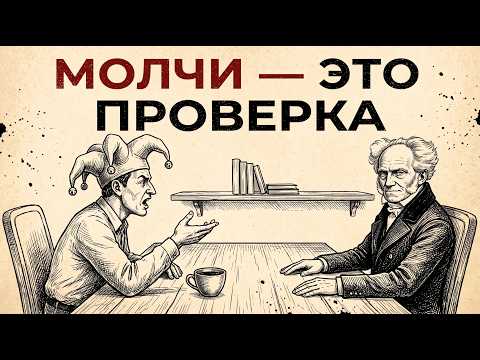
12 Questions You Shouldn't Answer Right Away | Schopenhauer and the Art of Argument
There are questions that are asked not for the sake of an answer, but to put you in a favorable position. "Don't you trust me?" "Are you perfect?" "Are you feeling sorry for me?" "After everything I've done for you?" They sound harmless, sometimes even thoughtful. But answer them without thinking, and a minute later you're making excuses, apologizing, and proving you're a normal person, and no one remembers what the conversation was about.
In this video, we examine 12 manipulative questions, drawing on Arthur Schopenhauer's ideas from his book "Eristic Dialectic" ("The Art of Winning Arguments"). For each question, we explain what they're actually asking, what premise they're trying to get you to agree to, and how to calmly answer without making excuses and losing your position. We'll also discuss how to distinguish manipulation from simple awkwardness, why a pause is a key skill in any argument, and how to learn to maintain it.
You'll learn:
— How to recognize a deflection, personal attacks, and a false dilemma
— Why "you always make things difficult" is a label, not an argument
— The difference between caring and control
— How to respond to gaslighting ("Are you sure you remembered correctly?")
— How to refuse without guilt and avoid falling into the debt trap of gratitude
— How to withstand ridicule and pressure from other people's opinions
— 3 questions to ask yourself before responding
— When you shouldn't start an argument at all (advice from Schopenhauer himself)
00:00 — Questions that are not asked for the sake of an answer
00:40 — Schopenhauer and the "Eristotic Dialectic"
01:29 — Question 1. "Don't you trust me?"
3:00 — Question 2. "Why do you always make things so complicated?"
4:41 — Question 3. "Are you perfect?"
6:19 — Question 4. "Are you feeling sorry for me?"
7:53 — Question 5. "Do you really think you're smarter than everyone else?"
9:33 — Question 6. "You do realize I'm doing this for you, right?"
11:08 — Question 7. "Why didn't you say anything before?"
12:34 — Question 8. "Yes or no? Just answer!"
14:09 — Question 9. "Are you sure you remembered correctly?"
15:56 — Question 10. "After everything I've done for you?"
17:27 — Question 11. "What will people think of you?"
19:30 — Question 12. "Do you seriously believe this?"
21:36 — Not every awkward question is manipulation
22:30 — How to distinguish a manipulator from a normal person
23:17 — The main skill is the pause
24:00 — 3 questions to ask yourself
24:40 — What to answer after a pause
25:40 — Body signals and training
27:27 — Schopenhauer's advice: Who is worth arguing with?
28:20 — Bottom line: are they trying to understand you or control you?
If you found this video helpful, give it a like, let us know in the comments which of these questions you hear most often, and subscribe to the channel so you don't miss new episodes.
#Schopenhauer #manipulation #psychology #artofargument #eristicdialectics #manipulator #gaslighting #psychologyofcommunication #personalboundaries #selfdevelopment #philosophy #psychologicalpressure #toxicrelationships #selfconfidence #hownottomakeexcuses #psychologyofinfluence #criticalthinking #wisdom #relationships #manipulationinrelationships
Schopenhauer, Arthur Schopenhauer, eristic dialectic, the art of winning arguments, the art of argument, Schopenhauer manipulation, Schopenhauer tricks, manipulator's questions, 12 questions of a manipulator, questions that cannot be answered, manipulation, manipulator, how to recognize a manipulator, how to recognize manipulation, manipulation in relationships, manipulation in the family, manipulation at work, psychological manipulation, psychology of manipulation, hidden manipulation, how to resist manipulation, protection from manipulation, response to a manipulator, What to say to a manipulator, gaslighting, what is gaslighting, don't you trust me, you always make things more complicated and you're perfect, do you feel sorry for me, do you think you're smarter than everyone else, am I doing this for you, why didn't you say anything before, yes or no, false dilemma, after everything I've done for you, what will people think, do you seriously believe this, getting personal, making an argument with someone, shifting the blame, guilt, guilt-based pressure, how not to make excuses, how to stop making excuses, how to refuse without guilt, how to say no, personal boundaries, how to protect personal boundaries, care and control, toxic relationships, toxic person, abuse, psychological pressure, communication psychology, influence psychology, self-confidence, critical thinking, the power of a pause, how to argue, how to win an argument, how to argue correctly, wisdom, philosophy, philosophy of life, self-development, relationship psychology, emotional intelligence, opinions of others, ridicule, communication strategy, logical Tricks, logical fallacies
Questions that can't be answere...