See High Voltage Created From Falling Snow!
131K views · Jan 24, 2020 · Education

Comments · 1.1K
@MrCarlsonsLab · 6 years ago · pinned
To learn more about electronics in a very different and effective way, and gain access to Mr Carlson's personal designs and inventions, visit the Mr Carlson's Lab Patreon page here: <a href="https://www.patreon.com/MrCarlsonsLab">https://www.patreon.com/MrCarlsonsLab</a>
45
@chaddonschaddons7084 · 6 years ago
If you play with snow, you are doing it at your own risk. Leave snow to the professionals like me.
355
@Gameboygenius · 6 years ago (edited)
Very interesting phenomenon. Here's my analysis of it. The first clue is that you got an arc to the chassis despite the 36 ohm coil to ground. That means that the arc must have been caused by a spike of current, as that is the only condition where the coil is high impedance. So what I think happened is this: static built up on the aerial from the wind. This slowly charged the X1 capacitor. At this point the chassis and the arc point are at the same potential, while the aerial is charged to however many kV. <br><br><br>When the capacitor is sufficiently charged, an arc happens. This is not the arc in the receiver, but a big arc between the two sides of the aerial. As a path opens to ground, the X1 capacitor starts to quickly discharge. However, due to the high impedance of the coil, the current discharging the capacitor must find another way. And within microseconds, the potential over the chassis rises enough to create the arc that you witnessed. <br><br><br>So the final discharge loop is: one side of the X1 capacitor --- the coax --- one side of the aerial --- arc --- the grounded side of the aerial --- electrical wiring --- probably another arc in the isolation transformer --- the chassis --- the arc in the receiver --- the other side of the X1 capacitor. This would also have enough loop area to create the strangeness in the speakers.<br><br><br>And for maximum youtuber collaboration awesomeness, may I suggest that you send the broken LED lamp to Big Clive?
265
@kenzuercher7497 · 5 years ago
I'm a broadcast Engineer who specializes in maintaining AM arrays. We were hooking up a new tower in an older 4 tower array and there was an electrical storm approaching. one of the guys with me touched the tower and got a healthy shock from it! (the transmitter was off). We measured about 120 volts AC across the base insulator! Since then we use a jumper cable to ground the tower and make it more safe. Also don't play with a 285 foot lightening rod with electrical storms around!
16
@nbntelevision1 · 6 years ago
As A commercial pilot, I have gotten St. Elmo's Fire from snow! It is a real thing, even with snow.
106
@chakathewolf · 6 years ago
40-something years messing with electronics and I have NEVER seen or heard of this! Awesome!
64
@leejarvie1836 · 6 years ago
I would be interested to see if you find any issue with your isolation transformer in lab 2, especially since I have the same one. I also would love to see a video entirely on safety capacitors, how to tell if you need them and where to put them in old radios, as well as determining proper capacitance for them. This arc'ing issue you've seen seems to play right into that.
40
@LiLi-or2gm · 6 years ago
Was the snow the dry, powdery kind? If so, your antenna rig created a charge-separation accumulator. The atmospheric voltage gradient between ground and your antenna can be several kilovolts. In dry conditions, each flake of snow forms a tiny capacitor and picks up a charge when high in the atmosphere. As these flakes pass by the antenna elements, they dump their charge. Any insulation or resistance would allow the charge to build up in the antenna until breakdown is achieved. <br><br><br>In a similar vein, I worked for a blimp company many years ago. We had grounding chains hanging from the envelope to ground the static charges that would build up during flight. Because the envelope was basically a giant capacitor (made of polyester), lethal voltages could accumulate during dry weather. The last thing you wanted your ground crew to do was touch the metal handrails of the gondola before the chains hit the ground!
78
@henrythompson7595 · 1 year ago
Also Mr Carlson, I live at the end of a street in a housing tract, all underground utilities, and for a number of months I was off the air due to 20 over S9 noise on all bands, Members from my local ham club came out and tried to figure out where the problem was, but we could detect AC noise several houses down away where I live -finally determined that the problem was the local power company had an easement across my front yard, and their buried underground primary for the entire street I live on was intermittently open/arcing IN THE DIRT They came out, dug up my yard, spliced this primary, and voila! my noise disappeared. The roses don't produce very well now......
2
@johnbellas490 · 6 years ago
I have heard of this happening several times from HAM radio friends who had long wire receiving antenna's (REALLY LONG WIRES for ELF and VLF frequencies) seeing ARCS and in one instance getting physically shocked! This incident was recalled by a famous radio show host in the U.S.A. whose name was Art Bell who hosted the "Coast to Coast" radio show on late night, Art recalled this event on one of his show's a few decades ago!! Art has been a "Silent Key" now for quite a few years!! Yea dry snow with wind behind it could really generate some high voltages on a long wire!!<br> John Bellas KC2UVN 73's Interesting to see this happening! Thanks for the video!! Just before any storms with or without wind, I always disconnect antenna feeds with a switching system that disconnects all my equipment of any antenna's and grounds them out even though they have static suppressors inline on the coax as well as lightning protection outside the house!!
44
@keeshahdarkfurr8328 · 6 years ago (edited)
Show us your antenna's set up's. Plz. <br><br>What kind you have, what there used for, which one was the one hooked up at the time of the arcing.
52
@dolamyte · 6 years ago
We make concessions for precision and resolution. Over a decade and a half as an RF bench engineer and this is a fun thought project. Are the labs built to R56 or similar standard? Have you tested the quality of your line voltage and grounds? I've seen highly charged air and mediocre grounds clash in expensive ways like this, especially if you throw in distant lightning strikes. It's just enough sometimes to cause unshielded ICs to internally become something different forever and let the games begin. This is an interesting one and will be following along as usual! Thank you for sharing!
18
Up next

High Voltage AM Transmitter equals FUN!
Mr Carlson's Lab · 246K views

Testing A Large Tube Used For Heating People With RF!
Mr Carlson's Lab · 331K views

9 Schematic Rules to NEVER Break
Predictable Designs with John Teel · 69K views

Why Is Coax 50 Ohms? The Real Reason Explained
Telecom Training · 129K views

What Part Failed In This Fluke 6071A? Found And Explained In Detail.
Mr Carlson's Lab · 110K views

Electricity Doesn't Actually Need a Return Wire
Electromagnetic Videos · 1M views

Standing Inside a Broadcast Transmitter While it's ON!
Mr Carlson's Lab · 628K views

Invention Release! Carlson LV Capacitor Leakage Tester.
Mr Carlson's Lab · 306K views

The Professor Who Taught People How To Think (1962)
ABC Science and ABC Australia · 2.9M views

Y2k crap: Auto-scan FM radios
VWestlife · 41K views

Big Power! 14000 Watt 892-R Transmitter Tube - Will It Work? Power It Up!
Mr Carlson's Lab · 166K views

Is This The Most Useful Chip Nobody Talks About?
Part That Changed American History · 31K views

HeathBuilt Voltage Reference Source [Restoration]
Mr Carlson's Lab · 86K views

Rocket Radio Lamp Restoration From 1941 - See it Work!
Mr Carlson's Lab · 47K views

The 7 Greatest Hi-Fi Receivers Ever Built (And Why You've Never Heard of Half of Them)
Honest HiFi · 1M views

What Happened to Varactor Diodes? The Diodes That Replaced Moving Plates
Fallen America FM · 7.1K views

EEVblog 1771 - A Tricky OpAmp Exam Question
EEVblog · 301K views

5 Things German Soldiers Found Strange About American Hellcat Tanks"
WW2 American Files · 17K views

1950 Ford Zenith AM Tube 6 Volt Car Radio Repair Diagnosis With RISION AG01 Thermal Imager TEST
shango066 · 73K views

What Happened to Cat’s-Whisker Detectors? The Crystal Contact Behind Battery-Free Early Radios
Circuit Relics and Mechanical Frontlines · 4K views

What Powers An Electron? The Answer Will Shock You
The Roger Physics · 361K views

Electronic Tech Tips - Troubleshooting Process And Fault Diagnosis Made Easy!
Mr Carlson's Lab · 51K views

The Tiny Chip That Made Amplifiers Just Work — The Story of the 741
Part That Changed American History · 81K views

Capacitors And Resistors -A Parts Substitution Guide!
Mr Carlson's Lab · 120K views
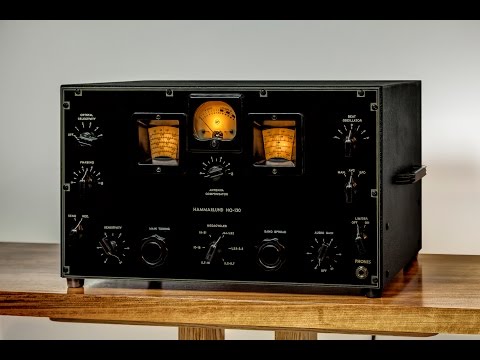
Tube Radio Restoration, Hammarlund HQ-120
Mr Carlson's Lab · 1.5M views

Why Put Diodes Together In Both Directions? Explained With Examples!
Mr Carlson's Lab · 955K views